

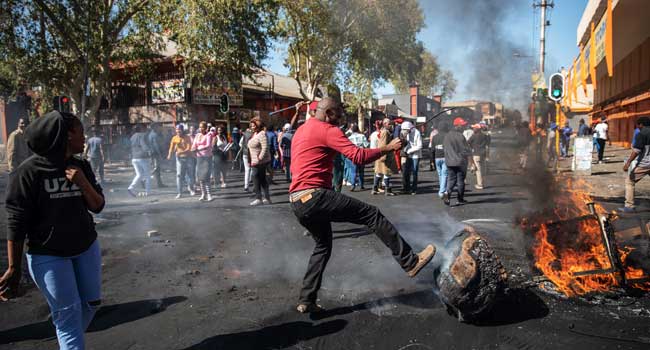
TWO Nigerians, Bishop Michael Taiwo Fakunle and James Uchechukwu Nwankwo, have been killed in separate incidents in South Africa amid renewed concerns over xenophobic attacks, alleged abuses by law enforcement officers and growing hostility towards Nigerians and other African nationals in the country.
News Point Nigeria reports that the Federal Government, through the Ministry of Foreign Affairs, has condemned the latest deaths and called on South African authorities to conduct thorough and transparent investigations, identify those responsible and ensure that they are brought to justice.
The National Assembly has also responded by suspending all official visits to South Africa and directing lawmakers, committees, officials and staff to boycott legislative activities hosted or organised by South African authorities until further notice.

In a statement issued on Friday, spokesperson for the Ministry of Foreign Affairs, Oluwafemi Adeniyi, said Fakunle and Nwankwo were killed in separate incidents on September 4 and 5 respectively. According to the ministry, Fakunle was murdered at his residence in Kensington, Johannesburg, while Nwankwo was reportedly killed during what it described as “gruesome interrogation techniques” allegedly used by officers of the South African Police Service (SAPS) in Somerset, Cape Town.


The Associated Press also reported the two deaths, identifying Nwankwo as having died following alleged treatment by South African police, while Fakunle was killed at his home in Johannesburg.
The latest deaths have come only two months after two other Nigerians were killed amid renewed anti-migrant tensions in South Africa, adding to a growing pattern of violence and insecurity involving Nigerians and other African nationals. In recent months, attacks, intimidation and destruction of property targeting Nigerians and other Africans have continued to raise concern in Nigeria, with the latest incidents further straining relations between the two countries.
The federal government has questioned the commitment of South African authorities to effectively curbing targeted attacks against foreigners and ensuring the protection of Nigerian nationals living and doing legitimate business in the country.
The Ministry of Foreign Affairs expressed particular concern over the alleged involvement of law enforcement officers in the latest incidents and the use of what it described as “unacceptable interrogation techniques”, which it said have frequently resulted in the deaths of foreigners.
It also raised concern over South Africa’s refusal to sign a memorandum of understanding establishing an early-warning mechanism, despite the mechanism having been agreed upon during bilateral discussions between Nigeria and South Africa. The ministry said the mechanism was intended to provide an avenue for both countries to identify and respond to emerging threats before they escalate into violence.

Against that background, the Federal Government called on the South African authorities to undertake thorough and transparent investigations into the circumstances surrounding the deaths of Fakunle and Nwankwo, identify those responsible and ensure that they are brought to justice.
The ministry also disclosed that Nigeria was actively considering “other concrete measures” to secure South Africa’s cooperation, following previous diplomatic efforts to address recurring attacks against Nigerians and other Africans.
Among the options being considered by the Nigerian government is taking the recurring waves of xenophobic and Afrophobic attacks against Nigerians and other Africans to the Authority of Heads of State and Government of the Economic Community of West African States (ECOWAS) and the Assembly of Heads of State and Government of the African Union.


The move would elevate the matter beyond the bilateral framework and place the safety of Nigerians and other African nationals living in South Africa before the continent’s principal regional and continental institutions.
The National Assembly has meanwhile taken a more immediate legislative step in response to the worsening situation. On Friday, the Nigerian legislature suspended all official visits to South Africa and resolved to boycott legislative activities hosted or organised by South African authorities until further notice. The decision followed consultations between the leadership of the Senate and the House of Representatives and was conveyed by the Clerk to the National Assembly, Kamoru Ogunlana.
The suspension covers official visits by the National Assembly, its committees, lawmakers, officials and staff, as well as conferences, seminars, workshops, parliamentary meetings, legislative exchanges and other activities organised or hosted by South African legislative authorities. The boycott also extends to physical participation in South African-hosted programmes and participation through virtual or online platforms.
The National Assembly said the action was prompted by continuing reports of Nigerians being killed, injured, displaced and forced to abandon their homes, businesses, investments and other property in South Africa.
The National Assembly stressed, however, that the decision was not intended to undermine the longstanding historical, diplomatic and people-to-people relationship between Nigeria and South Africa. Rather, it described the suspension as a strong expression of concern over the safety, dignity and welfare of Nigerians living and conducting legitimate businesses in the country.
The legislature called on the South African government to take urgent and concrete measures to protect Nigerians and other African nationals, prevent further xenophobic attacks, investigate reported incidents, arrest suspected perpetrators and prosecute those found culpable.
Reacting separately to the killings, former Minister of Aviation and politician, Femi Fani-Kayode, described the reports as “unacceptable” and warned that there would be consequences if attacks against Nigerians in South Africa continued without meaningful action from the South African government.
Fani-Kayode, in a statement on his X handle on Saturday, said he was “mortified and deeply shocked” by the reported murder of Bishop Michael Taiwo Fakunle by unknown persons in Johannesburg on September 4. He alleged that Fakunle had received a series of threats before his killers went to his residence and shot him dead.
Fani-Kayode also expressed shock over the reported death of James Uchechukwu Nwankwo on September 5, alleging that he died as a consequence of what had been described as “gruesome interrogation techniques” by officers of the South African Police Service.
According to Fani-Kayode, Fakunle and Nwankwo were the seventh and eighth Nigerians to have been murdered in South Africa in 2026 alone, while he claimed that no fewer than four of those eight Nigerians were allegedly killed by South African police officers.
He further claimed that more than 100 Nigerian nationals had been murdered in South Africa between 2022 and the present, with more than 30 allegedly killed by officers of the South African Police Service and the South African Defence Force.
Fani-Kayode expressed particular concern that, despite what he described as constant expressions of concern by Nigerian authorities and other stakeholders, no person had been arrested, detained, prosecuted or brought to justice for any of the alleged killings. He said the situation was unacceptable and called on the South African government to do far more to protect Nigerians and ensure that those responsible for killing or planning to kill them are brought to justice.
“No-one deserves to be targetted and murdered simply because they are Nigerian,” Fani-Kayode said, adding that the Nigerian community in South Africa was deeply disturbed by the developments and living in trepidation over what could happen next. He also said the Nigerian Mission in South Africa was equally disturbed by the situation.
Fani-Kayode further raised concern over what he described as another deadline issued to African nationals, including Nigerians, to leave South Africa by September 30. He alleged that the latest deadline, like the previous one, was issued by what he described as “brazenly racist, xenophobic and Afrophobic South African Non-Governmental Organisations” that had openly threatened to target and harm Nigerian nationals if they failed to comply with the deadline.
He called on the South African government to protect Nigerians and other Africans from the excesses of those responsible for the threats and attacks and ensure that perpetrators face the full weight of the law. He also warned that continued discrimination, attacks and killings of Nigerian nationals could have consequences for relations between the two countries.
“We also call on the South African Government to bring to justice those that take pleasure in traumatising, terrorising, torturing and killing our nationals,” Fani-Kayode said, stressing that while Nigeria seeks stronger and deeper ties with South Africa, “one thing remains clear”: if what he described as the “vicious cycle of discrimination against and killing of our nationals” does not stop, there would be consequences.
“Simply put our patience is wearing thin,” he said, arguing that South Africans are not targeted and killed in Nigeria by Nigerians or Nigerian security forces and that the least the South African government could do was to reciprocate the gesture by protecting Nigerian nationals and addressing Nigeria’s legitimate concerns.
He ended his statement by praying for the souls of Bishop Taiwo Fakunle and James Uchechukwu Nwankwo to rest in peace.