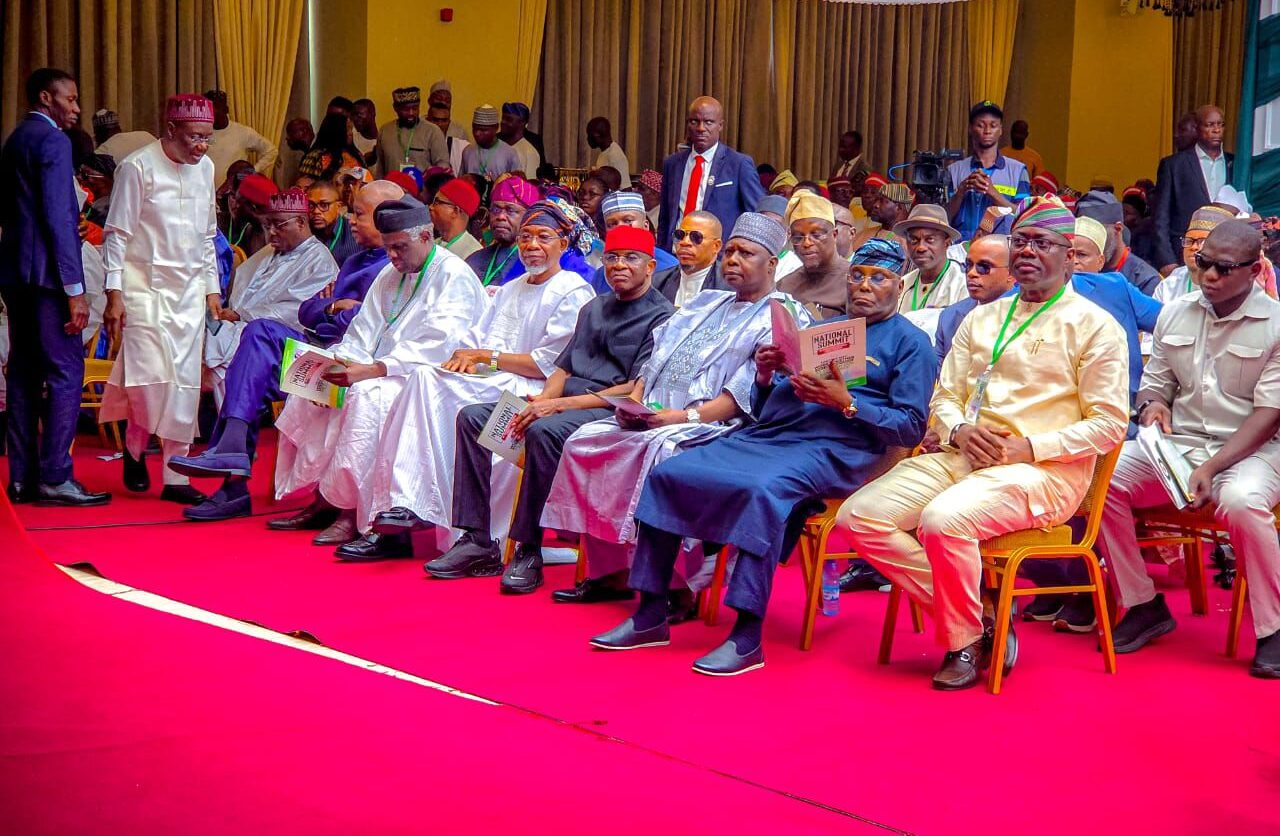
ON April 25, what unfolded in Ibadan was widely seen as one of the most consequential political gatherings on the road to the 2027 general election. Opposition figures converged under a shared sense of urgency and a common political concern: that if President Bola Ahmed Tinubu and the ruling All Progressives Congress were to be effectively challenged in 2027, then the opposition could no longer afford its long-standing weakness of fragmentation.
At the end of the meeting, an ambitious declaration was made. The participants pledged to close ranks, overcome internal divisions, and rally behind a single presidential candidate, an effort designed to correct what many within their ranks still view as the costly strategic errors of the 2023 elections. It was, on paper, a bold attempt to reset the political equation and construct a unified front capable of altering Nigeria’s electoral trajectory.
Read also: ‘I Won’t Go Everywhere With You,’ Tinubu Says Presidential Duties May Limit 2027 Campaign Tour
Yet, in this Sunday Political Features, News Point Nigeria takes a deeper look at the issues and observes that the optimism that followed Ibadan has proven strikingly short-lived. Barely a month on, the promise of unity has dissolved into a crowded field of presidential aspirants, deepening factional rivalries, and renewed contestations over leadership and legitimacy within opposition ranks.

What was once framed as a disciplined move toward consolidation has instead evolved into another cycle of political dispersion, raising fresh questions about whether Nigeria’s opposition truly possesses the organisational coherence, discipline, and structural stability required to mount a credible challenge in 2027.
The figures, and the unfolding political realities behind them, tell a revealing story.


Instead of one opposition candidate, Nigeria now has a crowded presidential field stretching across multiple political parties and rival factions. Rather than a unified coalition, the country is witnessing the emergence of numerous presidential contenders spread across competing platforms. What was designed as a strategy for consolidation has transformed into another season of fragmentation.
For the APC and President Tinubu, this development may represent one of the most significant political advantages heading into the next election cycle.
The logic behind the Ibadan meeting was simple.

Many opposition strategists believed that the 2023 presidential election offered a lesson that could not be ignored. In that election, opposition votes were distributed among several major candidates, including former Vice President Atiku Abubakar, former Anambra State governor Peter Obi and former Kano State governor Rabiu Musa Kwankwaso.
The result was a fragmented opposition landscape that enabled Tinubu to emerge victorious.
To many anti-APC forces, the conclusion seemed obvious: unity was not merely desirable; it was essential.


The Ibadan declaration was therefore designed as a corrective measure. Opposition leaders publicly committed themselves to avoiding another multi-candidate contest. They argued that a fragmented opposition would only strengthen the ruling party’s hold on power.
However, translating political arithmetic into political reality proved far more difficult than anticipated.
Barely weeks after the declaration, the consensus project began to unravel.
Rather than rallying around a single candidate, opposition parties produced their own presidential flagbearers.
The African Democratic Congress presented Atiku Abubakar as its presidential candidate through the faction associated with former Senate President David Mark. Atiku emerged ahead of former Rivers State governor Rotimi Amaechi and businessman Mohammed Hayatu-Deen.
The Nigeria Democratic Congress settled for Peter Obi.
The Allied Peoples Movement nominated Seyi Makinde.
Within the Labour Party, rival factions endorsed different candidates, while divisions within the Social Democratic Party and other platforms produced competing presidential tickets.
The Peoples Democratic Party itself remained split between rival tendencies, with one faction backing former President Goodluck Jonathan and another selecting Senator Sandy Onor.
Elsewhere, the presidential field expanded further as parties nominated candidates such as Donald Duke, Omoyele Sowore, Aliyu Bin Abbas and Anita Zugwai-Chukwu, the only female presidential candidate currently in the race.
The outcome was the exact scenario opposition leaders had promised to avoid.
Political analysts argue that the collapse of the single-candidate initiative is not merely an organisational failure.
It reflects a deeper challenge that has repeatedly undermined opposition politics in Nigeria: the inability to subordinate personal ambition to collective strategy.
Atiku remains convinced that his experience, political reach and national network make him the strongest challenger to Tinubu.
Obi continues to enjoy passionate support among many young Nigerians who view him as the opposition’s most credible electoral asset.
Makinde commands influence within his own political constituency.
Several other aspirants also believe they possess unique advantages that justify their participation in the race.
Under such circumstances, consensus becomes extraordinarily difficult.
The aftermath of the Ibadan summit therefore mirrors the very scenario opposition leaders publicly vowed to avoid.
Beyond the collapse of the unity project, questions have also emerged regarding the significance of the Ibadan gathering itself.
Critics argue that the event was organised by individuals associated with a faction of the African Democratic Congress whose status has been complicated by ongoing legal disputes and court rulings.
According to this argument, any declaration emerging from such a gathering lacks the institutional authority necessary to bind recognised political parties or alter the wider electoral landscape.
In every democratic system, legitimacy flows through recognised structures.
Political parties derive authority from their registration, internal processes, and recognition by electoral authorities.
When disputes over leadership and party control remain unresolved, questions naturally arise regarding who possesses the authority to negotiate alliances, select candidates, or commit entire parties to strategic agreements.
These concerns have become particularly pronounced within the ADC, where competing factions continue to dispute control of party structures.
The result is a situation in which declarations made by one faction may not necessarily bind the broader organisation.
Many supporters of opposition unity frequently invoke the events that led to the historic 2015 election.
That process eventually produced the APC itself, a coalition that successfully united previously separate opposition parties behind the candidacy of Muhammadu Buhari.
However, observers argue that important differences exist between that period and the current situation.
The 2015 coalition emerged from negotiations among legally recognised political parties with functioning structures, defined leadership hierarchies and agreed operational frameworks.
Those parties voluntarily merged into a new organisation with a shared purpose.
The current opposition landscape presents a very different picture.
Instead of strong institutional structures moving toward integration, several parties are battling internal disputes, factional conflicts and legal challenges.
Read also: Tinubu Must Stay Movement Appoints Ex-Obidient Movement Leader, Marcel Ngogbehei, As DG
Rather than moving toward cohesion, many appear increasingly fragmented.
For that reason, comparisons with 2015 may oversimplify the challenges confronting opposition forces today.
With party primaries largely concluded, Nigeria’s political map for 2027 has become clearer.
INEC has scheduled the presidential election for January 16, 2027.
President Tinubu has secured the APC ticket and will seek a second term.
Meanwhile, the opposition field continues to expand.
The presidential race now includes candidates from a wide range of political parties and ideological backgrounds.
The emergence of rival factions within several parties has complicated matters further, producing competing claims to legitimacy and multiple presidential tickets under the banners of some political organisations.
This proliferation of candidates reflects both the vibrancy and the fragmentation of Nigeria’s multiparty system.
While voters will have numerous options, opposition strategists worry that the abundance of candidates could once again divide anti-incumbent votes.
One of the more interesting dimensions of the emerging race is its regional composition.
Most of the presidential candidates currently in the field come from the southern part of the country.
Only a limited number originate from the North.
On the surface, this might appear to create opportunities for northern candidates.
However, several analysts caution against simplistic conclusions.
Political scientist Dr. Christian Okeke argues that electoral success in modern Nigeria increasingly depends on national appeal rather than regional identity alone.
In his assessment, the contest remains primarily between Tinubu and Obi, regardless of how many additional candidates eventually appear on the ballot.
According to him, voters are unlikely to approach the election solely through regional considerations.
Instead, factors such as political influence, mobilisation capacity and voter loyalty will play more significant roles.
Former Youth Democratic Party national chairman Georgina Dakpokpo believes economic realities may significantly shape voter behaviour.
She argues that insecurity, poverty and hardship, particularly across northern Nigeria, are likely to influence how voters evaluate candidates.
For many citizens, questions of safety, economic opportunity and governance effectiveness may outweigh traditional political loyalties.
Dakpokpo also expresses concern that opposition parties continue to prioritise personal ambitions over collective national interests.
Her view reflects a wider frustration among voters who believe that opposition leaders have repeatedly failed to unite around a common purpose despite recognising the strategic necessity of doing so.
For many observers, President Tinubu remains the central figure in the 2027 contest.
Beyond being the incumbent president, he enjoys advantages associated with visibility, established political structures and nationwide networks developed over decades in public life.
According to governance advocate Auwal Musa Rafsanjani of CISLAC and Transparency International Nigeria, multiple southern candidates may fragment portions of the traditional southern voting bloc.
However, he cautions against assuming that regional identity alone will determine electoral outcomes.
Economic conditions, governance performance, security concerns and public confidence are becoming increasingly influential in shaping voter preferences.
Rafsanjani argues that candidates who successfully build alliances across regional and political divides may ultimately enjoy a decisive advantage.
Political analyst Sylvanus Udoenoh believes the emerging election will be determined less by geography and more by coalition-building.
According to him, presidential elections in Nigeria are won through broad national alliances rather than regional popularity alone.
While multiple southern candidates could divide votes in parts of the South-West, South-East and South-South, Tinubu retains significant advantages through incumbency and organisational strength.
At the same time, a northern candidate who successfully consolidates support across multiple regions could become highly competitive.
However, no candidate can assume automatic regional loyalty.
The APC remains deeply entrenched in several northern states, while opposition parties continue to struggle with internal cohesion.
As Nigeria moves closer to the official campaign season, one reality is becoming increasingly apparent.
The central issue may not be whether there are more northern or southern candidates.
It may not even be the sheer number of presidential aspirants.
The defining question is whether any candidate can build a national coalition broad enough to transcend regional identities, overcome party divisions and convince Nigerians that he or she possesses the capacity to address the country’s pressing challenges.
For now, the opposition remains divided.
The APC remains relatively united.
And as the political chessboard continues to evolve, the greatest threat to the opposition may not be President Tinubu or the ruling party at all.
Read also: Tinubu Orders Security Chiefs To Destroy All Bandit Camps, Rescue Abducted Victims
It may be the opposition’s continued inability to unite behind a common cause.
If that reality persists until election day, the dynamics that shaped the outcome of 2023 could once again shape the outcome of 2027.