

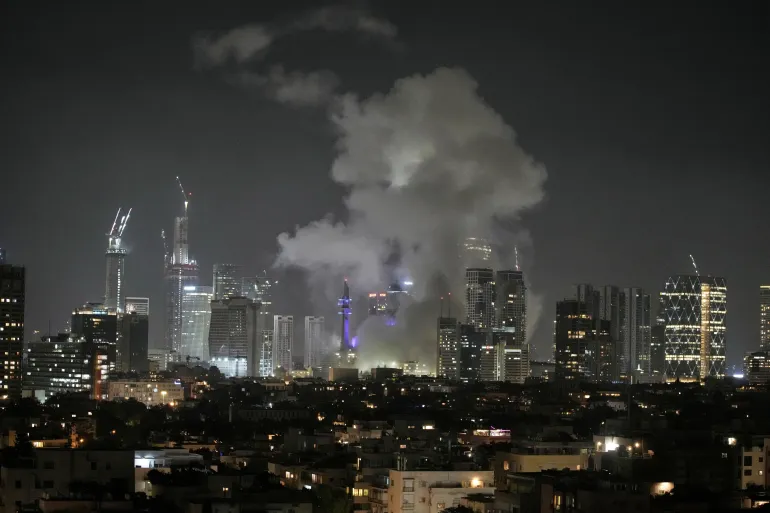
THE United States Central Command (CENTCOM) says it has completed its 11th consecutive night of air strikes against Iran as part of efforts to further weaken the country’s “ability to threaten commercial shipping in the Strait of Hormuz”.
News Point Nigeria reports that CENTCOM, in a statement, said US forces targeted “Iranian military operations centres, maritime capabilities, aircraft hangars, drone storage facilities, and military logistics infrastructure”.

Al Jazeera correspondent Tohid Asadi, reporting from Tehran, said “massive explosions were heard across the Iranian capital”, while air-defence systems were activated in different parts of the city.

Iran’s Tasnim news agency also reported explosions in parts of Bushehr in southern Iran, while the Fars news agency said several blasts were heard around Sirik, also in the south of the country.


According to Fars, areas near Behbahan and Omidiyeh in Iran’s southwestern Khuzestan province were targeted in US missile attacks, a development confirmed by the province’s deputy governor.
The news agency further reported that US forces struck a military facility on the outskirts of Tabriz in northwestern Iran. Citing local crisis management officials, Fars said the strike occurred at about 2:40 a.m. local time (23:10 GMT), targeting a military zone near the city, although no attacks were reported inside Tabriz itself.
The attacks on Tehran and Tabriz mark a significant shift from the recent pattern of strikes, which had largely focused on southern Iran and areas surrounding the Strait of Hormuz.
Earlier on Tuesday, the Kuwaiti army announced that its air defence systems had intercepted an Iranian drone attack. Iran has repeatedly launched attacks against Gulf states, including Kuwait, Bahrain and Qatar, since the latest wave of US military operations resumed this month.
Amid the escalating conflict, US Secretary of State Marco Rubio insisted that Washington remained open to diplomacy with Tehran, while stressing that Iran must demonstrate genuine commitment to negotiations.

“If we create a precedent in the Middle East where a nation state can decide that they are going to control an international waterway, charge a toll, and if you don’t pay them, blow up your ships, we have created a very dangerous precedent,” Rubio said.
He added that the United States remained committed to defending freedom of navigation through the Strait of Hormuz.
Meanwhile, US Secretary of Defense Pete Hegseth told Congress on Tuesday that the military campaign against Iran had cost the United States $37.5 billion and that the Pentagon required an additional $90 billion in funding.


Hegseth, however, faced stiff opposition from Democratic lawmakers during the hearing.
Senator Jon Ossoff of Georgia, who is seeking re-election later this year, questioned Hegseth’s earlier claim that Iran’s military capability had been “destroyed”, citing the Pentagon’s request for more funding as evidence that the conflict remained unresolved.
US President Donald Trump also heightened tensions by declaring that he intended to attack a suspected Iranian nuclear facility known as Pickaxe Mountain “pretty soon, and very heavily”.
Responding to Trump’s comments, Iran’s Khatam al-Anbiya Central Headquarters warned that any US strike on Iranian nuclear facilities would trigger an expansion of attacks across the region.
As the violence intensified, diplomatic efforts aimed at ending the conflict gathered momentum.
Iranian Interior Minister Eskandar Momeni met with senior Pakistani officials, including Pakistan’s Army Chief, Asim Munir, in Islamabad as part of mediation efforts.
In a related development, Qatari Prime Minister and Minister of Foreign Affairs Sheikh Mohammed bin Abdulrahman bin Jassim Al Thani held a telephone conversation with Saudi Arabia’s Foreign Minister, Prince Faisal bin Farhan Al Saud.
According to a statement from Qatar’s Ministry of Foreign Affairs, both leaders discussed “enhanced diplomatic efforts and closer coordination for de-escalation and strengthening security and stability in the region”.
The Qatari prime minister also stressed the need for all parties to remain committed to diplomacy and implement the provisions contained in the Memorandum of Understanding signed between the United States and Iran.
The renewed hostilities come amid growing competition between Washington and Tehran over control of the strategic Strait of Hormuz, following the collapse of the June 17 memorandum of understanding.
Announcing the conclusion of the latest air strikes, CENTCOM alleged that Iran had attacked more than 30 commercial vessels transiting the vital international waterway over the past three months.
“The unwarranted attacks have endangered hundreds of innocent mariners and undermined freedom of navigation,” the command stated.
Despite the hostilities, CENTCOM maintained that the Strait of Hormuz remained open to commercial shipping.
The US military added that since early May, its forces had facilitated the safe passage of approximately 900 commercial vessels and about 450 million barrels of crude oil through the strategic maritime corridor.