

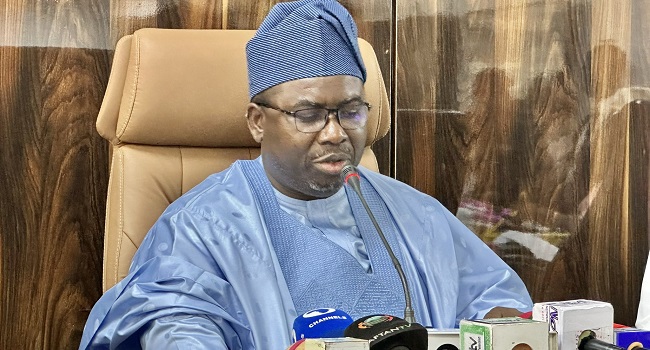
THE Chairman of the Independent National Electoral Commission (INEC), Prof. Joash Amupitan, has declared that the electoral umpire cannot attain genuine independence without financial autonomy, warning that continued reliance on the normal budgetary process could undermine its ability to conduct free, fair and credible elections.

News Point Nigeria reports that Amupitan said granting INEC greater control over its finances is critical to strengthening the commission’s operations and boosting public confidence ahead of the 2027 general elections.

According to Vanguard, the INEC chairman made the remarks on Thursday while delivering the keynote address at the public presentation of “Shadows: Protest Essays on Africa’s Most Consequential Country (1999–2023),” authored by the Managing Director of THISDAY, Mr. Eniola Bello, at the Shehu Musa Yar’Adua Centre in Abuja.

Amupitan argued that although the Constitution provides for INEC’s funding through the Consolidated Revenue Fund, the current arrangement does not guarantee true financial independence because the commission still depends on the regular appropriation process.


“Can INEC truly be independent without financial autonomy? If we are serious about strengthening our institutions and conducting free, fair and credible elections, then financial autonomy is essential,” Amupitan said.
He explained that the commission’s dependence on budgetary approvals from other government institutions remains a major limitation to its operational independence.
“The Constitution places INEC’s funding on the Consolidated Revenue Fund, and many believe that is sufficient.
“However, experience has shown that as long as INEC remains subject to the normal appropriation process and depends on budgetary approvals by other institutions, genuine financial independence remains difficult,” he said.
The INEC chairman stressed that the commission’s responsibilities extend far beyond conducting elections, noting that it is also responsible for voter registration, the registration and monitoring of political parties, maintaining the national register of voters, and conducting federal and state elections.

He added that INEC also plays a role in supporting local government elections in certain respects.
“For these reasons, there is a strong case for giving INEC greater operational and financial autonomy to improve efficiency and strengthen public confidence in the electoral process,” Amupitan said.
He, however, emphasised that the responsibility for delivering credible elections does not rest on INEC alone, saying political parties, security agencies, the media, civil society organisations and citizens all have critical roles to play in strengthening Nigeria’s democracy.


“When we talk about strengthening institutions, there are several institutions involved in the conduct of elections.
“Most times, people think only of the Independent National Electoral Commission, but beyond INEC, we also have the media, the security agencies, civil society organisations and, indeed, the Nigerian people.
“The health of our democracy is reflected in the strength of this wider institutional framework,” he said.
Amupitan called for stronger collaboration among all stakeholders, stressing that such cooperation is indispensable if Nigeria is to conduct peaceful, credible, free and fair elections in 2027.
“Therefore, if we truly want the 2027 elections to be free, fair, credible and peaceful, all these institutions must work together,” he added.
Speaking on concerns surrounding the appointment of INEC’s leadership, Amupitan said the Constitution already contains safeguards by requiring the President to appoint the chairman and national commissioners in consultation with the Council of State and subject to confirmation by the Senate.
He noted, however, that the effectiveness of such constitutional provisions often depends on those responsible for implementing them.
“Sometimes, however, the issue is not the law itself but those who operate it,” he said.
The INEC chairman cited the views of former Chief Justice of Nigeria, Justice Aloma Mukhtar, who maintained that Nigeria’s challenge is not necessarily the absence of laws but the failure to uphold the spirit of the Constitution and the Electoral Act.
Amupitan also described Bello’s book as an important contribution to Nigeria’s democratic discourse, saying it chronicles the country’s political journey from the return to democratic rule in 1999 through 2023.
According to him, previous electoral cycles have provided valuable lessons that should guide preparations for the 2027 general elections.
“Every election teaches us lessons, and every electoral cycle provides an opportunity to improve on the last,” Amupitan said.