

FOR over a decade, Nigeria has grappled with relentless waves of violence from Boko Haram, bandits, and other insurgent groups, leaving a trail of death, displacement, and destruction across vast swathes of the country. Yet, beneath the recurring tragedy lies a deeply troubling pattern, many of these attacks were neither sudden nor entirely unforeseeable.

Time and again, reports have emerged suggesting that actionable intelligence warning of impending assaults had been available, but was either inadequately processed, poorly coordinated, or outright ignored by the very security institutions tasked with protecting lives and property.

From remote villages in the North-East to farming communities in the North-West and parts of the North-Central, survivors’ accounts and local sources consistently point to advance warnings that failed to translate into preventive action.


The consequences have been devastating: mass casualties, razed communities, disrupted livelihoods, and a growing erosion of public confidence in the nation’s security architecture.
It is worthy of note that beyond capacity challenges, systemic issues such as inter-agency rivalry, bureaucratic inertia, and gaps in intelligence-to-action frameworks have continued to undermine the effectiveness of Nigeria’s military and other security agencies.
In this weekend feature, News Point Nigeria takes a critical look at this recurring failure to act on credible intelligence, examining how missed opportunities have emboldened terror groups and prolonged the cycle of violence. The report dissects the implications for human lives, national stability, and economic resilience, while raising urgent questions about accountability, coordination, and the reforms needed to prevent further tragedies.
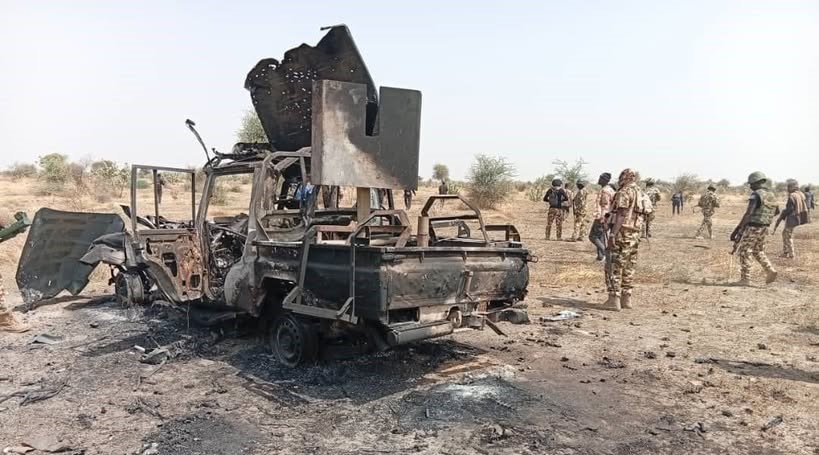
On Friday, Governor Babagana Zulum of Borno State strongly condemned the recent attack on the 15 Task Force Brigade in Benisheikh, revealing a troubling detail that has become all too familiar in Nigeria’s protracted security crisis. According to the governor, troops had received intelligence regarding a potential assault by terrorists three days before the incident occurred yet the attack still happened.
During a sympathy visit to Benisheikh, Zulum expressed deep condolences following the death of Brigade Commander, Brigadier General OO Braimoh, and several others. The assault on both the military formation and the town took place on Friday morning, leaving behind grief, destruction, and renewed questions about Nigeria’s security preparedness.
Intelligence reports had earlier indicated a possible attack by suspected insurgents on the formation. Consequently, Zulum called on the military to urgently review its security architecture in order to address emerging threats more effectively within its areas of responsibility.

“This is one of the most surprising attacks that I have witnessed in recent times,” Zulum said, emphasising the urgent need to review security protocols. He noted that credible intelligence about the impending attack had been available for approximately three days before the tragedy unfolded.
The governor went further to question local leadership regarding their awareness of the intelligence. The chairman confirmed that such reports had indeed been received, prompting Zulum to lament the glaring lapse that allowed the attack to proceed despite prior warnings.
It was, therefore, no surprise that just a day earlier, the Minister of Defence had ordered security agencies to improve intelligence sharing. The Chief of Defence Staff, General Christopher Musa, called for an end to silo operations among security and intelligence agencies, stressing the urgent need for integrated intelligence to tackle Nigeria’s complex security challenges effectively.


Speaking during a meeting with members of the intelligence community in Abuja, the minister noted that actionable intelligence remains critical in supporting troops on the ground, particularly in asymmetric warfare where threats can emerge from both internal and external sources.
He acknowledged that although security agencies have been operating with some level of effectiveness, their efforts are often fragmented, thereby reducing overall impact.
“We all know the importance of intelligence, particularly in asymmetric warfare, where threats come both from within and outside our borders. What we have observed is that, while we have been operating effectively, much of our work has been in silos. It is high time we integrate these efforts so that all actions are coordinated and impactful,” Musa said.
He added that the President had directed enhanced jointness in operations, stressing that every service and agency must work collaboratively to improve national security.
“Jointness means every service and agency is important; none is irrelevant. Intelligence whether human or technical must be harnessed collectively to provide better leverage,” he stated.
The minister explained that the meeting was convened to strengthen collaboration, build collective capacity, and ensure that intelligence gathered across agencies is effectively applied in operations.
“Asymmetric warfare is largely a warfare of intelligence. Without intelligence, we operate blindly. Unlike conventional warfare, threats are often unidentified, and even those close to us may be potential adversaries,” he added.
However, recent and past incidents suggest that this challenge is far from new.
In November 2025, the Presidency confirmed that security agencies failed to act on intelligence warnings that could have prevented the abduction of 25 students from the Government Comprehensive Girls’ Secondary School in Maga, Danko Wasagu Local Government Area of Kebbi State.
In a statement by Bayo Onanuga, it was revealed that terrorists abducted at least 25 schoolgirls and killed the school’s vice principal, Hassan Makuku, despite prior warnings.
According to locals and traditional leaders, authorities had received intelligence before the attack, prompting soldiers stationed at the Ribah junction checkpoint to mobilise to the school.
“The soldiers indeed went to the school and left around 12 a.m.,” a traditional leader recounted. “It was after the soldiers left that the bandits struck.”
The Presidency acknowledged that the attack occurred despite intelligence warnings and admitted that security agencies did not respond appropriately to avert the kidnapping, even as it commended Governor Mohammed Nasir Idris for his efforts.
This pattern stretches further back.
In 2015, the Nigerian military reportedly received reliable intelligence indicating that Boko Haram insurgents would launch a massive attack on Monguno. The warning specified that the attack would occur between January 22 and 25, and it was read to officers and soldiers of the 5 Brigade with instructions to remain on high alert.
Yet, despite the warning, the leadership of the formation failed to take necessary steps or deploy men and equipment adequately to counter the imminent assault.
Military sources revealed that insurgents arrived around 2am, parking their Hilux vehicles deep in the bush with headlights on. Soldiers, noticing the unusual lights, opened fire without realising that the insurgents had already advanced closer to the Brigade headquarters.
What followed was a fierce exchange of gunfire between troops including members of the Multinational Joint Task Force camped within the barracks and the attackers. Although the Brigade’s largest fighting tank, known as “Shika,” neutralised several insurgents, the attack underscored glaring lapses in preparedness despite prior intelligence.
Even within the security establishment, concerns about intelligence quality and utilisation have been raised.
While serving as Defence Chief in 2024, General Christopher Musa disclosed that the military was sometimes fed misleading intelligence by informants, complicating operations against bandit groups responsible for widespread kidnappings in northern Nigeria.
He noted that troops, often overstretched, relied heavily on informants, sometimes to their detriment.
“They make the troops go elsewhere, and when they get there, they meet nothing and allow the bandits to commit acts of criminality,” Musa said.
Although the military later rescued 137 abducted students in Kaduna State, Musa declined to disclose operational details or confirm whether any suspects were apprehended.
Data from SBM Intelligence indicated that at least 68 mass abductions occurred in the first quarter of 2024 alone, most of them in northern Nigeria further highlighting the scale of the crisis.
Similar intelligence lapses were reported in attacks on Buni Yadi in Yobe State, where failures in response timing led to casualties, while informants were suspected of tipping off militants whenever troop movements changed.
The consequences of intelligence failure are not limited to insurgency alone.
During the #EndBadGovernance protests, the Emir of Kano, Muhammadu Sanusi, attributed the destruction of public and private properties in Kano to the failure of security operatives to act on intelligence.
The protests, which began on August 1 over rising cost of living and insecurity, turned violent in several cities including Potiskum, Lagos, Borno, and Gombe.
In Kano, protesters vandalised and looted the newly built Nigerian Communications Commission Industrial Park ahead of its commissioning.
Speaking during a visit to affected sites, Sanusi warned that those behind the destruction were enemies of the state.
“As we used to say, whoever had a hand in this is an enemy of Kano and its people. What happened in Kano, whoever saw them knew was planned,” he said.
Experts insist that the recurring failure to act on intelligence combined with poor coordination among security agencies continue to fuel attacks across Nigeria.
Former intelligence officer, Wing Commander Eli Waziri (Rtd), noted that intelligence in Nigeria is often treated reactively rather than proactively, with warnings about impending attacks frequently ignored.
Retired Air Commodore Abayomi Balogun also pointed to systemic failures, including delayed responses and weak intelligence-gathering mechanisms.
At the heart of the problem, analysts say, is fragmentation commonly described as “silo operations” where agencies fail to share information effectively, resulting in disjointed and ineffective responses.
Security experts emphasise the urgent need to shift from reactive to proactive strategies, where intelligence is not only gathered but acted upon decisively to prevent attacks before they occur.
The failure to act on actionable intelligence, they argue, remains one of the most critical gaps in Nigeria’s national security framework, enabling terrorist groups and criminal networks to repeatedly exploit vulnerabilities.
Speaking to News Point Nigeria, security expert, Dr. Yunusa Madu issued a stark warning to Nigeria’s military and other security agencies, urging them to significantly improve their response to actionable intelligence in order to prevent further loss of lives across the country.
According to him, a disturbing pattern has emerged over the years, where major attacks by insurgents and criminal groups are often preceded by credible intelligence that fails to translate into timely preventive action.
He stressed that the consequences of such lapses have been devastating measured in lives lost, communities destroyed, and a growing sense of insecurity among citizens.
Dr. Madu noted that virtually every large-scale attack in recent times has had prior warnings from local sources, informants, or intelligence channels. However, these warnings are often ignored, delayed, or trapped within bureaucratic bottlenecks, allowing attackers to strike with deadly precision.
He called for a more proactive, coordinated, and intelligence-driven approach to security operations, emphasising that prevention must take precedence over reaction.
Dr. Madu also commended the Minister of Defence for his recent directive mandating improved intelligence sharing among agencies, describing it as both timely and necessary.
He argued that stronger collaboration could close longstanding gaps that insurgents have continued to exploit, but warned that beyond policy statements, there must be accountability and concrete reforms to ensure intelligence is not only gathered but acted upon swiftly and effectively.
As Nigeria continues to grapple with insurgency, banditry, and emerging security threats, the recurring theme remains painfully clear: warnings are often available, but action is not. And until that gap is bridged, the cycle of preventable tragedies may persist.