

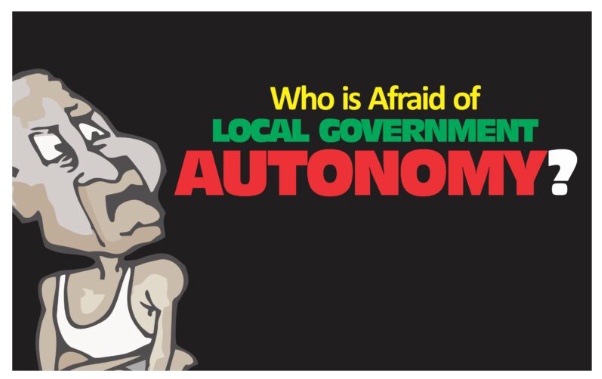
PRESIDENT Bola Ahmed Tinubu’s promise to enforce financial autonomy for Nigeria’s 774 local government councils has come under fresh scrutiny, as emerging revelations suggest that political considerations ahead of the 2027 general elections may be slowing the implementation of the landmark Supreme Court judgment granting councils direct access to their federal allocations.
Nearly two years after the Supreme Court declared it unconstitutional for state governors to withhold local government allocations, investigations indicate that the overwhelming majority of councils across the country are still receiving their monthly funds through state governments rather than directly from the Federation Account.

Sources within the Presidency and the ruling All Progressives Congress (APC) claim the President has been reluctant to aggressively enforce the judgment for fear of straining relations with governors, who are considered central to his anticipated 2027 re-election bid. The latest development comes about six months after Tinubu warned that he could issue an Executive Order to compel compliance with the apex court’s ruling.

In this Sunday Feature, News Point Nigeria dissects and examines the controversy, the political calculations said to be delaying the implementation of local government financial autonomy, the lingering influence of state governors over council funds despite the Supreme Court’s landmark judgment, the concerns raised by labour unions and opposition parties, and what the prolonged stalemate means for grassroots governance, accountability and Nigeria’s democratic system.


On July 11, 2024, the Supreme Court of Nigeria delivered a landmark judgment granting full financial and administrative autonomy to all 774 local government areas across the country.
The apex court ruled that it was unconstitutional for state governors to withhold funds allocated to local government councils.
The Federal Government had taken the 36 state governors before the Supreme Court, accusing them of usurping the constitutional powers of local governments by withholding federal allocations meant for the councils and disbursing the funds at their discretion through the State Joint Local Government Account, often after making deductions.
Delivering the lead judgment, Justice Emmanuel Agim held that local governments should henceforth receive their allocations directly from the Office of the Accountant-General of the Federation.
He further ruled that it was illegal and unconstitutional for governors to receive and withhold funds allocated to local government councils in their respective states.

In December 2025, Tinubu warned governors that he might be compelled to issue an Executive Order if they continued to resist implementation of the Supreme Court judgment.
The President had earlier sounded the same warning during the APC’s 14th National Caucus meeting on December 18, 2025, stressing that genuine local government autonomy could not exist without financial independence.
Tinubu said persistent non-compliance by state governments could force the Federal Government to release allocations directly to local governments through the Federation Account Allocation Committee.


However, nearly two years after the Supreme Court verdict, and despite repeated assurances and warnings by the President, implementation of financial autonomy for local governments has remained stalled.
A senior Presidency official, who spoke on condition of anonymity because he was not authorised to comment publicly on the matter, admitted that the issue had become politically sensitive as attention shifted toward the 2027 general elections.
According to the official, the administration is mindful of the political consequences of aggressively pursuing a policy that could strain its relationship with state governors, many of whom are expected to play vital roles in Tinubu’s re-election campaign.
“We can’t be talking about this now. It’s politics season, and that would be a sensitive matter,” the official told Sunday PUNCH.
Similarly, a senior APC official described implementation of local government autonomy as politically delicate, saying the President was carefully weighing the possible reaction of governors.
The party chieftain disclosed that governors remained opposed to local government autonomy and had continued to frustrate its implementation.
According to the APC official, who also requested anonymity due to the sensitivity of the issue, governors constitute the backbone of Tinubu’s re-election machinery, making it politically risky to antagonise them.
“The issue of LG autonomy is delicate because of the governors’ position on it. You will recall that after the Supreme Court judgment, the governors requested a three-month moratorium before implementation. After that, they had meetings with Mr President, and since then, the process has continued to drag.
“We are a political party, and these governors are the major drivers of Tinubu’s re-election. It would be unwise to provoke the governors or do anything that would dampen their morale. We need to tread softly on LG autonomy,” the source said.
Meanwhile, the Nigeria Union of Local Government Employees (NULGE) blamed the prolonged delay on what it described as a lack of political will among those responsible for implementing the Supreme Court judgment.
Speaking with this newspaper, NULGE National Secretary, Isah Gambo, said no local government council in Nigeria had begun receiving its statutory allocation directly from the Federation Account despite the Supreme Court order.
He noted that although the President had directed implementation of financial autonomy, officials charged with carrying out the directive had ignored it without consequences.
“To the best of our knowledge, we are not aware of any local government that has started receiving its allocation directly from the Federation Account.
“The government has issued a directive for the implementation of LG autonomy, but those responsible for implementing it have refused to comply. The government should sanction them for flouting the President’s directive,” Gambo said.
The NULGE secretary specifically called for sanctions against the Accountant-General of the Federation, whose office he said is responsible for disbursing statutory allocations to all tiers of government.
“The Accountant-General should be sanctioned for the non-implementation because his office is responsible for implementing the payment process. His office is responsible for allocating funds to states and local governments, yet it has remained defiant of the President’s directive and the Supreme Court judgment,” he stated.
Gambo argued that continued delay in implementing financial autonomy was weakening local government administration and depriving councils of the financial resources needed to tackle insecurity and drive grassroots development.
“If local governments were receiving their allocations directly, they would be better empowered to tackle insecurity at the community level. Financial and fiscal autonomy for local governments is part of the solution to insecurity in Nigeria,” he added.
Responding to concerns that direct allocations could encourage corruption at the grassroots level, Gambo insisted that existing anti-corruption and oversight agencies were sufficient to ensure accountability.
“If the excuse is that local government officials will embezzle funds, there are institutions to deal with that. We have the EFCC, the ICPC, state ministries of local government, and audit departments to monitor how councils spend public funds,” he said.
However, the Association of Local Governments of Nigeria (ALGON) declined to comment on the implementation of financial autonomy.
ALGON National Public Relations Officer, Obiora Orji, referred Sunday PUNCH to the association’s various state chapters.
Meanwhile, most ALGON officials and local government workers contacted by the newspaper declined to speak publicly on the matter, with only a few agreeing to comment anonymously.
Findings by this newspaper showed that most states continue operating joint accounts with their local governments instead of allowing direct payment from the Federation Account.
Local government officials across several states, who requested anonymity for fear of victimisation, disclosed that councils still lacked financial independence as state governments continued to determine how council funds were released and spent.
An ALGON official in Kano State revealed that none of the state’s 44 local government councils currently receives allocations directly from the Federal Government.
“Kano State Government still operates a joint account with the local governments. No LGA is receiving its allocation directly from the Federal Government,” the source said.
The official added that council chairmen must first seek the governor’s approval before embarking on projects.
“Any local government chairman who wants to carry out a project must write a request and forward it to the governor for approval of the funds needed for its execution.
“Despite the Federal Government’s directive to the LGAs to open independent bank accounts, the councils are yet to comply, while those that have already complied are yet to begin receiving their monthly allocations through those accounts,” the source added.
The situation is similar in Plateau State, where all 17 local government councils still receive allocations through the state government.
“For now, all the 17 LGAs in Plateau State are still receiving allocations through the state government. We don’t have independent accounts because the joint accounts with the state government are still in use,” a local government official disclosed.
In Kaduna State, all 23 local government councils also remain under the joint account arrangement.
A senior local government official said councils still receive only amounts approved by the state government regardless of allocations announced from the Federation Account.
“We are yet to receive allocations directly from the Federation Account, as pronounced in the Supreme Court judgment granting local government autonomy.
“You will always hear huge amounts being allocated to local governments on paper, but in reality, we are still at the beck and call of the state government. For instance, when you hear that a local government received about N800m, what eventually gets to the council may be as little as N50m released through the Ministry of Local Government and Chieftaincy Affairs,” he said.
A NULGE member in Ogun State also said local government autonomy remained unimplemented despite repeated engagements with the state government.
“The union even recently met with the government, but there has been no impressive progress as far as the implementation of local government autonomy is concerned.
“Everyone is now becoming careful about speaking on the issue because nobody wants to lose their job. We can only continue to pray and remain hopeful. All that we have heard from the government are promises and appeals for patience. That is the situation,” the source said.
Another senior local government worker added:
“There is nothing like local government autonomy in the state. It is still the state government that pays the salaries of local government workers, as it has done for over 10 years.”
In contrast, ALGON Chairman in Jigawa State, Sibu Abdullahi, confirmed that all 27 local government areas in the state now receive their allocations directly from the Federal Government.
Abdullahi, who also chairs Dutse Local Government Area, said every council now independently manages its finances.
“Yes, our LGAs are now receiving allocations directly from the FG without any deductions at the state level.” He added:
“Independent accounts have strengthened transparency and allowed us to respond more quickly to community needs.”
Similarly, Abia State ALGON Chairman, Chinedu Ekeke, said implementation of local government autonomy remains the responsibility of the Federal Government.
“The onus is on the Federal Government to seek the necessary clarification and implement it,” he said.
Ekeke also confirmed that all local government councils in Abia operate independent bank accounts.
Meanwhile, the African Democratic Congress (ADC) dismissed Tinubu’s earlier threats to compel governors to implement local government financial autonomy, alleging that the President lacked the political will to enforce the Supreme Court judgment.
Speaking with this newspaper, ADC National Publicity Secretary, Bolaji Abdullahi, argued that Tinubu would be unwilling to take actions capable of straining his relationship with state governors, whom he described as central to the President’s political fortunes.
According to Abdullahi, Tinubu’s repeated public statements on local government autonomy were intended more for public consumption than genuine implementation.
“The President is just playing to the gallery and deceiving Nigerians. He is just saying all those things for the headlines. He is afraid of the governors because he is beholden to them. He cannot do anything against them because the governors know that he needs them. That is why nothing has been done concerning the issue of local government autonomy,” Abdullahi said.
He further argued that despite significantly increased federal allocations to states under the current administration, the President had failed to hold governors accountable.
“You are talking about local government autonomy; what about the huge allocations he has been giving them? They are receiving more money than any generation of governors in Nigeria’s history, but as the President and the leader of their party, he has not been able to hold them accountable,” he stated.
Abdullahi also questioned the Federal Government’s push for constitutional reforms, particularly state police, while local government autonomy remains unenforced.
“Tinubu is beholden to the governors; he will never demand accountability from them. That is why we are concerned about the way they are pursuing the issue of state police. If state governments have refused to grant autonomy to local governments despite what the law says, what do you think will happen when they are given control of state police?” he queried.
He concluded by insisting that several reforms being championed by the Tinubu administration were driven more by public relations than genuine political commitment.
“Some of these reforms that the Tinubu administration claims it is pursuing are just for media headlines. They know exactly what they are doing. The President and the governors are simply playing games with Nigerians,” he added.