

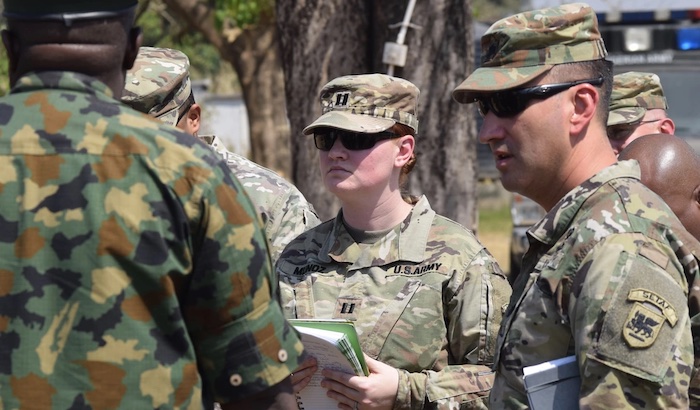
THE United States’ intensified military partnership with Nigeria, marked by joint airstrikes against terrorist groups and expanded intelligence cooperation, has yet to translate into improved security, as fresh data shows violence across the country continues to rise at an alarming rate despite the renewed collaboration.

News Point Nigeria reports that when United States airstrikes pounded ISIS-linked targets in Sokoto State on Christmas Day in 2025, they were hailed as a sign that Nigeria’s fight against terrorism had gained a powerful international ally. Although the US has long supported Nigeria’s counterterrorism efforts, the December strikes marked a dramatic escalation and became the first in a series of operations launched to avenge what US lawmakers described as the “mass slaughter of Christians” by Islamist terrorists, which they identified as the principal driver of violence in Nigeria.

However, several months into the strengthened security partnership between both countries, security remains elusive.

According to the Armed Conflict Location & Event Data Project (ACLED), a United States-based conflict monitoring organisation, Nigeria recorded 5,918 violent incidents within the first seven months of 2026 almost four-fifths of the 7,539 incidents documented throughout the whole of 2025.


The conflict monitor also revealed that the incidents recorded so far this year have resulted in 10,904 deaths, representing 73.2 per cent of the total fatalities recorded throughout 2025 in just over half a year.
The latest figures continue a years-long trend of worsening insecurity across Nigeria.
Political violence increased from 2,970 incidents in 2015 to 7,539 in 2025, representing a 153.8 per cent rise over the decade, meaning the country experienced approximately two and a half times more political violence in 2025 than it did ten years earlier.
With 2026 figures already exceeding half of last year’s total, analysts warn that violence could escalate significantly if the current trajectory persists.
The figures present what many observers describe as an uncomfortable paradox.

The United States, regarded as the world’s strongest military power, has assumed a far more visible role in Nigeria’s counterterrorism efforts through intelligence sharing, joint military operations and sustained political pressure. That increased involvement created expectations that terrorist organisations would be weakened and security improved.
The central question, however, remains why Nigeria’s security crisis has continued to deteriorate despite the heightened foreign intervention.
Nigeria has consistently argued that its security challenges are far more complex than the religious violence narrative frequently promoted by international commentators, and analysts believe that assessment may be correct.


The country’s security threats include terrorism spilling over from neighbouring Sahel countries, widespread banditry across the North-West, Islamist extremist groups including ISWAP, ISIS and Boko Haram, persistent farmer-herder conflicts, cult groups and various militia organisations.
A top military source described the situation as “a very complicated security situation.”
Speaking with this newspaper, the military source said that although the United States has increased pressure on Nigeria and expanded its military involvement, its intervention remains largely concentrated on combating Boko Haram and ISWAP, rather than addressing the broader spectrum of Nigeria’s security challenges.
“To some extent, airstrikes can only go so far,” the source said.
“Much of the insecurity in the north-west by bandits won’t be solved through air strikes.”
The source explained that targeted air operations against specific bandit leaders have instead contributed to the fragmentation of criminal groups operating mainly across Nigeria’s North-West and increasingly in other regions.
“The ability to conduct an air strike against a particular leader or even carry out ground operations against a particular bandit leader has only fragmented the number of groups that operate in Nigeria’s north-west primarily, but increasingly in other areas of the country.
“So, with this fragmentation, we’ve seen new leaders develop smaller groups and begin competing against one another as well as carrying out very high levels of violence against civilians.
“And so if the US chooses to focus its efforts solely on air strikes, we can’t expect this to resolve.”
Despite the continuing violence, the strengthened military cooperation has recorded notable successes.
In May, the Presidents of Nigeria and the United States announced that Abu-Bilal al-Minuki, identified as ISIS’s second-in-command, had been killed during a joint military operation in Nigeria.
United States officials also disclosed that electronic equipment recovered during the operation represented the largest intelligence haul since the September 11, 2001 terrorist attacks.
Since then, both countries have conducted several additional joint operations that reportedly eliminated multiple ISWAP fighters.
The military source acknowledged that Nigeria and the United States have significantly increased the tempo of air operations compared to previous years, alongside intensified military campaigns by Nigerian forces.
However, the soruce stressed that Insurgent militant organisations account for only a relatively small proportion of Nigeria’s overall violence.
According to the source, Nigeria must adopt broader approaches beyond airstrike campaigns if it hopes to effectively confront the country’s insecurity.
Attention is increasingly turning to banditry, which analysts say has become one of the country’s most devastating security threats.
Although commonly understood to mean theft, the European Union Agency for Asylum (EUAA) defines banditry as a multifaceted criminal enterprise involving armed robbery, murder, rape, kidnapping, cattle rustling and coordinated attacks on communities.
The agency notes that such crimes are typically perpetrated by highly fragmented armed groups with varying capabilities and organisational structures.
It is this type of violence that has increasingly destabilised Nigeria’s security architecture.
The full scale of the problem remains difficult to determine.
The military source estimated that more than 100 armed bandit groups currently operate across parts of North-West Nigeria.
Malik Samuel, Senior Researcher at Good Governance Africa, estimated that these groups collectively command more than 30,000 members.
Their expanding influence has coincided with a dramatic increase in kidnappings, which have become one of the defining characteristics of Nigeria’s insecurity.
A report by SBM Intelligence, a geopolitical research organisation, revealed that 2,938 people were kidnapped across the North-West between July 2024 and June 2025, accounting for more than 60 per cent of all reported kidnapping incidents nationwide.
The report said kidnappers demanded approximately ₦48 billion in ransom and successfully collected ₦2.57 billion.
Although official figures for 2026 have yet to be released, more than 1,000 Nigerians, including schoolchildren, are believed to have been abducted so far this year.
The scale of the violence has prompted renewed questions about the factors enabling armed groups to flourish.
Samuel argued that unlike insurgent organisations with structured command systems, bandit groups operate through loose networks of independent leaders.
“One of the reasons for this is because, unlike the jihadist or violent extremist groups that usually have structured organisation, the bandits are loose.
“They don’t have a command and control structure, sort of. You have several bandit leaders scattered here and there.
“And then, of course, if you look at the motivation for these bandits, it’s purely criminal, which means they are able to terrorise communities regularly. And because it is driven by the need to make money by crime, the payment of ransom continues the cycle.”
Samuel also identified Nigeria’s vast forest reserves as another major factor sustaining bandit operations.
“The north-west and the north-central, the forests in these areas are a big part of it. Yes, the violence takes place in remote communities, but these guys are coming from forests, and when they finish attacking, they retreat back to these forests,” he said.
He added that some forests also provide routes for illegal mining activities and cross-border arms smuggling.
“You can take a bike from Zamfara state, for instance, and head all the way to Mali,” Samuel said.
He further blamed the limited presence of security personnel in many northern communities for enabling armed groups to continue operating with relative ease.
Both Serwat and Samuel identified governance failures as a central factor behind Nigeria’s deteriorating security environment.
Samuel said longstanding grievances against government institutions have fuelled the rise of armed groups.
He explained that tensions between Hausa and Fulani communities over land ownership and questions of indigeneity have created fertile ground for conflict in many parts of northern Nigeria.
According to him, Fulani communities are frequently regarded as settlers rather than indigenous inhabitants, a perception that has contributed to local disputes.
“I’ve attended a peace deal between bandits and communities.
“When the bandits made their demands, for a neutral person sitting there, you just feel these are not illegitimate grievances. These are legitimate demands. They want their children to be able to go to school in the communities; they want to be able to access markets; they want to be able to access healthcare — all these amenities are in communities that are seen as Hausa communities, and because the Fulanis are usually not in these towns, they’re usually on the outskirts; they are considered as outsiders,” Samuel said.
He also pointed to the absence of government services in many affected communities.
“If you look at communities where this violence takes place, these are communities where the state is largely absent. You talk about communities without potable water, without electricity.”
Samuel cited a community in Batsari Local Government Area of Katsina State where residents reportedly lived without electricity for a decade.
“When these governance issues are very present, it is easy for not just bandits now, but also jihadists or violent extremist groups to take advantage of these grievances, because what we’ve seen are situations where violent extremist groups are presenting themselves as the best alternative government to people by having some sort of governance in place, by having conflict resolution, and by economic empowerment,” he said.
“These are functions that the state should provide.
“So if the state does not provide this, it is difficult to talk about security.”
The analysts also questioned Nigeria’s heavy reliance on the military for internal security operations.
Although the police and other civilian agencies are constitutionally responsible for internal security, the military has increasingly assumed that role, prompting criticism of what analysts describe as the “over-militarisation” of policing.
Some sourcess attribute the development to Nigeria’s prolonged history of military rule, while others cite chronic shortages of police personnel and operational resources.
Calls for the establishment of state police have therefore gained momentum.
On July 23, the House of Representatives passed a constitutional amendment bill seeking to establish state police.
The proposal has generated mixed reactions.
Another source argued that Nigeria’s current centralised policing system is inadequate for a federation of more than 230 million people, while critics fear political abuse by state governments.
The military source urged caution in implementing the proposal.
“This often has the negative effect when bandit groups or even Islamist groups move into an area with some sort of self-formed vigilante group or armed defence group. They suspect all civilians to be militants, and we tend to see very high levels of targeting of civilians when they’re retaking over this area.
“And this is where potentially a state police force could support these communities and deploy additional security support for protecting these communities from the various armed groups that continue to often loot and abduct for ransom.”
Samuel, however, expressed greater optimism.
He argued that Nigeria’s centralised policing system places disproportionate responsibility for security on the Federal Government.
According to him, decentralised policing would improve accountability by making governors directly responsible for security outcomes in their respective states.
He also maintained that recruiting officers from the communities they would serve would strengthen intelligence gathering, improve public trust and enhance operational effectiveness.
“If we learn from our current mistakes, I think it should work. There is a positive line in state policing,” he said.
As Nigeria’s security crisis becomes increasingly fragmented and complex, analysts say the challenge is no longer whether military force or foreign intervention has a role to play, but whether either can succeed without stronger institutions, improved governance and greater accountability.
For now, they say, the answer remains uncertain.