

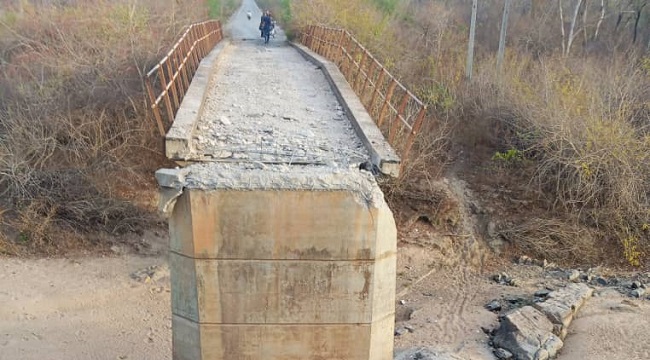
SUSPECTED bandits have bombed a critical bridge linking Wawa and Luma communities in Borgu Local Government Area of Niger State, severely disrupting movement and economic activities in the area.
News Point Nigeria reports that the incident, which occurred in the early hours of Monday, led to the destruction of the only access route connecting the affected communities, leaving residents unable to move freely between the towns.
The development has also impacted the popular Babanna border market, which holds every Monday, forcing traders and buyers to suspend activities due to the damaged bridge.


A local source told News Point Nigeria that the situation as devastating, noting that the bridge serves as a vital link for surrounding communities and plays a key role in facilitating trade and social interaction.
The source appealed to both the Federal Government and the Niger State Government to urgently intervene by reconstructing the bridge to restore normalcy and revive economic activities in the area.
Confirming the incident, the Police Public Relations Officer of the Niger State Police Command, SP Wasiu Abiodun, said the attack was carried out by suspected terrorists using explosive devices.
According to him, “On 23rd March 2026, at about 6:30 a.m., a report was received indicating that at about 2:00am of the same date, suspected terrorists within the park forest used explosive devices to bomb a bridge located along Luma road in Borgu LGA, connecting Luma–Babanna–Agwara communities.”
He added that the destruction of the bridge was an apparent attempt by the hoodlums to undermine ongoing security operations in the area.
The police spokesperson, however, assured that security agencies have intensified clearance operations, while continuous monitoring of the situation is ongoing to ensure the safety of residents and the restoration of order.

In recent months, Niger State has witnessed a surge in terror‑related violence, including deadly attacks by suspected militants on communities and markets that have heightened fear among residents and stretched local security responses.