

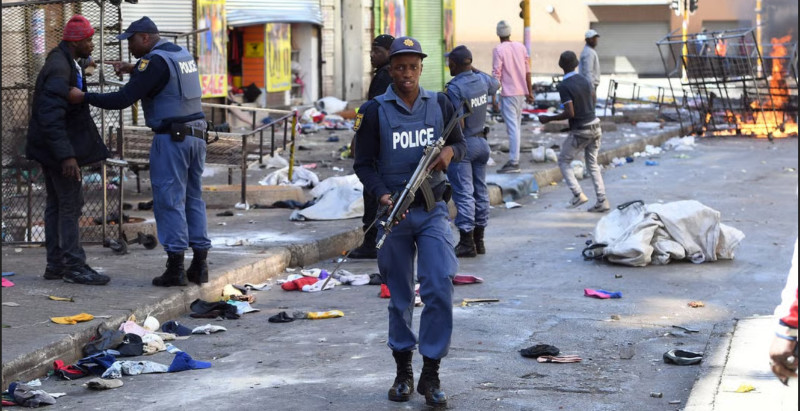
VIOLENT unrest has erupted in the Eastern Cape Province of South Africa following protests against the controversial coronation of an Igbo traditional ruler, with demonstrators torching vehicles, houses and looting businesses owned by foreign nationals.
News Point Nigeria reports that the protests, which began as a political and cultural demonstration, quickly escalated into widespread violence on Monday, particularly in KuGompo City, where angry crowds clashed with security forces and targeted properties linked to foreigners.

The demonstrations were led by members of ActionSA alongside traditional leaders and residents, who argued that the coronation violated the province’s sovereignty, constitutional order, and established traditional leadership systems.

According to reports by SABC News, the situation deteriorated rapidly as protesters blocked roads, set vehicles ablaze, and looted shops, forcing police to intervene to restore order.


Videos circulating on social media platform X showed scenes of chaos, with buildings and vehicles allegedly belonging to foreign nationals engulfed in flames, while heavily armed security personnel struggled to disperse the crowds.
Local media outlets, including Newsroom Afrika and eNCA, reported that the violence turned deadly after a stabbing incident allegedly involving Ethiopian shop owners, leaving at least two people hospitalised and several others injured.
The unrest has been linked to growing anger over the installation of a Nigerian traditional ruler in the region, a move critics say undermines South Africa’s recognised traditional governance structures.
Reacting to the development, Eastern Cape chair of ActionSA, Athol Trollip, strongly condemned the coronation, describing it as unlawful and inconsistent with the country’s constitutional framework.
“This is a sovereign nation protected by a constitution. There is no provision for a Nigerian from the Igbo tribe to be crowned as a king in the Eastern Cape,” Trollip said.

He further warned against what he described as attempts to create a “homeland” for foreign nationals, referencing the painful history of apartheid-era territorial divisions such as Ciskei and Transkei.
“We will not tolerate the establishment of another homeland. This province is not up for the taking,” he added, insisting that only recognised traditional leaders should hold authority in the region.
Protesters echoed similar sentiments, with some issuing strong warnings that the crisis could escalate further if authorities fail to act.


One protester, Inoksi Sigcawu, said residents were prepared to take drastic measures to defend what they described as their sovereignty.
“If law enforcement fails to act, people may take matters into their own hands. We do not want that, but we will not allow our authority to be undermined,” he said.
Amid the growing tension, calls for the deportation of Nigerians linked to the coronation have intensified, while demands have also been made for investigations into foreign-owned businesses operating in the province.
Meanwhile, Nigeria’s diaspora authorities have urged caution in reacting to the reports.
The Nigerians in Diaspora Commission (NiDCOM) said it had yet to receive any official report confirming targeted attacks on Nigerians in South Africa.
Speaking on the matter, NiDCOM spokesperson Abdur-Rahman Balogun stated that the commission could not act on unverified social media claims.
“We will rely on official reports from our embassy. Incidents of this magnitude are usually communicated through diplomatic channels,” he said.
In response to the situation, the Nigerian High Commission in Pretoria issued an advisory urging Nigerians living in South Africa to remain vigilant and exercise caution.
The advisory called on citizens to maintain a low profile, avoid large gatherings, limit unnecessary travel, and be mindful of their activities online, warning that misinformation could further inflame tensions.
It stressed that the guidance was not intended to cause panic but to promote safety and responsible conduct during the period of uncertainty.