

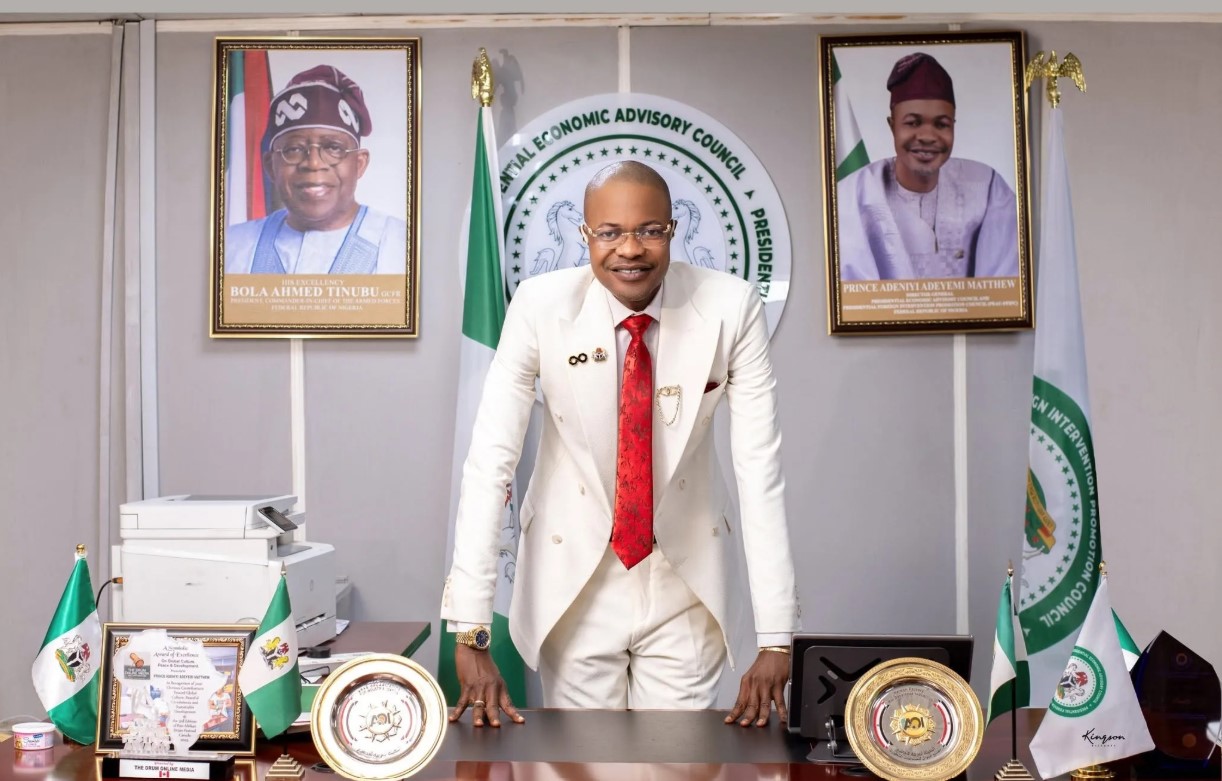
DESPITE a firm dismissal by the Presidency of claims linking it to a purported Presidential Foreign Intervention Promotion Council and a so-called Presidential Economic Advisory Council allegedly run by one Adeyemi Adeniyi Matthew, who is accused of falsely parading himself as Director-General of the fabricated bodies, the controversy continues to deepen amid ongoing security investigations into alleged forged presidential appointment letters and the use of fake government identities to impersonate official institutions.
The issue first came to light after the Office of the Chief of Staff to the President, Femi Gbajabiamila, through the Special Adviser to the President on Information and Strategy, Bayo Onanuga, raised concerns over suspicious activities tied to what was described as a parallel and unauthorised organisation. The alarm followed complaints from officials of the Nigerian Investment Promotion Commission, who reportedly discovered that a group was operating in direct conflict with an established government agency while falsely presenting itself as a legitimate federal institution.

In this weekend feature, News Point Nigeria dissecting the controversy, takes a deep dive into the unfolding scandal surrounding allegations of a non-existent presidential intervention and investment promotion structure allegedly deployed to impersonate the Federal Government, forge official documents, and defraud unsuspecting individuals and institutions.

On October 17, the Chief of Staff formally escalated the matter to the Department of State Services (DSS) and the Nigeria Police Force, requesting a comprehensive investigation into what he described as a network of fraudsters allegedly forging presidential appointment letters purportedly issued from his office. The petition detailed concerns that individuals were producing fake official documents bearing falsified signatures, reference numbers, and government seals, which were then used to claim leadership roles in non-existent government bodies, particularly the alleged Presidential Foreign Intervention Promotion Council.


According to the alert, the group allegedly led by Adeyemi was said to be operating from an office within the Federal Secretariat Complex Phase III, Second Floor, where meetings were reportedly held with both Nigerian and foreign participants under the guise of a legitimate federal agency. It was further accused of attempting to secure a note verbale from the United States Ministry of Foreign Affairs to facilitate visa issuance for its members, raising diplomatic and security concerns.
Gbajabiamila described the development as a serious breach capable of undermining the integrity of the Presidency and official communication channels, urging security agencies to identify, arrest, and dismantle the alleged network behind the scheme. The petition was supported with documentary evidence including purported forged appointment letters, screenshots of online activities, and a formal request for diplomatic documentation.
Around the same period, the Federal Ministry of Foreign Affairs also raised concerns, prompting inter-agency exchanges. In a letter dated October 15, 2025, signed by Ambassador Anderson Madubuike, the ministry sought clarification from the Office of the National Security Adviser and the Chief of Staff following reports of a meeting allegedly held by Adeyemi with foreign ambassadors at the Wells Carlton Hotel and Apartments in Asokoro without official clearance.
The ministry stressed that such engagements violated established diplomatic protocols governing official government interactions. On October 20, the Office of the National Security Adviser escalated the matter to the Office of the Secretary to the Government of the Federation (OSGF) for further action, deepening the administrative review of the allegations.
By October 29, the OSGF formally contacted the Chief of Staff seeking clarification, citing multiple inquiries from government and non-government bodies attempting to verify the legitimacy of the alleged appointments. Two days earlier, Gbajabiamila had already responded to the Ministry of Foreign Affairs, denying ever issuing any appointment letters to Adeyemi and clarifying that his office had no connection to the alleged council. He further emphasized that such appointments fall outside his office’s mandate and rest within the Office of the Secretary to the Government of the Federation.

On November 5, 2025, he reaffirmed this position in a formal response to the OSGF, stating clearly that Adeyemi and the alleged organisation were unknown to any legitimate government structure and that security agencies had been directed to investigate the matter thoroughly.
Following the petition, the Nigeria Police Force commenced investigations and subsequently arrested Adeyemi in Abuja on October 27 at the Secretariat office where he was allegedly operating the scheme. A search of his residence in Suleja reportedly led to the recovery of documents and materials believed to be relevant to the investigation.
During interrogation, Adeyemi allegedly claimed that one Dolapo Babatunde Tanimola assisted him in obtaining the fake appointment letter. However, investigators later discovered that Tanimola had died in a fire incident at Kachi Hotel in Abuja on October 22, just days before the arrest.


Further investigations revealed that the alleged agency was entirely fictitious, with Adeyemi accused of forging appointment documents, impersonating a government appointee, and attempting to secure diplomatic facilitation from the Ministry of Foreign Affairs. Police also uncovered a sprawling financial trail involving 34 bank accounts linked to him, including nine opened under fictitious entities such as the FCT Investment Promotion Agency and related pseudo-government structures.
He was additionally found to have allegedly opened a Central Bank of Nigeria account using forged documents and by deceiving the Office of the Accountant-General of the Federation, although no public funds were reportedly disbursed. A police investigative report led by Assistant Commissioner Kabir Mogaji concluded that the actions amounted to criminal forgery, impersonation, and obtaining by false pretence, all of which allegedly brought the Presidency and the Chief of Staff’s office into disrepute.
Based on these findings, police filed an eight-count charge against Adeyemi and two accomplices at the Federal High Court in Abuja on November 27, 2025, with the case scheduled for hearing on July 27. While on bail, Adeyemi reportedly contradicted his earlier statement by claiming that he had been appointed by the Chief of Staff as Director-General of the fictitious council, a claim Gbajabiamila has strongly denied, describing him as an impostor in a fresh disclaimer issued on June 8.
Authorities say the case reflects a sustained pattern of deception, including a previous 2016 allegation in which Adeyemi reportedly posed as an ambassador and President-General of a non-existent World Youth Organisation allegedly linked to the United Nations, a claim later denied by the UN.
The Presidency has urged the public to await the outcome of ongoing court proceedings, stressing that the matter remains sub judice and should not be prejudged outside the courtroom.
However, fresh revelations obtained from official documents have further complicated the narrative, raising questions about whether the alleged Presidential Foreign Investment Promotion Council was entirely unknown to government structures at all stages. The documents indicate that the Office of the Secretary to the Government of the Federation received, acknowledged, and processed correspondence submitted in the council’s name months before the Presidency publicly disowned it.
The SGF’s office reportedly forwarded a request by Adeyemi, who styled himself as Director-General of the council, seeking office accommodation from recovered Federal Government properties through the Economic and Financial Crimes Commission. The correspondence dated November 21, 2024, was signed by Permanent Secretary, General Services Office, Nnamdi Maurice Mbaeri, acting on behalf of the SGF.
Registry records show the letter was received on November 12, 2024, before being forwarded to the anti-graft agency nine days later. The forwarding correspondence indicated that multiple government institutions had applied for office accommodation, including the PFIPC request identified as Ref. No. SH/DG/PFIPC/RQ/107.
In his submission, Adeyemi described the PFIPC as a Federal Government investment promotion agency tasked with attracting foreign direct investment into Nigeria, acting as a one-stop coordination centre for investment activities across ministries, departments, and agencies.
He further claimed the council facilitated public-private sector engagement, policy advocacy, and served as a central repository for investment data, while promoting Nigeria as a global investment destination. He also stated that its mission was to identify and promote private sector investments that would create jobs and enhance national prosperity.
The letter outlined an ambitious mandate, presenting the PFIPC as a coordinating hub designed to ensure that investors receive seamless support from government institutions while positioning Nigeria as a preferred global investment destination.
These documents have surfaced amid ongoing criminal proceedings in which Adeyemi is accused of operating a fictitious government agency, forging presidential appointment letters allegedly linked to the Chief of Staff, and falsely presenting himself as Director-General of the PFIPC.
In a separate statement, the Special Adviser to the President on Information and Strategy, Bayo Onanuga, reiterated that the PFIPC and related structures were entirely fictitious, outlining the criminal charges, investigative findings, and what he described as the suspect’s long history of fraudulent activity.
Meanwhile, the Federal Government has listed Gbajabiamila and ten others as witnesses in the ongoing criminal trial. The eight-count charge alleges conspiracy, forgery, impersonation, and the creation of a non-existent federal agency using forged presidential documents.
The charges claim the defendants operated a fake institution and used forged seals, reference numbers, and official insignia of the Presidency. The alleged offences are said to have occurred between 2024 and 2025.
Court documents also allege that Adeyemi falsely presented himself as Director-General of the PFIPC and engaged in official interactions, including meetings with diplomats at the Wells Carlton Hotel in Abuja.
An interim police report submitted to the court states that the investigation was triggered by a petition from the Chief of Staff’s office after suspicious appointment letters allegedly began circulating. It further alleges that forged documents were used to create fictitious leadership positions within the non-existent agency.
Police also alleged that Adeyemi attempted to obtain a Note Verbale from the Ministry of Foreign Affairs to facilitate visa issuance for staff members of the purported organisation. He was arrested on October 27, 2025, following surveillance operations, with search warrants executed at his Abuja office and Suleja residence.
Investigators reportedly recovered forged letters, official letterheads, correspondence with ministries, and documents bearing presidential insignia. Adeyemi allegedly told investigators he was assisted by a deceased individual, a claim later contradicted by evidence.
A visit to the Federal Secretariat in Abuja reportedly revealed no trace of the alleged PFIPC office, with security personnel and civil servants stating they had no knowledge of its existence. No signage or operational presence was found within the complex.
Further digital checks showed that the alleged agency once operated a website under a government domain, which is now inaccessible, though archival traces suggest it was active until April 2025.
In a new twist, the Presidency vowed to identify internal collaborators within government institutions who may have enabled the alleged fraud. Presidential media aide Temitope Ajayi stated that investigators from the DSS, Police, and EFCC are working to uncover any internal compromise that allowed the scheme to persist.
Ajayi argued that while systemic weaknesses may have allowed the alleged fraud to flourish temporarily, the same system eventually detected and exposed it. He also accused Adeyemi of attempting to exploit public distrust in government to deflect responsibility.
He further stated that complaints from the Nigerian Investment Promotion Commission and the Ministry of Foreign Affairs were what ultimately triggered official scrutiny, describing the system’s response as evidence of institutional functionality.
The Presidency has made this its third official response to the controversy, as efforts to obtain comments from the EFCC and the Secretary to the Government of the Federation remain unsuccessful.
Human rights lawyer Femi Falana faulted the Presidency’s position, arguing that it lacks constitutional authority to exonerate anyone and calling for an independent investigation by the Independent Corrupt Practices and Other Related Offences Commission into all parties involved, including the Chief of Staff.
Falana also questioned alleged budgetary allocations reportedly linked to the fictitious agency and how it was able to open accounts with the Central Bank of Nigeria.
Opposition parties, including the African Democratic Congress and the Nigeria Democratic Congress, have also demanded independent probes and the immediate removal of Gbajabiamila, describing the matter as a serious corruption scandal.
The ADC argued that if the Presidency’s defence is correct, Nigerians deserve clarity on how a non-existent agency allegedly obtained approvals, appeared in official records, interacted with diplomats, and operated across government systems.
The party further stated that the government’s focus on defending individuals rather than explaining systemic failures suggests either complicity or incompetence.
The Nigeria Democratic Congress similarly called for the removal of top officials and a full-scale investigation into financial transactions, recruitment approvals, and alleged irregularities surrounding the case.
As the matter heads deeper into judicial scrutiny, the controversy continues to raise fundamental questions about institutional safeguards, internal oversight, and the vulnerability of government systems to sophisticated impersonation schemes.