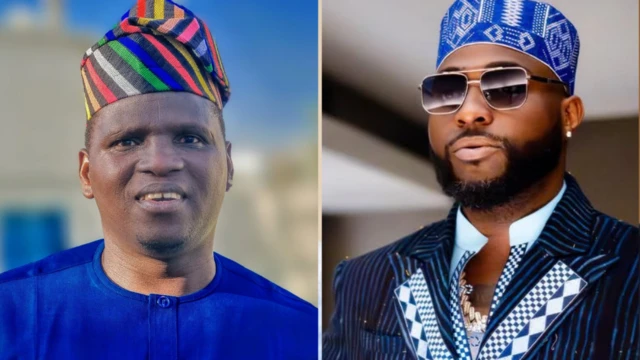
THE controversy between Hausa praise singer Dauda Adamu Kahutu, popularly known as Rarara, and Afrobeats superstar Davido has evolved into a wider national conversation on insecurity, regional representation, and the limits of celebrity activism. At the centre of the storm is Davido’s appearance at the 2026 FIFA World Cup countdown concert, where he wore a jacket inscribed with “Bring Them Home” alongside the names of abducted schoolchildren and teachers from Oyo State, a gesture that has sharply divided public opinion.
The incident referenced in the tribute occurred on May 15, when gunmen attacked three schools in Oriire Local Government Area of Oyo State and abducted 39 students alongside seven teachers. What was meant to be a global entertainment performance soon turned into a political flashpoint after Davido used the international stage to spotlight victims of Nigeria’s worsening insecurity.
Read also: Buhari, Tinubu, Osinbajo And The Unanswered Question Of 2023 Succession
In this weekend feature, News Point Nigeria Saturday takes a deeper look at the issues and dissects the controversy, unpacking the arguments, emotions, and wider implications behind the heated exchange.

During the 2026 World Cup opening performance, Davido blended entertainment with advocacy, later posting: “From Nigeria to the world I will always represent my people with pride 🇳🇬… Grateful to perform on this stage for the #FIFAWorldCup2026 pre-show but still praying for the souls we’ve lost, their families, and for peace. We carry our people everywhere we go. ❤️🙏🏾”
While many fans praised the gesture as courageous and empathetic, others—including Rarara—interpreted it as a damaging international portrayal of Nigeria. For Davido’s supporters, however, the message was a reminder that insecurity remains a national crisis deserving global attention, not silence for the sake of image management.


Reacting in a video on his verified Facebook page, Rarara condemned Davido’s action in strong terms, describing it as “barbaric” and arguing that it projected Nigeria negatively on the world stage.
He questioned the intent behind displaying the names of abducted children on the Nigerian flag abroad, accusing the singer of politicising a sensitive national security issue.
“Davido took the names of abducted schoolchildren in Oyo State, wrote them on the Nigerian flag and displayed it in America. What was the purpose?” he asked.

Rarara further alleged that Davido’s action may have been influenced by political interests, suggesting it could be tied to his uncle’s political ambitions under the Accord Party, while President Bola Tinubu belongs to the APC. He argued that insecurity should not be used as a campaign tool.
The disagreement intensified when Davido responded on X with a short post, “Debidoo,” widely seen as a playful jab at Rarara’s pronunciation of his name. The response triggered an immediate reaction from the Hausa singer, who warned him to “stay in your lane.”
Davido escalated the exchange, questioning Rarara’s education level and dismissing his criticism in strong terms, stating he would not engage someone he considered uninformed.


He later followed up with a more detailed message defending his position, insisting that no patriotic Nigerian should remain silent in the face of insecurity.
“A lack of compassion, political sycophancy, and placing personal or political interests above the welfare of the people are nothing to be proud of,” he wrote.
The controversy quickly spilled into wider social media debates, with users split between defending Davido’s activism and supporting Rarara’s concern about Nigeria’s global image.
Some users argued that Davido was right to use his international platform to highlight insecurity, while others accused Rarara of ignoring the very crisis affecting Northern communities while focusing on the singer’s actions.
Several comments also reflected regional sensitivities, with some Northerners publicly distancing themselves from Rarara’s position, while others defended him as misunderstood or misrepresented.
At the same time, criticism emerged over Davido’s “Debidoo” comment, with some arguing it mocked the Hausa accent and could deepen regional tensions.
Read also: Gombe Governor Mourns Bauchi Health Agency Boss, Four Children Killed In Road Accident
However, entertainment expert Dr. Mathew Audu Ighosa has offered a nuanced comparison, condemning what he described as selective outrage on both sides while dissecting the broader implications of celebrity involvement in national issues.
According to him, from Rarara’s standpoint, Davido’s comments were seen as insufficiently reflective of Northern Nigeria’s prolonged insecurity challenges. The criticism suggests that despite receiving widespread support from Northern audiences over the years, Davido has not consistently used his global platforms to highlight crises in the region.
Supporters of Rarara’s view argue that insecurity in Northern Nigeria has persisted for years, affecting communities across states like Borno, Zamfara, Katsina, and Kaduna. They believe that public figures with international visibility have a responsibility to amplify such issues proportionally.
A key point raised in this perspective is that Davido’s World Cup-related messaging allegedly referenced insecurity in a general sense but did not specifically highlight high-profile incidents such as the Askira Uba school abductions in Borno State, which occurred around the same period as the Oyo school pupil kidnapping, leading critics to accuse him of selective attention.
From this angle, Rarara’s reaction is framed as a defence of regional representation—arguing that the North is often overlooked in national and international conversations about insecurity.
On the other hand, Davido’s broader supporters maintain that his comments were intended as general advocacy for Nigeria’s insecurity crisis, not a region-specific political statement.
They argue that celebrities often use global stages like the World Cup to draw attention to national issues in broad terms, and expecting detailed incident-by-incident coverage may not align with the nature of entertainment-driven advocacy.
From this perspective, Davido’s engagement is seen as part of a long-standing tradition where artists and entertainers use their platforms to raise awareness, even if not all incidents are individually mentioned.
Dr Ighosa criticised both the framing of Davido’s advocacy and Rarara’s response, arguing that the debate is more complex than it appears.
He stated that Davido should not be accused of neglecting the North entirely, pointing out that insecurity is a national issue affecting multiple regions simultaneously, and that expecting a single public statement to catalogue every incident is unrealistic.
At the same time, he also suggested that Davido’s critics are missing the strategic value of celebrity advocacy, even when it is not deeply detailed or region-specific.
However, Dr. Ighos strongly pushed back against Rarara’s attack on Davido, describing it as misguided, especially given the history of how political messaging and international campaigns have historically influenced Nigerian governance responses.
Dr. Ighosa added a historical dimension to his argument, noting that during the Goodluck Jonathan administration, several actors—some of whom are now in government were allegedly involved in or supported international advocacy campaigns such as the Bring Back Our Girls movement following the Chibok kidnappings in Borno State.
He argued that such campaigns, including foreign-facing activism, were instrumental in forcing global attention on Nigeria’s insecurity challenges, suggesting that international visibility and pressure often shape government response mechanisms.
From this angle, Davido’s World Cup message is seen as part of a long tradition of using global stages to amplify domestic crises, even if the messaging is not region-specific or detailed.
The Davido–Rarara controversy has moved beyond entertainment into a broader debate about identity, representation, and responsibility in a divided media environment. What began as a World Cup-related performance has now become a symbolic battleground over how Nigeria’s insecurity should be communicated to the world.
Read also: How My Mother Was Abducted After I Exposed $2.4bn Subsidy Fraud In 2012 – Okonjo-Iweala
While Rarara’s criticism reflects longstanding frustrations over Northern insecurity and representation, Davido’s supporters argue that silence on such issues would amount to neglect. Dr. Mathew Ighos’ intervention ultimately reframes the dispute, suggesting that the truth lies between emotional regional expectations and the realities of global celebrity advocacy.
In the end, the episode highlights a familiar Nigerian pattern: when insecurity meets celebrity influence, even a concert stage can become a political arena.