

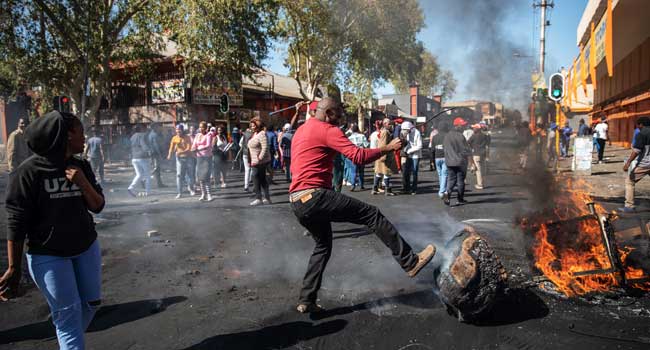
THE Federal Government has taken a firm stance against the growing wave of xenophobic attacks on Nigerians in South Africa, calling on the South African authorities to take urgent and “concrete” action to halt the violence.
News Point Nigeria reports that the Minister of State for Foreign Affairs, Ambassador Sola Enikanolaiye, made the call on Monday during a meeting with South Africa’s Minister of International Relations and Cooperation, Ronald Lamola, who is in Nigeria as a special envoy of President Cyril Ramaphosa.

Expressing Nigeria’s growing concern over the recurring attacks on its citizens, Enikanolaiye said the violence has followed a disturbing pattern spanning several decades.

“We’ve seen a pattern emerge as early as 1995, in 1998, in 2006, in 2015, in 2016, 2019, 2021, 2024, and 2026. It is on record that from 2022 alone, 98 Nigerians have died in mob actions, in hate-related actions that we have called Afrophobia, because we found that the primary victims of this ugly situation are Africans, and Nigerians in particular,” the minister said.


He added: “So, we appreciate the warm sentiments you have expressed. We also reciprocate our desire for us to maintain excellent relations and take urgent, concrete measures not just to build confidence but to address these ongoing Afrophobic attacks, of which we thought enough has got to stop—which is why we thought we should discuss firmly.”
According to the minister, migration remains a fact of history, stressing that anyone who violates the laws of a host country should be dealt with strictly in accordance with established legal procedures.
“If there are criminals, as you alluded to them, we reiterate that the solution is not to kill them. I mean, we’re a country governed by the rule of law. If someone is, quote-unquote, a criminal for drug trafficking, there are rules and regulations: get them arrested, prosecuted, and jailed. The Nigerian government will not support drug peddlers. But please, what we are saying is to treat them in accordance with your constitution, in accordance with international human rights instruments, and in accordance with the minimum requirements of humanity.
“But what we have found is that these xenophobic attacks have gone beyond attacks on criminals. We have records of Nigerians who have legitimate papers to remain in South Africa, yet they have been attacked.
“And we could see some mob actions where we saw the police watching as if they were helpless to address this situation, which to us raises issues of state responsibility. They raise issues of complicity if the state authorities are not able or are unwilling to tackle these challenges in a manner that offers some confidence to citizens and foreigners that, indeed, they are safe to remain in the country,” he said.

Enikanolaiye disclosed that President Bola Tinubu directed the meeting to enable both countries address the persistent attacks against Nigerians in South Africa in a frank and constructive manner.
The minister urged the South African government to take urgent and concrete measures to end what Nigeria described as recurring Afrophobic attacks against Nigerians and other African nationals, warning that the violence threatens decades of strategic partnership between Africa’s two largest economies.
He also recalled Nigeria’s historic support for South Africa’s liberation from apartheid and the close collaboration between both countries in transforming the Organisation of African Unity into the African Union, as well as advancing the New Partnership for Africa’s Development (NEPAD).


For months, South Africa has witnessed protests, some of them violent, directed against African immigrants, whom demonstrators accuse of contributing to crime, unemployment and pressure on public services.
Enikanolaiye revealed that about 1,500 Nigerians have been evacuated from South Africa since the latest wave of xenophobic attacks began.
According to him, the evacuation exercise was emotionally devastating for both the victims and the Nigerian government.
“The repatriation was not a pleasant experience, not just for the victims, but also even for us as a government. I recall I received the first batch. I shed tears on the plane when I saw children, women, and the elderly returning home almost with nothing.
“Some of their properties have been looted; some of them have been destroyed. I don’t think that is the way we want to conduct relations in Africa. I don’t think that is the way to go,” he said.
South African police, meanwhile, say at least four foreign nationals have been killed in attacks linked to the anti-migrant protests, although some African governments repatriating their citizens have reported a higher death toll.
More than 160,000 people have fled South Africa, according to an AFP tally based on figures provided by African governments repatriating their nationals, including about 1,500 Nigerians.
Nigeria, alongside Ghana, has remained one of the most outspoken countries in criticising the South African government’s handling of the protests and attacks against foreign nationals.
Reports also indicate that in some instances, anti-immigrant groups have forcefully entered homes and dragged occupants into police vans.
Responding on behalf of the South African government, Lamola acknowledged concerns over the attacks but maintained that the country was also grappling with criminal activities allegedly involving some immigrants, including drug trafficking and wire fraud.
“President (Cyril) Ramaphosa and the government he leads have been outspoken against any intolerance,” Lamola said.
He, however, stressed that South Africa has the sovereign right to “deal decisively with irregular migration and undocumented immigrants including acts of criminality.”
South Africa, one of Africa’s most industrialised economies, has long attracted both documented and undocumented migrants seeking better economic opportunities.
However, the country continues to grapple with high unemployment, overstretched social services and rising crime, with analysts saying immigrants are frequently scapegoated for broader socioeconomic challenges and government shortcomings.