

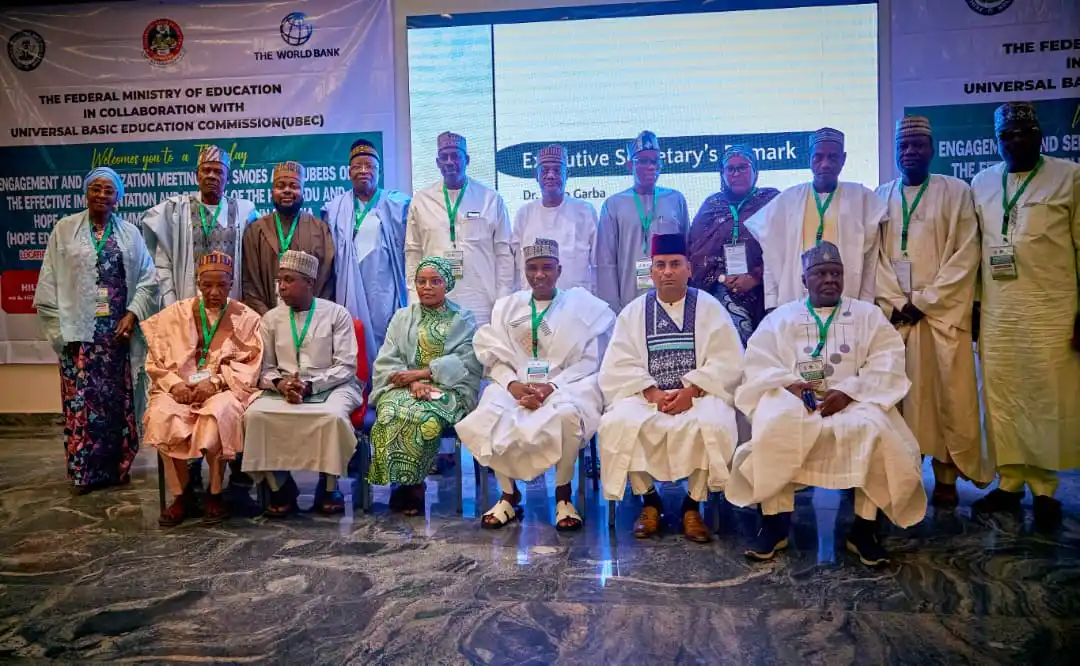
A DELEGATION from the African Institute for Solutions and Development (AISD) of Maryam Abacha American University of Nigeria (MAAUN) participated in a sensitisation workshop held in Kano for Commissioners of Education and Chairmen of State Universal Basic Education Boards (SUBEB) drawn from seven North-West and six North-East states.
According to MAAUN news website, the workshop forms part of the nationwide rollout of the HOPE-EDU programme, an initiative supported by the World Bank and the Global Partnership for Education, aimed at strengthening Nigeria’s education sector.

The MAAUN-AISD delegation comprised the President of MAAUN, Mohammad Israr; Executive Chairman of AISD, Audu Liman; Executive Director of AISD, Salisu Muhammad; Haj Nafisa Ado; and Hayatuddeen M. Abdallah.

According to the institute, its participation underscores its commitment to supporting policies and practical solutions that enhance access to quality education across Nigeria.


MAAUN-AISD described the HOPE-EDU initiative as a significant step toward achieving inclusive and sustainable education development nationwide.
The programme, valued at $552.18 million and driven by the Federal Government, is designed to transform basic education and improve learning outcomes across the country.
Implementation is being coordinated by the Federal Ministry of Education in collaboration with the Universal Basic Education Commission (UBEC) and various State Universal Basic Education Boards.
Speaking during the workshop, UBEC Executive Secretary, Aisha Garba, disclosed that the programme is expected to benefit more than 29 million children, facilitate the training of 500,000 teachers, and support the construction of 13,000 classrooms.
She further noted that the initiative would play a critical role in reintegrating millions of out-of-school children into Nigeria’s formal education system.

The event drew participation from key stakeholders, including Commissioners of Education, SUBEB Chairmen, Permanent Secretaries, and other government officials from across the North-West and North-East regions, reflecting broad institutional support for the initiative.