

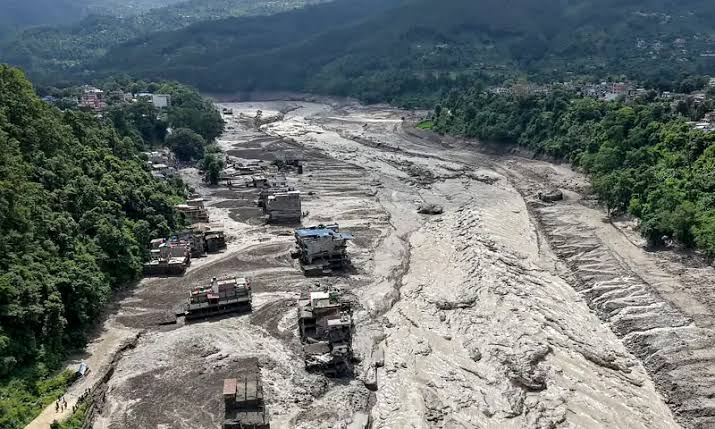
SOME 390 bodies have been recovered, and more than 1,400 people are missing across Nepal and China’s Tibet region after a huge collapse of mud and rock into a Himalayan river triggered catastrophic flooding across local towns and valleys, authorities have said.

Rescue teams waded through mud on Thursday, searching for the missing, as authorities in Nepal said at least 389 people have been killed there.

At least three people have died in the neighbouring Tibet region.

Chinese Premier Li Qiang visited the mudslide site in Tibet on Thursday afternoon to “guide emergency rescue and relief work” a day after the disaster, state media reported.


Nepalese police and tourism officials said that more than 500 foreigners were among 910 people missing in Nepal.
Among the missing are tourists from more than two dozen countries: 177 are from India, 90 from the United States, 34 from Australia, 33 from the United Kingdom, and 25 from Canada.
Beijing’s foreign ministry also said 100 Chinese nationals were among the missing in Nepal.
In Tibet’s Gyirong county, 558 people are reported missing, including 260 foreign nationals, according to Chinese state broadcaster CCTV.
Search and rescue operations are proving to be a “massive challenge” as simply “getting to the affected areas … to try and recover the survivors” is proving to be extremely difficult, because the roads and bridges there have suffered extensive damage, said Al Jazeera’s Minelle Fernandez, reporting from the Nepalese capital, Kathmandu.

A mix of government and private helicopters have “been drafted to fly into the areas to try to bring as many survivors as possible” to hospitals to receive treatment for injuries that doctors say include broken ribcages and skin burns, said Fernandez.
Rescuers in Nepal have deployed helicopters to search for survivors and drop emergency supplies to thousands of people cut off in a rugged mountainous area popular with trekkers and pilgrims travelling between Lhasa in Tibet and Kathmandu.
Video footage from Wednesday, verified by news agencies, showed rapid torrents of water and debris sweeping away dozens of people at a border crossing in Gyirong, while downstream in Nepal, homes, roads, and power infrastructure were destroyed.


Nepal’s disaster authority said on Thursday that a lake, which formed at the site where the floods occurred, was rising and at risk of bursting.
Army spokesperson Raja Ram Basnet said helicopters were dropping tents, food, and medicine, provided by neighbouring India, into the hardest-hit districts. More than 5,000 army and police rescue personnel have joined the rescue effort, he said.
India evacuated thousands of people from the states bordering Nepal, including Bihar, Uttar Pradesh, and Uttarakhand, as the floods threatened the Gandak River Basin.
Nepal’s Prime Minister Balendra Shah left by road for Bidur in one of the worst-affected districts of Nuwakot to assess the flood situation, his office said on social media.
Early reports from Nepalese officials suggested an earthquake in the area may have caused the lower section of a glacier to collapse, triggering the flash floods.
However, the US Geological Survey noted that the seismic event, initially recorded as a magnitude 4.4 earthquake, was actually the seismic energy generated by the sudden collapse of glacial rock and ice, followed by a huge debris flow.