

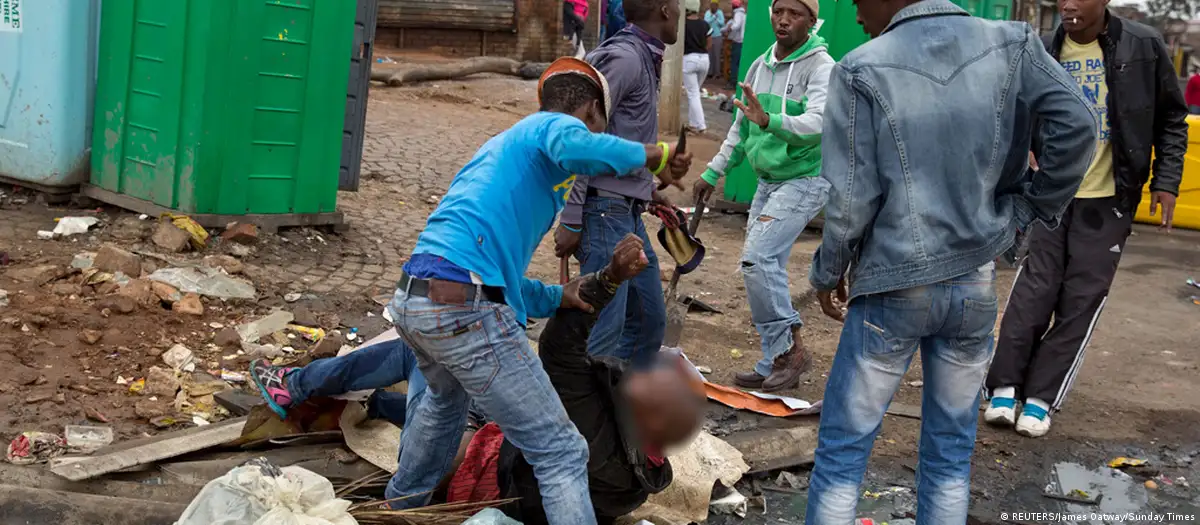
NIGERIA has evacuated 1,695 of its citizens from South Africa this year amid growing threats against foreign nationals, the Acting High Commissioner to South Africa, Ambassador Ajayi Alexander, has disclosed.
News Point Nigeria reports that the figure comprises 1,490 Nigerians repatriated through government-sponsored arrangements and another 205 who returned with support from private individuals, according to the envoy.

Alexander made the disclosure on Friday during a visit by fellows of the MTN Media Innovation Programme in Pretoria, South Africa, explaining that the Federal Government funded five repatriation flights, each carrying at least 200 Nigerians, while the mission also arranged two or three batches of one-way tickets for citizens seeking to leave the country.

He said the evacuations were voluntary, meaning some Nigerians who registered to return eventually did not show up for the flights.


According to Alexander, some of those repatriated owned property in South Africa, while others were legal residents who became caught up in the situation after delays prevented them from renewing their residence permits.
The mission is now preparing for another evacuation after the Redeemed Christian Church of God offered to sponsor the return of 500 Nigerians, with Alexander appealing to other religious organisations and private individuals to support further evacuations.
The development comes as anti-immigrant groups in South Africa have issued fresh threats against foreigners and set a deadline for them to leave the country by the end of September, according to the envoy.
“We are not taking that threat lightly,” Alexander said, stressing that the mission’s priority was to prevent Nigerians from being exposed to violence.
Despite the security concerns, the Acting High Commissioner said relations between Nigeria and South Africa remained strong at the highest level of government.

“There is a good relationship between the governments at the highest level,” he said.
The two countries have been seeking to ease tensions over attacks on Nigerians and other African nationals in South Africa. In July, South Africa’s Minister of International Relations and Cooperation, Ronald Lamola, led a delegation to Abuja after President Bola Tinubu directed talks with Nigerian officials on the issue.
Nigeria has described attacks on its citizens in South Africa as a recurring problem, with Minister of State for Foreign Affairs, Ambassador Sola Enikanolaiye, previously saying that 98 Nigerians had died in mob and hate-related incidents since 2022.


Alexander said the two countries had agreed on five areas, including preventive mechanisms, prosecution of offenders, restraint by public officials, respect for the rule of law and possible compensation for Nigerians whose property was damaged or abandoned during attacks.
However, an early-warning mechanism under a proposed Nigeria-South Africa memorandum of understanding remains unresolved. Alexander said the agreement, which would allow both countries to share information and respond to potential threats before they escalate, had been under negotiation for six to seven years.
He said Nigeria had signed its side of the agreement while South Africa had completed its part, but the mechanism had yet to become operational.
The latest threats, Alexander noted, recall the 2019 xenophobic attacks in South Africa that prompted Nigeria to arrange voluntary repatriation flights for citizens seeking to return home.
He said the mission would continue working to protect Nigerians in South Africa while helping those who want to return home to do so safely.
“We want to be able to evacuate as many as possible so that we will not allow violence to be inflicted on them,” he said.