

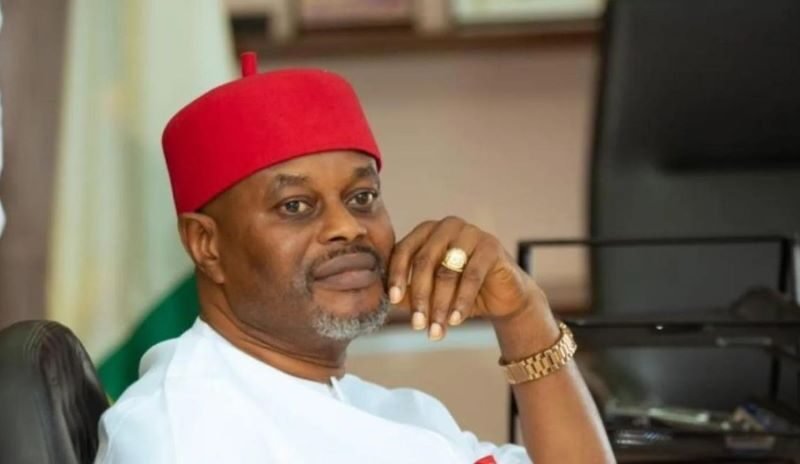
THE continued payment of salaries and allowances to former Minister of Science and Technology, Godfrey Uchechukwu Nnaji, many months after leaving office has sparked outrage among stakeholders and anti-corruption activists, who are now demanding a full investigation and possible prosecution over the alleged payroll breach.
News Point Nigeria reports that federal payroll records obtained from the Integrated Payroll and Personnel Information System (IPPIS) show that Nnaji, who left office on October 7, 2025, has remained on the government payroll as of June 2026, despite being at large over pending federal charges.
According to the records, the former minister—listed under payroll number 561829—has continued to receive a monthly basic salary of about N1.1 million. Ministry officials further disclosed that he also received allowances amounting to at least ₦12.8 million after his removal from office by President Bola Tinubu, benefits that ought to have been immediately stopped.


Internal communications reviewed by The Gazette indicated that officials believe Nnaji may have received at least ₦125 million since leaving office, with fears that the total sum could rise to over ₦300 million in illicit payments over the past nine months.
As of June 15, he was reportedly still queued for his June 2026 salary, which was expected to be credited to his First Bank account, according to individuals familiar with the payroll system.
The ongoing payments to a former public office holder, now facing legal proceedings and a court-issued arrest warrant, have intensified criticism of Nigeria’s IPPIS framework, with activists and stakeholders describing the development as evidence of deep administrative failure and weak accountability controls.
They argue that the case underscores the persistent inefficiencies in Nigeria’s payroll system, which has long been criticised for failing to eliminate financial leakages despite years of reforms.
Nnaji was among the initial ministerial nominees submitted by President Bola Tinubu to the Senate in July 2023. Following his nomination, the State Security Service (SSS) conducted background checks and reportedly contacted the National Youth Service Corps (NYSC) for verification of his credentials.
News Point Nigeria reports that the NYSC allegedly flagged discrepancies in Nnaji’s academic records, but the intelligence was not fully transmitted to the Senate, leading to his confirmation as minister in August 2023 despite concerns over alleged falsified documents.

Among documents he submitted to lawmakers were his West African Examinations Council (WAEC) certificate, University of Nigeria, Nsukka (UNN) degree, tax records, and filings with the Code of Conduct Bureau.
Questions later emerged over inconsistencies in his NYSC certificate, including claims that he began national service before graduating from university, and discrepancies in service duration. NYSC officials also reportedly stated they could not locate any authentic record matching the duration stated on the certificate.
He later admitted that the University of Nigeria, Nsukka never issued him a certificate, further deepening the controversy around his credentials.


A series of court cases followed The Gazette’s initial report, eventually forcing Nnaji to resign, during which he claimed—without evidence—that he was the target of political “blackmail” in his home state of Enugu.
Following his resignation, he disappeared from public view as the Independent Corrupt Practices and Other Related Offences Commission (ICPC) opened a criminal investigation into the matter. A federal court subsequently issued a warrant for his arrest.
Despite repeated requests, Nnaji did not respond to inquiries on why he continued to receive salaries after leaving office or whether he intended to return the funds.
He has consistently denied all corruption allegations, insisting in earlier statements that he was being targeted by political opponents.
Federal sources said the continued payment was due to a failure by responsible payroll officers to remove him from the IPPIS system, although it remains unclear whether this was deliberate or an administrative lapse.
Officials within the Ministry of Innovation, Science and Technology admitted that his biometrics and banking details were never fully deactivated.
“He was not removed, and we don’t know if it was deliberate corruption or an oversight on the part of our human resources desk,” a senior ministry official said anonymously.
“We are still calculating how much has been paid monthly because of this error. So far, we have confirmed about ₦125 million,” the official added, noting that the total could exceed ₦300 million.
“We expect the figure to be higher given the duration involved, although only minor allowances were adjusted after he left office,” the source said.
A ministry spokesperson did not respond to requests for comments.
A review of previous exits from the federal payroll system showed that officials who left service after May 2023 were promptly removed, including former minister Betta Edu, who was delisted following suspension over corruption allegations in 2024.
Meanwhile, the Accountant-General of the Federation recently directed a review of the IPPIS system to improve transparency and accountability in payroll administration.
Under existing procedures, MDAs are required to notify the Office of the Accountant-General and initiate exit protocols to deactivate departing staff from the payroll system. However, this process appears not to have been completed in Nnaji’s case.
Activists and stakeholders have now called for accountability, urging the Tinubu administration to sanction officials responsible for the lapse.
Anti-corruption campaigner Chidi Nwachukwu said the situation highlights systemic failures that must be urgently addressed.
“The system is not supposed to work most of the time it is supposed to work all the time,” he said.
He warned that billions of naira may be lost annually through payroll irregularities and called for a comprehensive audit of IPPIS.
“We need a credible reconciliation between what is paid out and the actual number of legitimate federal employees,” he added.
A presidential spokesman said the matter would be “looked into” but did not provide details on possible sanctions or recovery steps against those involved.