


THE political battle over the All Progressives Congress (APC) ticket for Kano Central Senatorial District has once again exposed one undeniable reality in Kano politics: despite the emergence of younger and ambitious politicians, former Kano State governor, ex-Minister of Education, and former senator, Malam Ibrahim Shekarau, remains one of the most influential political figures not only in Kano State but in Nigeria’s northern political landscape.
The unfolding controversy, closely monitored by News Point Nigeria, has become more than an ordinary party contest. It is now a referendum on political relevance, experience, grassroots connection, loyalty, and who truly possesses the political structure capable of winning one of the most strategic senatorial seats in Nigeria.
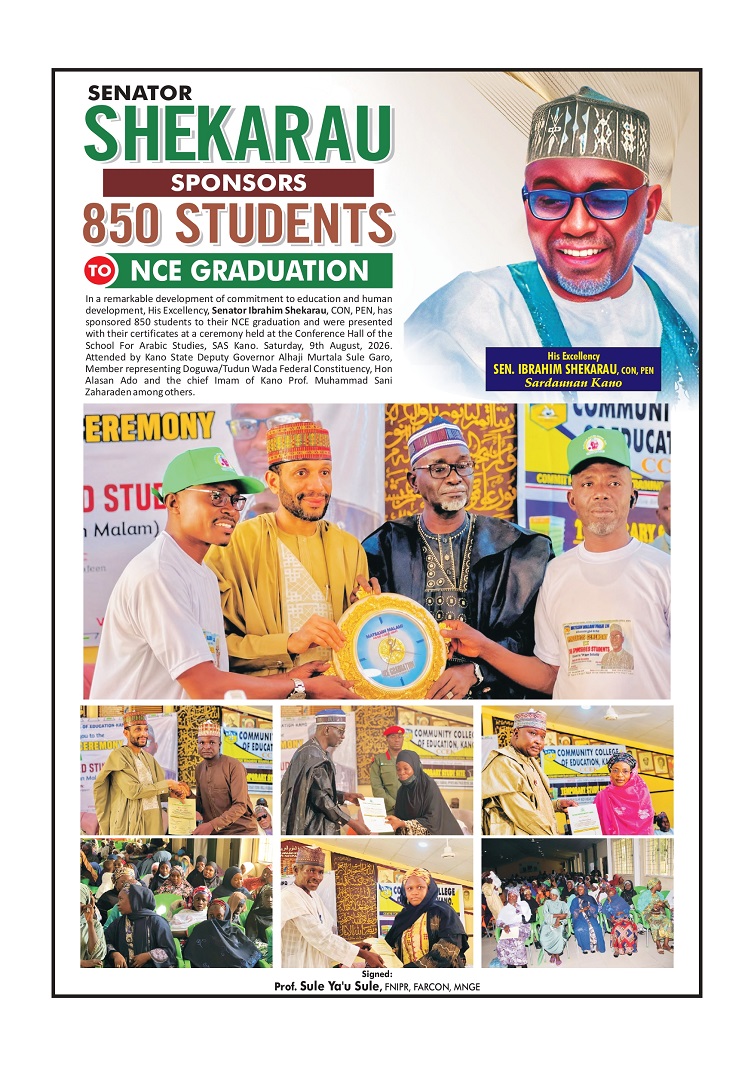
The crisis began after a high-level reconciliation meeting convened in Abuja by Kano State Governor Abba Kabir Yusuf, where several aspirants reportedly agreed to step down and endorse Shekarau as the consensus candidate for Kano Central ahead of the 2027 elections.

The move was presented as a strategic effort to unite the party, avoid internal divisions, and strengthen APC’s chances in Kano State. The agreement saw multiple aspirants voluntarily withdrawing from the race in support of Shekarau, who only recently defected from the Peoples Democratic Party (PDP) back to the APC.


But not everyone accepted the arrangement.
One of the aspirants in the race, Abdulsalam Abdulkarim Zaura, popularly known as AA Zaura, openly rejected the consensus deal, describing it as an imposition and an injustice.
Zaura, who was APC’s candidate for the same seat in 2023, argued that he had been in the race long before Shekarau joined the party and questioned why he was excluded from the reconciliation discussions.
Through his aide, Dahiru Ahmad Maihuddadu, Zaura insisted that he was neither officially invited nor informed about the consensus meeting.
“He was not invited either officially or through any means to the consensus discussion, that is why he didn’t attend. It is obvious that his omission is deliberate,” Maihuddadu told journalists

The aide further argued that while Zaura does not see the contest as a “do-or-die affair,” he deserved respect and fair treatment, especially considering that the decision was reportedly reached while he was mourning the death of his father.
“We want justice to be done,” Maihuddadu said, while also revealing that some aggrieved supporters had already begun calling for defection from the APC.
He maintained that Zaura remained optimistic about direct primaries, insisting that public sympathy over what they described as unfair treatment could work in his favour if the contest eventually goes to the ballot.


But while Zaura’s supporters see the situation as political marginalisation, many observers within Kano politics believe the endorsement of Shekarau was not accidental.
To many stakeholders, the decision reflects cold political calculation rather than emotion.
For decades, Shekarau has remained one of the most formidable political brands in northern Nigeria. Unlike many politicians whose popularity is built around temporary influence, financial power, or social media visibility, Shekarau’s strength is rooted in years of political struggle, public service, institutional experience, and grassroots relationships built over generations.
Political scientist and public commentator, Professor Ibrahim Aminu, believes this is exactly why many within the APC establishment rallied behind him.
According to him, AA Zaura may be energetic, youthful, and increasingly influential, but comparing him politically to Shekarau is still premature.
“AA Zaura is a nice young and progressive politician, but the truth is he is not close to Shekarau in terms of political relevance and voter power in Kano State and even Nigeria as a whole,” Professor Aminu said.
He acknowledged that Zaura has made visible contributions through youth and women empowerment programmes, donations, and welfare interventions across Kano.
Indeed, many young people in Kano admire Zaura’s style, accessibility, and growing political courage. His rise within the APC has been rapid, and his financial influence has made him an important political player.
But supporters of Shekarau insist that politics in Kano is deeper than visibility or recent popularity.
“A few years ago, many people did not even know AA Zaura politically,” Professor Aminu argued. “He came from abroad and joined politics recently. But Shekarau is a man whose political journey started from the grassroots.”
That journey is central to understanding why Shekarau still commands enormous respect across Kano State.
Long before he became governor, senator, or minister, Shekarau was a classroom teacher. He later rose through the ranks of the civil service to become a permanent secretary, earning a reputation for discipline, humility, and administrative competence.
His political evolution dates back to the 1980s when he contested and won leadership positions within teachers’ unions and educational associations, experiences many believe shaped his leadership philosophy.
By the time he became governor in 2003, Shekarau was already deeply rooted within Kano’s social and political fabric.
His emergence itself was historic.
He became the first politician in Kano State to defeat a sitting governor and went on to complete two consecutive terms in office, a feat many attribute to public trust, grassroots acceptance, and strong political organisation.
During his years as governor from 2003 to 2011, Shekarau cultivated an image defined by discipline, religious conservatism, grassroots connection, and institutional governance.
Even critics acknowledge that his government maintained a unique relationship with ordinary citizens.
Civil servants, for instance, still remember welfare initiatives such as “kudin gero” during Ramadan and “kudin rago” during Eid-el-Kabir, gestures that built emotional and political goodwill among workers and families.
Business communities also benefited from policies associated with economic inclusion and free trade.
Many traders and small business owners continue to speak about “jari kyauta,” empowerment programmes that supported economic activities and created opportunities for ordinary people.
Political associates also point to his generosity and loyalty to allies.
One recurring theme among those close to him is his support for Hajj and Umrah sponsorships, which created deep personal bonds with supporters and strengthened his political network beyond formal politics.
Perhaps the most significant aspect of Shekarau’s political strength is the diversity of his support base.
Unlike politicians whose influence is restricted to one demographic or ideological bloc, Shekarau commands loyalty across civil servants, traders, religious groups, business elites, rural communities, and sections of the youth population.
While former Governor Rabiu Musa Kwankwaso is often seen as commanding a larger and more emotionally driven youth movement, Shekarau’s support is frequently described as broader and more balanced across different segments of society.
Equally important is his ability to maintain long-term relationships.
In Kano politics, a terrain known for betrayals, defections, and internal conflicts — Shekarau has remarkably retained the loyalty of many allies years after leaving office.
Many of his former associates still regard him with deep respect and personal attachment.
Even outside the APC, his influence remains visible.
Members of opposition parties, including the African Democratic Congress (ADC) and other political blocs, still see him as a mentor and elder statesman.
That cross-party respect, is rare in modern Nigerian politics.
For many within the APC, these factors explain why Governor Abba Kabir Yusuf and other party stakeholders pushed strongly for Shekarau’s emergence as consensus candidate.
Kano Central is not an ordinary senatorial district. It is regarded as one of the largest and most politically strategic constituencies in Nigeria, covering 15 local government areas with millions of voters.
Winning Kano Central requires more than popularity; it demands political structure, experience, acceptance across communities, and the ability to unite different interests.
This is where many believe Shekarau has an advantage.
Even Shekarau’s campaign team has continued to project the contest as one that should prioritise party unity over internal confrontation.
His Campaign Director, Dr. Umar Musa Mustapha, described the former governor as “a very kind and humble person,” while appealing to Zaura to support the consensus arrangement.
“We want to work with him because we know how important he is politically,” Mustapha said.
Though he admitted Zaura has the constitutional right to insist on primaries, he maintained confidence that Shekarau would still prevail even if delegates decide the outcome through voting.
Beyond the immediate contest, however, the Kano Central battle reflects a deeper struggle within Nigerian politics, the clash between old political structures built over decades and newer movements driven by money, youth energy, and modern political branding.
AA Zaura represents a new generation of ambitious politicians attempting to challenge established political hierarchies.
But Shekarau represents institutional memory, tested leadership, and political endurance.
For now, many within the APC appear convinced that when it comes to electoral strength, experience, acceptability, and political influence across Kano State, Shekarau remains the safer and stronger option.
And in the brutal mathematics of Kano politics, that calculation may ultimately determine who flies the APC flag in one of Nigeria’s most consequential senatorial contests.