

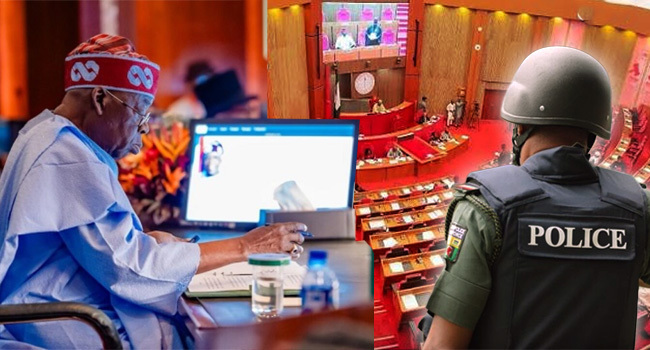
THE Senate on Wednesday approved a series of constitutional measures aimed at preventing governors from abusing the proposed state police structure for partisan, ethnic, religious, sectional or personal interests, as it passed the Constitution of the Federal Republic of Nigeria (Alteration) (State Police) Bill, 2026.

News Point Nigeria reports that the landmark legislation, which seeks to establish state police services alongside the existing federal policing structure, forms part of broader constitutional reforms designed to decentralise policing, strengthen internal security and improve responses to local threats across the country.

Leading debate on the bill, Senate Leader Opeyemi Bamidele said the proposed constitutional amendment was carefully designed to create a decentralised policing system while preserving national cohesion, accountability and federal oversight.

According to him, the bill, which was transmitted to the National Assembly by President Bola Tinubu, seeks to establish state police services alongside the existing federal police structure while ensuring that adequate constitutional safeguards are in place to prevent abuse.


Bamidele explained that the proposed amendment would empower the National Assembly to prescribe national minimum standards for recruitment, training, vetting, promotions, discipline, use of force, firearms, complaints procedures, accountability, data management and professional conduct.
He said the bill seeks to retain the Federal Police for national policing responsibilities while allowing states that choose to do so to establish their own police services.
According to him, state police services would be responsible for enforcing state laws, maintaining public safety and public order, preventing and detecting crimes within their jurisdictions, protecting lives and property, and carrying out other local policing duties.
The Federal Police, he added, would continue to oversee the protection of federal institutions, counter-terrorism operations, organised crime, cybercrime, border security, arms trafficking, interstate criminal activities and other matters relating to national security.
A key feature of the legislation is the provision outlining circumstances under which federal authorities may intervene in the affairs of state police services.

Bamidele said such intervention could only occur in cases involving a breakdown of public order, the inability of a state police service to function, serious violations of fundamental rights, electoral intimidation or threats to national security.
He stated that any intervention must be authorised in writing by the President and would be limited in scope and duration, subject to Senate oversight and open to judicial review.
“The bill provides robust safeguards against abuse, preserves federal authority where necessary, protects constitutional rights and creates a modern policing framework capable of addressing contemporary security challenges,” Bamidele said.


He added that the proposal seeks “to balance local policing autonomy with national cohesion, accountability with operational effectiveness and federal oversight with state responsibility”.
The Senate subsequently passed the landmark Constitution Alteration Bill after more than two-thirds of lawmakers voted in support during a manual voting exercise conducted on the floor of the chamber.
Senate President Godswill Akpabio announced the passage of the legislation after senators overwhelmingly backed the proposal during plenary.
The upper chamber approved the bill after considering the report of the Senate Committee on the Review of the Constitution presented by Deputy Senate President and committee chairman, Barau Jibrin.
The bill’s provisions were first considered at the Committee of the Whole before lawmakers adopted them and proceeded to a final vote.
Debate on the legislation was led by Bamidele, who urged senators to support what many lawmakers described as a critical reform aimed at strengthening internal security and improving responses to local threats.
The legislation seeks to establish a state policing framework that would operate concurrently with the existing federal police system, effectively ending the Federal Government’s exclusive control of policing.
One of the major provisions empowers state governors to appoint Commissioners of Police for their respective states, subject to confirmation by the state Houses of Assembly.
Under Clause 17 of the proposed constitutional amendment, while the Federal Police Service will continue to be headed by the Inspector-General of Police, each State Police Service shall be headed by a Commissioner of Police appointed by the governor and confirmed by the state legislature.
The bill also outlines the operational relationship between governors and state police commands.
Section 17(6) provides that a governor may issue lawful written directives of a general policy nature to the Commissioner of Police on matters relating to the maintenance of public safety and public order within the state.
To address fears that state police could be weaponised by governors, lawmakers inserted specific safeguards aimed at protecting political freedoms and civil liberties.
Section 17(7) states that a State Commissioner of Police shall not arrest, detain, investigate or deploy force against any person, political party or group merely for criticising the government except in accordance with the law.
The provision is intended to prevent state police formations from being used against political opponents, activists, journalists or dissenting voices and ensures that any action taken complies with due process and existing legal provisions.
The Senate’s consideration of the bill came amid increasing calls for policing reforms and greater involvement of subnational governments in tackling security challenges across the country.
Before the final vote, lawmakers adopted manual voting after concerns emerged that faulty electronic voting devices could disenfranchise some senators.
Under the arrangement, senators stood individually, announced their names and openly declared their positions on the proposed state police framework.
Moving the motion for manual voting, Bamidele said the procedure was necessary to guarantee transparency and ensure that no senator was excluded from the process.
“There is a need to also ensure transparency both within ourselves as people that will be performing this major constitutional responsibility, as well as members of the public.
“Rather than go by way of electronic voting, which obviously is not the case today, and disenfranchise a few or so of our colleagues whose machines are not working.
“I am moving that we give every distinguished senator the opportunity to answer his or her father’s name by doing manual voting,” he said.
The motion was seconded by Senate Minority Leader Abba Moro.
Lawmakers said the procedure would not only prevent any senator from being disenfranchised but would also make each lawmaker’s position on the contentious issue known to constituents.
Meanwhile, the Senate reversed an earlier decision and approved the admission of governors and other senior government officials into the chamber to observe deliberations on the state police bill.
The request had initially been rejected after a voice vote, as Senate rules ordinarily permit only senators on the floor of the chamber while visitors observe proceedings from the gallery.
The development briefly delayed proceedings as invited governors and other senior officials waited at the entrance to the chamber.
Akpabio later appealed to lawmakers to reconsider the decision, stressing the importance of allowing key stakeholders to witness the deliberations.
He noted that any constitutional amendment establishing state police would require approval by state Houses of Assembly and argued that governors should be allowed to follow the debate closely.
The Senate President also pointed out that the proposal originated from the executive arm of government and that many of the invited guests were executive officials.
Following the appeal, Bamidele moved a motion seeking the suspension of Order 12 of the Senate Rules on floor privileges to admit the visitors as strangers.
Jibrin supported the motion and commended Akpabio for what he described as his inclusive leadership style.
He said allowing governors and senior officials into the chamber would encourage broader participation in discussions on the proposed state police framework.
The Senate subsequently approved the motion, paving the way for the invited officials to witness the clause-by-clause voting on the constitutional amendment bill.
Among those admitted into the chamber were the Governor of Kaduna State, Uba Sani; the Governor of Ogun State, Dapo Abiodun; the Governor of Ondo State, Lucky Aiyedatiwa; and the Chief of Staff to President Bola Tinubu, Femi Gbajabiamila.