

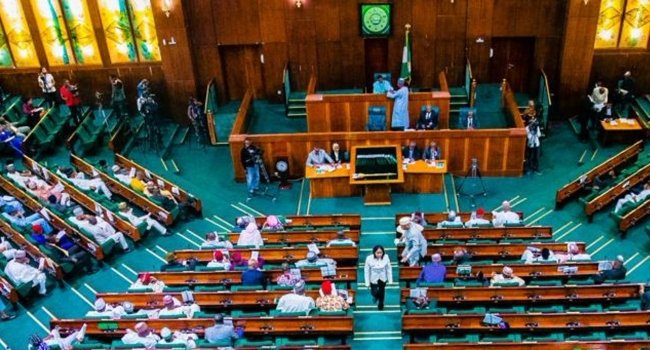
THE House of Representatives on Thursday passed a constitutional amendment bill seeking to establish state police across Nigeria, marking a major step in the ongoing effort to reform the country’s security architecture.

News Point Nigeria reports that the bill, formally titled “A Bill for an Act to Alter the Constitution of the Federal Republic of Nigeria, 1999 to Provide for the Establishment of State Police and for Related Matters (Sixth Alteration) Bill, 2026,” was approved during consideration at the Committee of the Whole.

It scaled through after lawmakers voted overwhelmingly in its favour, following the presentation of the report by the Deputy Speaker and Chairman of the House Committee on Constitution Review, Benjamin Kalu.

A manual voting process showed strong legislative backing, with 289 lawmakers supporting the proposal, one abstaining, and none voting against it.


The proposed amendment introduces a dual policing structure comprising the Federal Police and State Police, aimed at addressing Nigeria’s rising security challenges through a decentralised system.
Under the proposal, Section 214 of the Constitution will be amended to formally establish both policing formations. The National Assembly will be empowered to define the structure, administration and powers of the Federal Police, while also setting minimum standards for the creation and operation of state police services.
The bill stipulates that no state police formation shall begin operations unless it is established through a law passed by the relevant State House of Assembly and certified as meeting national standards set by the National Assembly.
It further provides that the Federal Police will continue to operate in any state until its own state police structure becomes fully functional.
To prevent abuse or undue interference, the amendment limits federal intervention in state policing affairs. Under the proposal, the Federal Police may only step in where there is a breakdown of law and order, upon request by a governor, or where a state police force is unable to function due to administrative, financial or operational challenges.

The bill also proposes changes to police leadership and command structures. The Inspector-General of Police will now be appointed by the President on the advice of the Nigeria Police Council from among serving members of the Federal Police, subject to Senate confirmation.
Similarly, a State Commissioner of Police will be appointed by a governor on the advice of the Nigeria Police Council from among serving officers of the State Police, subject to approval by the respective State House of Assembly.
It further empowers governors to issue lawful directives to State Commissioners of Police on matters of public safety and order. However, where such directives are considered unlawful or inconsistent with policing standards, they may be referred to the Nigeria Police Council for final determination.


The amendment also revises Section 84 of the Constitution by replacing references to the National Police Council and the Federal Police Service Commission with the Nigeria Police Council and the Police Service Commission.
The passage of the bill represents a significant milestone in Nigeria’s constitutional review process and revives long-standing national debates on whether state policing could provide a more effective response to insecurity.
For the amendment to become law, it must be approved by the Senate, endorsed by at least two-thirds of state Houses of Assembly, and finally receive presidential assent.
If enacted, the legislation is expected to establish a multi-layered policing system designed to improve responses to banditry, kidnapping, terrorism and other security threats through stronger localised security frameworks.