

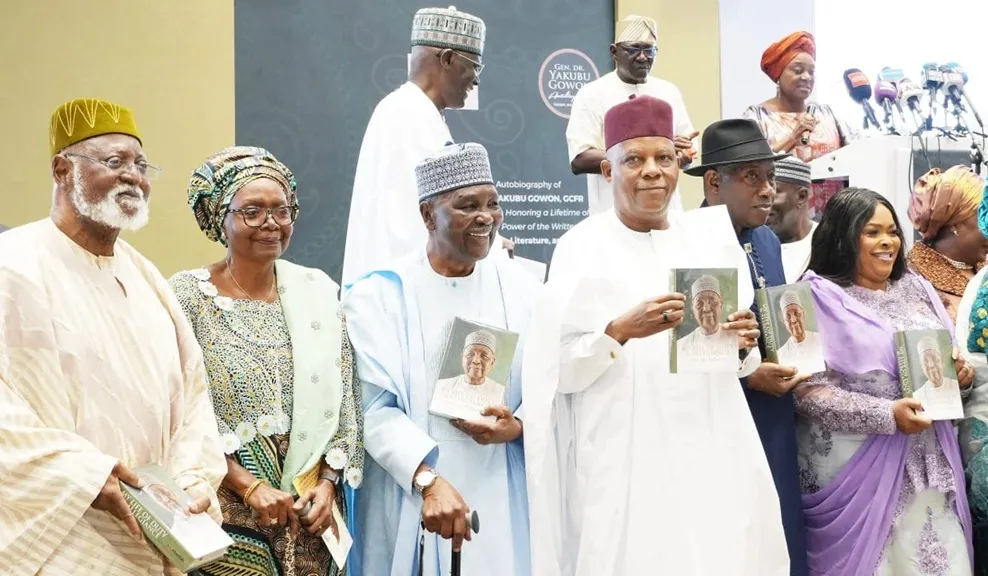
FORMER Head of State, General Yakubu Gowon (retd.), has declared that Nigeria will not collapse despite its numerous political, economic and security challenges, expressing confidence that the country still possesses the resilience to overcome difficult times and fulfil its potential as the giant of Africa.

News Point Nigeria reports that Gowon made the declaration on Tuesday in Abuja during the launch of his 859-page autobiography titled My Life of Duty and Allegiance, where he also warned the political class against the desperation driving what he described as “do-or-die politicking.”
The former military leader, who turned 91 in February, criticised the persistent inability to conduct free, fair and transparent elections, including intra-party polls, saying the culture has continued to undermine Nigeria’s democratic development since the colonial era.


Speaking at the event, Gowon insisted that Nigerians must not surrender to pessimism or allow critics to define the country as a failed state.
“We all must rise to contain the desperation frequently accepted by the political class who engage in what they love to call do-or-die politicking and their inability to conduct free, fair and transparent elections, even in matters as minor as intraparty elections, which has continued to plague our nation from colonial times,” he said.
“We must not give room to the naysayers who see no good in our nation and would rather label it as a failed nation.”
Reflecting on his years in office, Gowon said he remains convinced that Nigeria still possesses the potential to become the giant of Africa.
“Each time I reflect on my service to my country, I become further persuaded that Nigeria can get better and achieve its potential as the giant of Africa,” he stated.
“On my watch as head of state, the country did not fall, and I am confident that the nation, despite all its challenges, still will not fall.”

The former Head of State, however, expressed concern over what he described as Nigerians’ tendency to complicate simple national issues.
“I am worried that Nigerians never seem to get tired of presenting difficult solutions to simple problems, which they further complicate with more complex and ambiguous solutions that invariably generate tensions in the country,” he added.
Gowon ruled Nigeria as military Head of State between 1966 and 1975, a period that witnessed the 30-month civil war from 1967 to 1970 and the country’s post-war reconstruction efforts.


He was later overthrown in a bloodless coup led by General Murtala Muhammed in July 1975 while attending a summit of the Organisation of African Unity in Kampala, Uganda.
At the event, former President Goodluck Jonathan and former Defence Minister Theophilus Danjuma praised Gowon for his famous “no victor, no vanquished” declaration at the end of the civil war, describing it as a major step toward healing and national reconciliation.
Jonathan, who spoke during the presentation, described the autobiography as more than just a personal memoir.
“Today’s event is not merely the unveiling of a book. It is the presentation of a living testimony,” he said.
“It is a reflection of a leader who stood at the centre of some of the defining moments in our national journey.”
The former president said the memoir provides valuable insight into military leadership, peace building, reconciliation and the complexities of governing a diverse country like Nigeria.
“The Nigerian autobiography offers not only a personal account of military strategy and leadership, but also one of the big insights into the challenges of nationhood, reconciliation, peace building, and statesmanship,” Jonathan added.
Reflecting on the civil war years between 1967 and 1970, Jonathan described the period as one of the darkest chapters in Nigeria’s history but commended Gowon’s post-war reconciliation efforts.
“The years of the civil war from 1967 to 1970 remain among the most painful chapters of our national experience,” he said.
“Yet, this historical record is committed to the realisation of national unity and perhaps more importantly, the unanimity at the end of this conflict embodied in the enduring declaration of ‘no victor, no vanquished.’
“The declaration laid the foundation for healing, reconstruction and reintegration at a time when victims and witnesses would have been in pain.”
Jonathan also praised Gowon for introducing policies that transformed the country, especially the establishment of the National Youth Service Corps (NYSC).
“In Nigeria, the establishment of the NYSC was one key policy that today remains in place,” he said.
According to him, the scheme not only promoted unity among young Nigerians but also helped address the shortage of graduate teachers in rural schools.
Recalling his own experience, Jonathan said he benefited directly from the programme during his secondary school days.
“I remember in 1973, I was in class three in secondary school when the third batch of the NYSC came,” he said.
“In those days, it was so difficult to get graduate teachers to teach in secondary schools, especially schools that were not in the cities.”
He added that two corps members posted to his school taught him subjects including Mathematics, Chemistry and Biology, contributing significantly to his academic development.
“So the vision of the NYSC is great and will continue to be great,” Jonathan stated.
The former president further commended Gowon’s continued advocacy for peace and unity decades after leaving office.
“General Gowon has continued to distinguish himself through decades of public service and advocacy for peace,” he said.
“His commitment to national unity, interfaith harmony, and youth development has remained steadfast long after leaving office.”
Jonathan also emphasised the importance of memoirs in preserving national history and educating younger generations.
“As younger generations study our nation’s history, it is important that they hear directly from those who bore the burden of leadership during critical times,” he said.
“By sharing his stories, Gen Gowon has once again rendered another important service to Nigeria and the historical record of Africa.”
Danjuma, represented by former Chief of Defence Staff Martin Luther Agwai, also praised Gowon’s leadership during the civil war.
“As Nigeria’s Head of State during one of the most turbulent periods in our nation’s history, Gen Gowon exhibited immense courage and sterling character in steering our beloved country from the brink of disintegration to a united, stable and strong nation,” he said.
“His well-recorded slogan of ‘no victor, no vanquished’ after the civil war set the tone for his highly effective post-war policies, which helped to speedily heal the scars of the war and put Nigeria on the path to sustainable recovery.
“He will forever be remembered as a leader whose love for his country and fellow citizens was unwavering even in the most trying of times.”
The event attracted several prominent dignitaries, including former Military President Ibrahim Babangida, represented by his daughter Aisha Babangida; Senate President Godswill Akpabio, represented by Senator Ireti Kingibe; the Sultan of Sokoto Muhammad Sa’ad Abubakar III; Secretary to the Government of the Federation George Akume; and President of the Court of Appeal Monica Dongban-Mensem.
Several retired military officers, including the son of former Head of State Sani Abacha, also attended the event.
During the launch, Danjuma donated N3 billion and directed that 12 copies of the autobiography be purchased and distributed to the libraries of the 20 universities that had awarded honorary doctorates to Gowon over the years.
Chairman of the Dangote Group, Aliko Dangote, donated N500 million, while President of the BUA Group, Abdul Samad Rabiu, purchased copies of the book worth N25 million.
The autobiography was reviewed by Matthew Kukah, the Catholic Bishop of Sokoto Diocese, author and social commentator.