

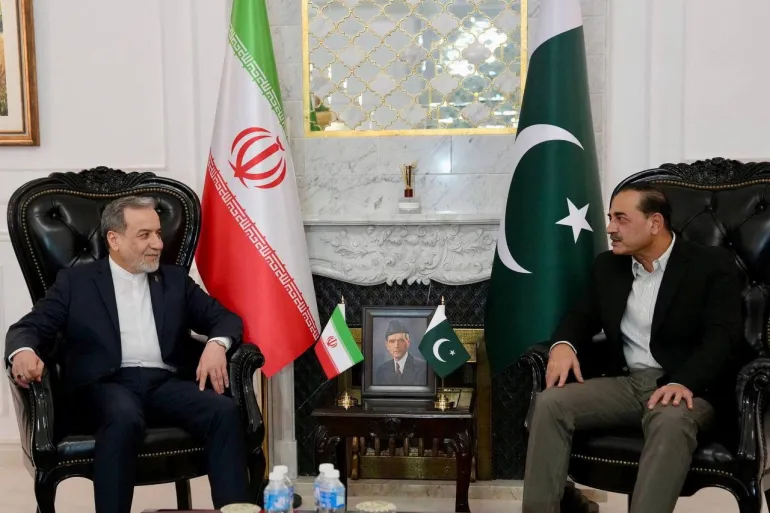
PAKSITAN is scrambling to keep channels of diplomacy open between the United States and Iran, amid escalating rhetoric from both sides, and growing signals from Washington that it is prepared to restart attacks that have been on pause since an April 8 ceasefire in the US-Israel war on Iran.
Pakistan’s Interior Minister Mohsin Naqvi arrived in Tehran on Saturday for a two-day visit, meeting President Masoud Pezeshkian, Interior Minister Eskandar Momeni and Parliament Speaker Mohammad Bagher Ghalibaf as Islamabad scrambled to prevent ceasefire negotiations from collapsing altogether. Ghalibaf has also been Iran’s chief negotiator in peace talks with the US to end the war, which began on February 28.

Yet on Sunday, as Naqvi continued talks with Iranian officials, US President Donald Trump issued a warning on Truth Social: “For Iran, the Clock is Ticking, and they better get moving, FAST, or there won’t be anything left of them. TIME IS OF THE ESSENCE!”

Over the weekend, Trump also met his top national security team, including Vice President JD Vance, Secretary of State Marco Rubio, CIA Director John Ratcliffe, Defence Secretary Pete Hegseth and special envoy Steve Witkoff.


Tehran’s version of events, however, has sharply differed from Washington’s public posture.
At his weekly press conference on Monday, Iranian Foreign Ministry spokesman Esmaeil Baghaei said that despite Trump publicly calling Iran’s response “totally unacceptable” last week, Washington had sent “a set of revised points and considerations” through Pakistani mediators.
Iran had reviewed them and responded through the same channel. “The process is continuing through Pakistan,” Baghaei said. Later, Iran’s state-run Tasnim news agency said that Iran’s submission to Pakistan — to be transmitted to the US included a 14-point proposal.
Yet tensions have continued to mount. Over the weekend, drones struck an electrical generator outside the perimeter of the Barakah Nuclear Energy Plant in the United Arab Emirates. Saudi Arabia separately said it intercepted three drones launched from Iraqi airspace.
Pakistan’s Foreign Ministry on Monday condemned the Barakah strike as “a grave violation of international law” and urged all parties to “exercise maximum restraint”.

The developments underscored how far diplomacy has deteriorated since the ceasefire came into effect 40 days ago.
Both sides have exchanged proposals, rejected each other’s core demands, and increasingly shifted to the language of military escalation, with renewed hostilities now a real possibility, according to analysts.
Following the April 8 ceasefire and the collapse of talks in Islamabad on April 11-12, Washington and Tehran continued exchanging proposals through Pakistani intermediaries.


On April 28, Iran submitted a 14-point counterproposal calling for a permanent end to hostilities within 30 days, a US withdrawal from areas near its borders, the lifting of a US naval blockade, the release of frozen assets, war reparations, and a new mechanism governing the Strait of Hormuz. Nuclear issues were explicitly excluded.
Washington responded early May with its own plan. Its central demands included a 20-year moratorium on uranium enrichment, the transfer abroad of Iran’s stockpile of highly enriched uranium, estimated at roughly 400kg (882 pounds) enriched to 60 percent, and the dismantling of nuclear facilities at Natanz, Isfahan and Fordow.
Confirming receipt of the US proposal at the time, Baghaei stressed that Iran’s own plan focused solely on ending the conflict.