

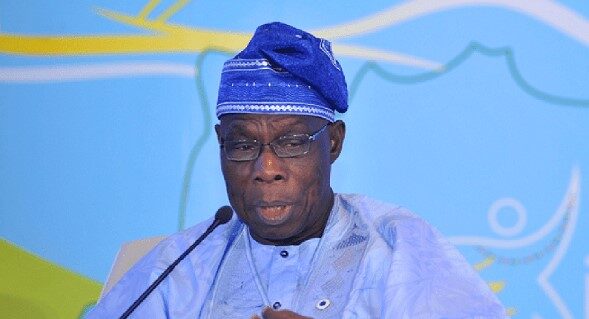
FORMER President Olusegun Obasanjo has dismissed claims by former Ogun State Governor, Olusegun Osoba, that he deceived leaders of the Alliance for Democracy (AD) ahead of the 2003 general election, insisting that he never misled anyone during the political negotiations that preceded the polls.
News Point Nigeria reports that Obasanjo’s response followed allegations by Osoba that the former president deceived AD governors and Afenifere leaders during political engagements before the 2003 elections.

In a letter issued in Abeokuta, the Ogun State capital, on Thursday, titled “Reply to Your Inaccurate Posture: How Obasanjo Deceived Us in 2003,” the former president said Osoba got many facts wrong in his article published in The Legal Observer on July 20, 2026.

“Your presentation in your write-up was far-fetched, to put it mildly,” Obasanjo wrote.


“But before I go further, I take strong and serious objection to your calling me a deceit because I deceived nobody.
“I always presented my case and all issues as I had them and as I understood them, no matter whose ox is gored. There were issues you did not know or understand because, as you pointed out, they were above your head.
“They were handled by your elders in the Alliance for Democracy (AD) party and Afenifere. And there were issues that you governors of the South-West kept away from me which normally should be discussed or raised with me but were raised or discussed somewhere else.
“I would not say that you were diabolical or deceitful. You chose what you would do and you did what you chose. Others could also choose differently.”
Obasanjo recalled that after his release from prison, several prominent Nigerians visited him and urged him to return to public office.

“I paid no attention initially because I had a serious family matter: my children’s schools to attend to,” he said.
He disclosed that the first delegation was led by Lawan Katsina, who visited him at his Ota Farm.
“The first group was led by Lawan Katsina to me on my Ota farm. I received them, thanked them and promised to think about their invitation.”


According to him, the second delegation was led by the late S.M. Afolabi, who served as deputy governor to the late Bola Ige, while the third was led by Martins Kuye, adding that the latter two delegations were Yoruba-led.
Obasanjo explained that he advised the groups that the consultations should be broadened beyond their immediate circles.
“I believed that the two groups included Afenifere and non-Afenifere. You did not know that I had these approaches, contacts or invitations,” he stated.
The former president said the consultations eventually took him across the South-West, South-East and Northern parts of the country.
According to him, the extensive consultations later influenced his interest in party formation and the political role then being played by the late Bola Ige.
“Peoples Democratic Party (PDP) attracted my attention and my interest, and I was being regularly posted.
“After the formation of the parties, I formally joined PDP. I continued my consultation and campaigns at the same time.”
Obasanjo maintained that politics, in his view, should always be about improving the welfare and well-being of the people rather than bitterness or personal animosity.
He added that Osoba’s decision to approach politics differently should never become the basis for hatred or antagonism.
“It is a matter of ideas, policies, competition and choice,” he said.
The former president also explained that his political philosophy had always centred on dialogue, broadening relationships and converting adversaries into friends wherever possible.
He disclosed that shortly after assuming office as president, he appointed South-West PDP governorship candidates who lost the 1999 elections into positions within the Federal Government.
According to him, he subsequently met with the defeated candidates and encouraged them to rebuild political support among the Yoruba people.
Obasanjo described the engagement as one of several initiatives undertaken during his first term to deepen political cooperation across the South-West.
Turning to his relationship with former Vice-President Atiku Abubakar, Obasanjo alleged that Atiku began nursing presidential ambitions immediately after assuming office in 1999.
“From the first day as Vice-President, he raised campaigners for his presidency,” Obasanjo claimed.
“It was all noted, recorded and reported to me by my Chief of Staff, a professional intelligence officer,” he added.
“The game continued to be played on with me treating it with contempt as I have committed no impeachable offence except my Vice-President who wanted to take over by hook or by crook.”
He further recalled that former President Shehu Shagari had approached him on the issue of impeachment.
“It was President Shagari who, on his own volition, asked me about impeachment and I told him that for me, there was absolutely nothing in it. He requested for my permission to handle it and, of course, I gave him the go-ahead.”
Obasanjo challenged Osoba to state what he believed he should have been remorseful about had he occupied the same position.
He also dismissed Osoba’s account of the political realities surrounding his administration, arguing that the former governor underestimated the level of support he enjoyed.
The former president further questioned Osoba’s narration of an alleged meeting held at his Ota Farm with the late Afenifere leader, Chief Ayo Adebanjo, where certain political demands were reportedly presented to him.
“My dear brother Olusegun Osoba, I don’t know what would best describe what you claimed was presented to me on my farm with Egbon Ayo Adebanjo leading: hyperbole, presumption, disregard, takeover or what?” he said.
He argued that it would have been unreasonable for a small delegation to dictate terms to an elected government with an Executive Council, National Assembly, political party and elected governors.
“Six to dictate to thirty is ridiculous,” Obasanjo declared.
“I would not say that you could not say all those things, but I may listen and in politeness not answer back but you should know I would not accept such dictation if you presented it. For you to present such to me was to grossly underrate me.”
Obasanjo further alleged that after failing in an impeachment effort against him, Atiku adopted what he described as a two-track political strategy involving the late former Vice-President Alex Ekwueme and the six Alliance for Democracy governors in the South-West ahead of the 2003 elections.
“When he failed in the impeachment exercise, he made a two-track approach: one to go with Alex Ekwueme and Alex to hand over to him in the third year of his presidency; second is for the six AD Governors of South-West not to have competition from any other party in 2003 so that in 2007, you would all yield the field to my Vice-President,” Obasanjo alleged.
He claimed that the AD governors accepted the arrangement and were wrongly made to believe that he supported the plan.
“You were all convinced of this anti-democratic plan and you all fell for it. I was told that I was said to be selling the idea and if that was said of me, it was a lie,” he stated.
Obasanjo faulted Osoba and other AD leaders for failing to verify the claims directly with him.
“Have no dealing with Obasanjo as President but deal with his Vice-President and you would get the best that was clever political move,” he said.
The former president also recalled Osoba’s earlier political contest against the late Shehu Musa Yar’Adua during the Social Democratic Party (SDP) era, noting that he had been informed of how Yar’Adua almost defeated Osoba in Abeokuta.
Describing Yar’Adua as his protégé, Obasanjo said he was familiar with the political strategies employed by the late military officer and politician.
He maintained that the AD’s defeat in the 2003 elections was genuine across the South-West except in one state.
“Your loss or defeat in 2003 was genuine in all the six States except the one where the figures were successfully and murderously changed as Chief Tinubu, the Head of Service in Lagos State then, accurately reported to me,” he said.
Obasanjo stated that he accepted the election outcome as part of God’s will.
He also claimed intelligence available to him suggested that some AD candidates barely campaigned before the elections.
“From information that reached me from the political field, you barely campaigned and at the tail end of the campaign, you went on TV to apologise to the people for your arrogance and informed them that the starch in your agbada caused your arrogant appearance,” he alleged.
The former president criticised what he described as the ethnic orientation of Afenifere politics, insisting that he had never subscribed to tribal politics.
“Afenifere and its political party never rose beyond tribal cul de sac. There is lesson for all in that. And it would appear that once you were not an AD or Afenifere member, you would be a liar or a deceiver,” he said.
“I have never believed in tribal politics.”
Obasanjo added that he sympathised with some late Afenifere leaders, including Chief Gani Daudu, Chief Abraham Adesanya and Chief Ayo Adebanjo, who, according to him, expressed regrets before their deaths.
He argued that the values cherished by Afenifere’s founding fathers differed from those later embraced by some of their successors.
“What they cherished, taught, believed and practised were not what their proteges accepted, believed and practised,” he said.
The former president also expressed disappointment that Afenifere leaders neither congratulated him after his release from prison nor after he became president.
“Did it mean anything to me? No. I did not even know of it until I was told that they held a meeting of Afenifere to decide such pettiness. How mean!” he remarked.
Obasanjo urged Osoba to reflect on his political journey, stressing that humility and gratitude remain essential irrespective of political office.
“You have lessons to learn: you have many things to understand and you have thanks to give to God and to give men and women,” he said.
He emphasised that political disagreements should never destroy personal relationships.
“In politics, no one should be ignored or disregarded and politics may end, relationships may live till life’s end,” Obasanjo added.
The former president concluded by stating that his decisions while in office were never determined by political party affiliation.
As an example, he cited his administration’s decision to encourage governors across party lines to acquire land and build official lodges in Abuja.
“Party consideration was not involved. You were driven to believe as I believed also that it was necessary to develop Abuja,” he said.