

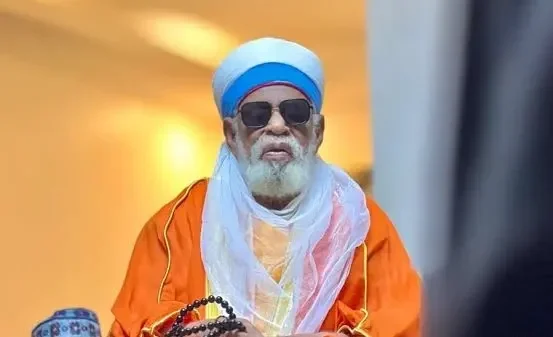
THE Police have filed cybercrime charges against Kano-based Islamic cleric, Sheikh Adam Zubair Adam, popularly known as Baffa Hotoro, over alleged criminal defamation, criminal intimidation and related offences involving prominent Islamic scholars Sheikh Dahiru Usman Bauchi and Sheikh Mannir Adam Koza.
The six-count charge was filed at the Federal High Court in Abuja and signed by prosecuting counsels M.K. Yahaya, R.N. Maigoro and A.I. Aminu of the Directorate of Legal Services, Police Force Headquarters, Abuja.

According to court filings obtained by this newspaper, the charges are offences contrary to Section 24(1)(b) of the Cybercrime (Prohibition, Prevention, Etc.) Act, 2015 as amended in 2024.

The case, marked FHC/ABJ/CR/87/2026 and dated May 10, 2026, has the Inspector-General of Police as complainant and Sheikh Baffa Hotoro as the defendant.


Court documents showed that the cleric, who was earlier arrested and granted bail in February 2026, was scheduled to be arraigned before the Federal High Court in Abuja on Monday, May 11, 2026.
However, the arraignment did not proceed because the defendant failed to appear in court.
This newspaper gathered that evidence before the court indicated the defendant was properly served with the court processes but did not appear and provided no reason for his absence.
Late Sheikh Dahiru Bauchi, who died on November 25, 2025, was one of Nigeria’s most influential Islamic scholars and leader of the Tijjaniyya movement with millions of followers across Nigeria and West Africa.
Sheikh Mannir Koza is also regarded as one of the leading younger voices within the Tijjaniyya movement with a large following nationwide.

On the other hand, Sheikh Baffa Hotoro is known as a Salafi cleric whose sermons and public engagements have often generated controversy, including criticisms directed at Sufi scholars, revered saints and fellow Wahhabi clerics.
According to the court filings, on June 18, 2024, Hotoro allegedly made slanderous and derogatory statements against both scholars, swearing by God that they were polytheists and idolaters who were religiously barred from entering the Ka’aba in Makkah.
In a viral Hausa-language video referenced in the charges, the cleric allegedly declared:


“I swear by Allah, Munir Koza is among the people that Allah disapproved of their visit to the Sacred House of Allah (Mecca). I swear by the mightiness of Allah, I swear by Allah; who owns my breath, Dahiru Usman Bauchi, the head of all-evil, by Allah he is among the people that Allah disapproved of their visit to His sacred house. These are polytheists…”
The police filings further stated that on May 19, 2023, the Department of State Services arrested Hotoro following complaints from the public and the Kano State Government over alleged derogatory comments against Sheikh Dahiru Bauchi.
He was later seen in a video apologising to the late cleric, his family and followers.
However, after the death of Sheikh Dahiru Bauchi in November 2025, Hotoro allegedly released another viral video containing fresh derogatory remarks against the late scholar, comments said to be capable of provoking sectarian violence and threatening national security.
Following petitions by the family of the late cleric and Sheikh Koza, the police arrested Hotoro again in February this year before granting him bail.
In count one, the police accused the cleric of knowingly publishing false videos on his TikTok and Facebook pages on June 18, 2024, with intent to cause annoyance, intimidation, hatred and needless anxiety against Sheikh Mannir Koza.
Count two alleged that on November 27, 2025, he again published false content targeting late Sheikh Dahiru Bauchi.
Counts three and four accused him of insulting both clerics by referring to them as “Mushrik” — meaning a non-believer in the oneness of Allah — with intent capable of causing disturbance among members of the Tijjaniyya movement.
Counts five and six accused him of making false statements harmful to the reputation of Sheikh Koza and late Sheikh Dahiru Bauchi through lectures reproduced into viral videos circulated online.
The case followed petitions dated July 19, 2024, and December 10, 2025, addressed to the Inspector-General of Police by Barrister M.M. Nasir of Compass Chambers on behalf of Sheikh Koza and the family of the late Sheikh Dahiru Bauchi.
The petitioners alleged that Hotoro publicly declared that Allah did not permit the two scholars to visit the Ka’aba and repeatedly described them as polytheists.
According to the petitions, the remarks had the potential to incite anger, provoke unrest and emotionally destabilise millions of followers and students associated with the late scholar.
The complainants further argued that the repeated comments, especially after the death of Sheikh Dahiru Bauchi, demonstrated disregard for constituted authority and a refusal to stop religious provocation.
They also alleged that the suspect made boastful social media posts mocking police authorities even while under investigation.
The petitioners urged the police to expedite action and ensure the suspect is prosecuted in accordance with the law to deter others from exploiting religious sentiments maliciously.
“Our late client and his family members are peaceful, law-abiding citizens who believe firmly in the rule of law. They rely on the Nigeria Police Force to urgently address this matter to prevent escalation, preserve public order, and ensure that the dignity of the late Sheikh is protected,” part of the petition read.
Several Islamic scholars from both Sufi and Wahhabi backgrounds who spoke to this newspaper in Kano, Kaduna, Jigawa, Katsina, Bauchi, Gombe and Jos described the legal action as a major step toward sanitising Islamic preaching in Northern Nigeria.
“This is a landmark case capable of sanitizing the da’awa system, particularly in Northern Nigeria, and also de-escalating sectarian tension,” Ustaz Muhammad Sagir said.
He noted that while clerics have the right to interpret actions according to the Qur’an and Hadith, it is unacceptable to arbitrarily declare fellow Muslims as polytheists.
Another cleric, Malam Yusuf al-Maliky, said the case could strengthen inter-sect relations and discourage reckless utterances from preachers.
Similarly, Sheikh Husain Kasim urged security agencies to act swiftly against clerics who abandon their religious responsibilities for personal attacks, saying it would help preserve public order.
Some legal practitioners also commended the complainants for choosing legal action instead of resorting to violence or mob retaliation.
“It is worthy to commend the complainants for taking legal action instead of resorting to taking the law into their hands. Religion is very sensitive in this part of the country,” Barrister Ibrahim Ahmad Kabir said.
Another lawyer, Garba Mohammed, noted that the court could issue a bench warrant against the defendant if it establishes that he was duly served but deliberately failed to appear.
Attempts by this newspaper to obtain reactions from Sheikh Baffa Hotoro were unsuccessful as of the time of filing this report.
Text and WhatsApp messages sent to the cleric seeking comments on why he failed to appear in court were not replied to.