
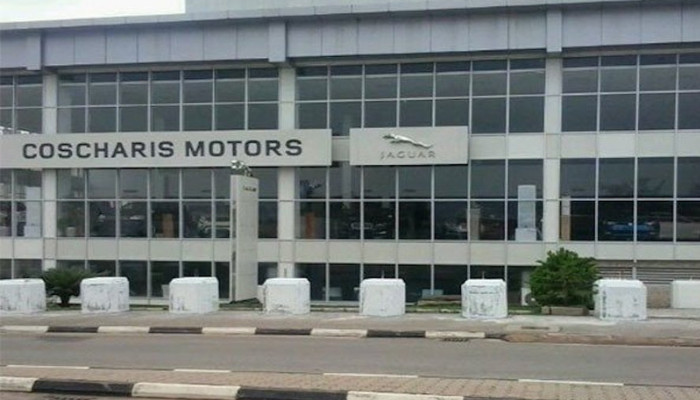
COCHARIS Motors is facing fresh legal trouble after a Federal High Court in Abuja ordered the Federal Competition and Consumer Protection Commission (FCCPC) to shut down the automobile company over a dispute involving the sale of a “defective” Range Rover Sport to a customer, Florence Ozor.
News Point Nigeria reports that the ruling was delivered on Wednesday by Justice Emeka Nwite, who presided over the matter arising from a motion for judicial review filed by Ozor against the FCCPC and Coscharis Motors over the controversial vehicle transaction.

Court documents showed that in September 2024, Ozor purchased a 2024 Range Rover Sport valued at N260 million from Coscharis Motors and began using the luxury vehicle in November 2024.

However, six months after taking delivery of the vehicle, the car reportedly developed repeated faults, including a defective right taillight.
According to an FCCPC notice letter cited in the case, the applicant complained that despite repair attempts by the dealer, the faults persisted.


Following the development, Ozor petitioned the FCCPC, accusing the dealer of supplying a defective vehicle in violation of the Federal Competition and Consumer Protection Act, 2018.
As part of its investigation, the FCCPC wrote to Coscharis Motors on July 16, 2025, requesting a comprehensive report detailing its findings and remedial measures regarding the complaints raised by the customer.
The commission subsequently convened a mediation meeting on August 15, 2025, attended by both the applicant and the car dealer.

According to the FCCPC letter, Coscharis Motors proposed three settlement options during the mediation.
The options included returning the repaired vehicle with an additional one-year warranty, replacing the vehicle with another of the same model while sharing the cost difference among the complainant, dealer and manufacturer, or refunding the purchase price.
The commission stated that Ozor rejected the refund option and insisted that any replacement vehicle must come at no additional cost to her.


“The Commission, having considered the complaint, the positions of both parties, and the applicable provisions of the FCCPA 2018 in particular Sections 130(1)(c), 131(1)(b)-(c), 132, and 136(3), finds that the Respondent supplied defective goods to the Complainant and is liable to provide an appropriate remedy,” the FCCPC stated.
Following its findings, the FCCPC directed Coscharis Motors to provide the complainant with a new 2024 Range Rover Sport at no extra cost under a two-month extended trial period.
The commission further ruled that if similar defects were discovered during the trial period, the dealer would be required to refund the applicant the prevailing market value of a 2024 Range Rover Sport, taking into account any discount granted at the point of purchase.
Alternatively, the FCCPC ruled that the dealer could provide the complainant with a 2025 Range Rover Sport, provided she paid the agreed cost difference between the 2025 model and the amount previously paid for the 2024 model.
The compliance notice, signed by the FCCPC’s Head of Legal Services, Nsitem Chizenum, on September 18, 2025, directed that the settlement terms be complied with within 14 business days.
However, court documents revealed that following the expiration of the compliance period, Coscharis Motors failed to comply with the settlement terms issued by the FCCPC.
Instead, the dealer allegedly approached the commission without the applicant’s knowledge, after which the FCCPC invited Ozor to further meetings where the same settlement options she had already rejected were again proposed.
The disputed vehicle has reportedly remained in the custody of the dealer since the FCCPC investigation commenced.
Dissatisfied with the commission’s inability to enforce its earlier order, Ozor approached the Federal High Court seeking an order compelling the FCCPC to implement the September 2025 settlement directives.
During proceedings, counsel to the FCCPC urged the court to dismiss the suit, arguing that the application was premature and amounted to an abuse of court process.
But in his judgment, Justice Nwite held that the FCCPC failed in its responsibility to enforce its own orders despite the dealer’s refusal to comply.
The judge subsequently granted an order of mandamus compelling the FCCPC to enforce its compliance notice and settlement order issued in September 2025.
“A DECLARATION is hereby made that the Respondent, as a government agency is bound by its orders as much as the parties involved are bound by same and the Respondent’s compliance notice remains in force until set aside by a court or the Respondent issues a compliance certificate affirming compliance pursuant to SECTION 150 (3) FCCPA 2018,” the judge ruled.
Read also: ‘Sirika Ordered Perm Sec To Award Contract To German Friend,’ EFCC Witness Tells Court
“AN ORDER of this court is hereby made mandating the Respondent, the Federal Competition and Consumer Protection Commission by way of mandamus, to enforce/comply with the stipulations of its binding order issued on the 18th of September 2025, and in the furtherance of its statutory powers under the FCCPA 2018 to protect the interest of the consumer.”
Justice Nwite further directed the FCCPC to invoke its statutory powers under Section 150(4) of the FCCPA, including shutting down Coscharis Motors’ premises or imposing administrative sanctions until the company complies fully with the commission’s directives.