

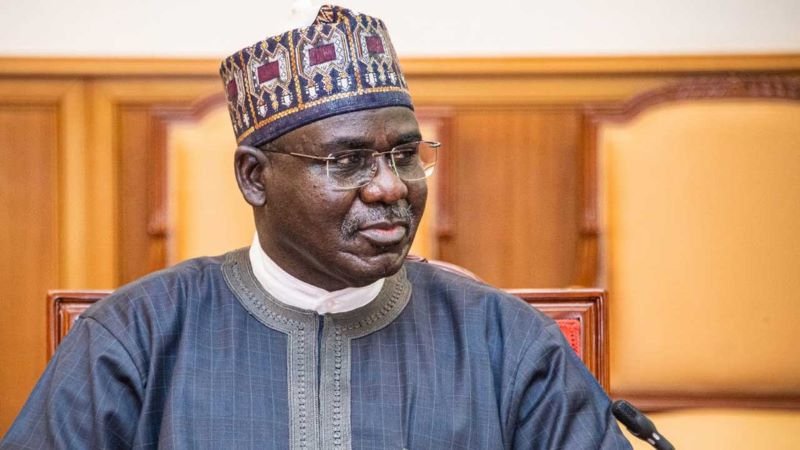
FORMER Chief of Army Staff, Lieutenant General Tukur Buratai (retd.), has raised concerns over the apparent inability of security agencies to locate bandits and kidnappers who openly share videos, make public communications and operate from known hideouts, insisting that authorities possess the capacity to track such criminals.
Buratai, who also served as Nigeria’s Ambassador to the Republic of Benin, suggested that the challenge may not necessarily be one of capability, as security agencies have demonstrated the ability to trace ordinary citizens and social media personalities.
News Point Nigeria recalls that gunmen recently abducted schoolchildren and teachers from three schools in Oriire Local Government Area of Oyo State and later beheaded one of the abducted teachers, sparking fresh concerns about the country’s worsening security situation.


The retired army chief made the remarks during an interview on TVC on Monday while reacting to growing concerns over the increasing use of social media platforms and video recordings by criminal groups operating across the country.
Questioning claims that security agencies are unable to trace such criminals, Buratai said he was unconvinced that authorities lacked the capability to identify and locate bandits who frequently publicise their activities.
“I don’t think they failed to locate. If they can locate ordinary citizens or social media influencers, I don’t believe they can locate these bandits that flaunt their loot or whatever activities they do,” he said.
Although he stopped short of directly accusing security agencies of negligence, Buratai hinted that there may be factors influencing operational decisions in dealing with such criminal elements.
“I would not like to say it is a capacity-building challenge, but I think they may have their reasons,” he stated.
The former army chief, however, stressed that Nigeria’s security architecture still requires significant strengthening through continuous capacity development, increased recruitment and improved welfare for personnel across all security agencies.

According to him, the fight against insecurity cannot be won without expanding the manpower available to security institutions.
“There must be capacity building of all the security agencies, and continuously,” he said. “There is a need for more operatives. We need more troops to be recruited, more operatives and more policemen.”
Buratai also emphasised the importance of regular training and retraining programmes, arguing that security personnel must be equipped with the skills required to respond to evolving threats.


He further maintained that improved welfare packages and decent living conditions are critical to boosting morale and enhancing operational effectiveness.
“They should be trained and retrained. Their welfare is very important. Let us have good accommodation. They must have good accommodation,” he said.
Addressing questions about whether Nigeria possesses specialised units capable of carrying out complex hostage rescue operations, Buratai affirmed that such capabilities already exist within the armed forces.
While declining to provide operational details, he noted that specialised military formations are trained specifically for rescue missions and high-risk security assignments.
“I will not tell you exactly or be specific, but generally we have within the military specialised units trained for such rescue missions,” he said.
According to him, the Nigerian Navy’s Special Boat Service and the Nigerian Army’s Special Forces possess the training and expertise required for hostage rescue operations as well as VIP protection duties.
“The Special Boat Service is trained for such rescue missions. Even the Nigerian Army has Special Forces. They have rescue and VIP protection capabilities,” Buratai explained.
Despite these capabilities, the former army chief acknowledged that decisions regarding rescue operations are often influenced by concerns over the safety of hostages and the potential consequences of military intervention.
He noted that factors such as the location of victims, the nature of the abduction and the possibility of collateral damage often shape operational choices.
“The sensitivity of that type of kidnap, the location and those involved, and the danger of collateral damage may play a very important part,” he added.
Buratai also called for the expansion of the National Counter Terrorism Centre under the Office of the National Security Adviser, arguing that stronger coordination and improved technological capabilities would significantly enhance Nigeria’s fight against terrorism, banditry and kidnapping.
Commending the leadership of the centre, he described its current commander as a highly professional and strategic officer.
“The Office of the National Security Adviser has a Counter Terrorism Centre. I think the commander there is a professional and highly strategic officer,” he said.
The former army chief further proposed the establishment of state-level branches of the Counter Terrorism Centre, equipped with advanced technology, modern operational facilities and real-time situation rooms to improve intelligence gathering and coordination.
“If it can be further expanded to have state branches of the Counter Terrorism Centre with highly technical equipment and very good operations centres or situation rooms, they will be able to do a lot in coordination with the security agencies and the military,” Buratai said.