

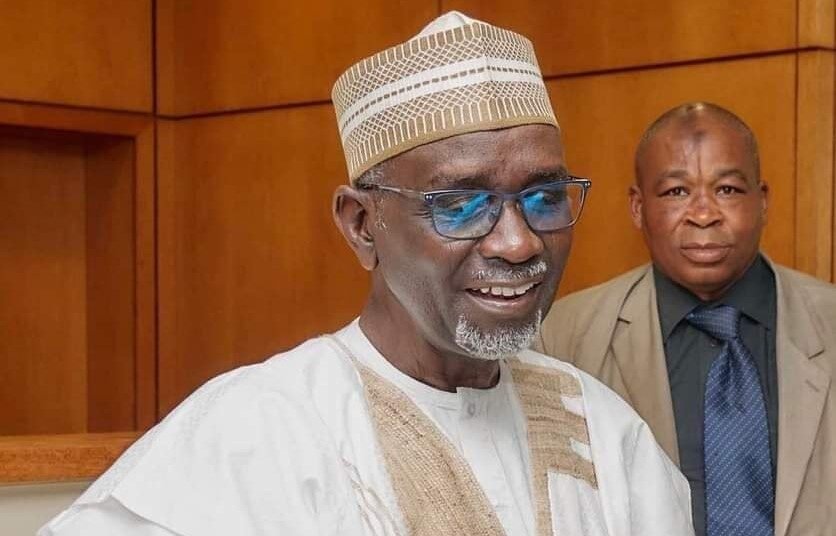
ON the ever-changing chessboard of Kano politics, few moves in recent weeks have carried as much weight and strategic significance as the return of Malam Ibrahim Shekarau, a former governor, former minister, and former senator to the All Progressives Congress (APC).
For hundreds of thousands of politically conscious Kano residents and long-time observers, this development goes far beyond a routine defection. It signals a recalibration of political strength, a reordering of influence, and a defining moment that could shape the trajectory of Kano’s politics as the 2027 elections draw closer.
The groundwork for this pivotal shift had been quietly unfolding behind the scenes. In the weeks leading up to it, Kano State Governor, Abba Kabir Yusuf, intensified efforts to bring Shekarau back into the APC fold, as part of broader political realignments steadily reshaping the state’s political landscape.

In this Sunday political feature, News Point Nigeria examines the shifting political dynamics and evolving terrain of Kano State, where recent developments have once again underscored the fluid and strategic nature of power alignment in the North.


These moves were not made in isolation. Kano’s political equation had already shifted significantly after Governor Yusuf himself exited the New Nigerian Peoples Party (NNPP) for the APC, setting off a chain reaction across party lines.
Soon after, Rabiu Kwankwaso, the national leader of the NNPP, also abandoned the party and moved to the African Democratic Congress (ADC), further deepening the fluidity of alliances.
In the midst of this, Nasir Gawuna, who had contested against Yusuf in the last gubernatorial election left the APC for the ADC, where he was warmly received by Kwankwaso, who personally witnessed his registration. The stage was set for a high-stakes political contest defined by shifting loyalties and strategic recalculations.
But weeks later, upon returning from Abuja, Governor Yusuf wasted no time in sending a strong political message to the ADC camp, warning that they would never win Kano. Behind the scenes, efforts intensified as the governor worked to consolidate his position ahead of 2027. Central to that strategy was Shekarau.
A crucial meeting had took place in Abuja between Yusuf and Shekarau before the governor returned to Kano. Sources close to the former governor described the engagement as part of wider consultations aimed at persuading him to rejoin the APC. The meeting was not merely symbolic; it was strategic. Yusuf was accompanied by the Kano APC Chairman, Umar Haruna Doguwa, underscoring the seriousness of the mission.

The timing was telling. The visit came just days after Shekarau had hinted at leaving the Peoples Democratic Party (PDP), though he made it clear he would not join the ADC. At that moment, he remained a respected elder statesman within the PDP and a figure widely regarded as a potential game-changer in Kano’s political landscape.
For days, uncertainty lingered. Shekarau did not immediately declare his position publicly, but insiders confirmed that consultations were ongoing. Then came a defining moment.
The National Chairman of the APC, Nentawe Yilwatda, personally visited Shekarau at his residence popularly known as Mundubawa Palace in Kano. He was accompanied by Senator Bello Hayatu Gwarzo. The visit was widely interpreted as a ‘presidential mission’ and high-level effort to woo Shekarau back into the ruling party.


In an emotional appeal, Yilwatda addressed Shekarau and his associates with humility and urgency.
“Come and help me, I am your son. I need your support, I need your mentorship. I am pleading with you to come and help me,” he said.
He extended the appeal beyond Shekarau, calling on all present to rally behind the APC in the interest of unity in the North.
“Let us all come back to APC. Your son at the APC is pleading; I cannot do it alone. Together we can build a very strong alliance to help the North,” he added.
In his response, Shekarau acknowledged the significance of the gesture, noting that the personal visit demonstrated respect and seriousness.
“You have come to us; it is something you could have sent someone to do or even meet me in Abuja, but you came yourself,” he said.
He revealed that the visit coincided with ongoing internal reflections within his camp, particularly in light of what he described as deep-seated challenges within the PDP.
“You came at a time we are also searching for a solution to the cancer that have infected us in the PDP, we don’t know whether it is real cancer or not, however we will discuss that later,” he said.
Even then, Shekarau maintained caution, making it clear that no immediate decision would be announced.
“In a couple of days, you will hear from us whether we will join you or not, but I assure you that you will hear from us,” he added.
He emphasized that whatever decision he would take would be guided by a singular principle: the interest of Kano State.
“Whatever we will do will be put on the scale of ‘Kano first’,” he said.
Beyond these immediate political maneuvers lies the deeper story of Shekarau himself, a figure whose relevance has endured across decades.
Speaking during his 70th birthday celebration, Shekarau reaffirmed his lifelong commitment to politics, describing it not merely as a profession but as a form of worship and service to humanity.
“My politics is my religion, and my religion is my politics,” he declared.
“I am not going to check out of politics because participating in the process of producing credible and trustworthy leaders is part of service to humanity, and that is a religious duty in Islam,” he said.
For Shekarau, politics has never been about personal ambition. It has been about nurturing leadership grounded in justice and accountability.
“So long as I have the strength to contribute in any form, I will continue to do so. Politics, for me, is not a career that ends; it is a lifelong responsibility,” he added.
Reflecting on his journey, he expressed no regrets, viewing every outcome—success or setback—as part of divine will.
“Whatever comes my way, I take it as Allah’s decision. Even when I fail to achieve what I desire, I believe it is because Allah has chosen what is best for me. Regret only comes when one fails to appreciate Allah’s wisdom,” he said.
His political journey dates back to the 1980s, when he first contested and won leadership roles within educational and teachers’ unions, experiences that shaped his leadership philosophy.
“I started contesting in 1982, and by 1988, I was National President of the Police Schools in Nigeria… That experience shaped my confidence in leadership and service,” he recalled.
As governor from 2003 to 2011, Shekarau carved out a legacy defined by discipline, faith, and grassroots connection. He remains the first politician in Kano to defeat a sitting governor and rule the state on a two-term tenure consecutively, an achievement he attributes to public trust and personal conviction.
Even today, his voice carries weight. Several times he had called for unity among opposition parties to strengthen democracy while also urging the federal government to prioritise security, poverty alleviation, and hunger.
“I am optimistic and will continue to support any government that works for the peace and welfare of our people, regardless of political differences,” he said.
But perhaps the most enduring aspect of Shekarau’s relevance lies in his unique and widespread followership. Unlike many politicians whose influence is confined to specific blocs, Shekarau commands loyalty across civil servants, business communities, youths, and even vulnerable groups.
Civil servants remember his welfare initiatives kudin gero during Ramadan and kudin rago during Eid al Adha, gestures that built lasting goodwill. Businessmen recall his free trade policies and empowerment schemes like jari kyauta, which created opportunities and economic inclusion. Political associates speak of his generosity, particularly his support for Hajj and Umrah, which fostered deep personal loyalty.
Among the youth, his empowerment programmes left a lasting imprint. While Kwankwaso may command a larger youth base, Shekarau’s appeal is broader, cutting across demographics with a rare balance.
Equally significant is his ability to maintain relationships. In a political environment often marked by fallouts and betrayals, Shekarau has largely avoided major rifts. His allies remain loyal, respectful, and deeply connected to him years after his tenure in office.
Even across party lines, his influence is acknowledged. Members of the ADC and other opposition platforms still regard him as a political mentor, an indication of the respect he commands beyond partisan boundaries.
Today, as thousands of his followers gather at Mundubawa to align with the APC, the implications are unmistakable. This is more than a political event; it is a shift in momentum.
For the APC, securing Shekarau’s return is widely seen as a strategic masterstroke, one that strengthens its foothold in Kano and reshapes the balance of power ahead of 2027. For the ADC and other opposition forces, his departure represents a significant setback, particularly given his stature and network.
Many Kano politicians point to the coordinated efforts involving Governor Yusuf, the APC leadership, and President Bola Tinubu as evidence of a calculated political strategy that has now paid off.
Conversely, the inability of Atiku Abubakar and the ADC to retain Shekarau is widely viewed as a missed opportunity, one that could have altered the political arithmetic in their favour.
Shekarau’s return to the APC is not just about party affiliation. It is about influence, legacy, and the enduring power of trust in politics. In Kano and indeed in Nigeria few figures embody these qualities as profoundly as Malam Ibrahim Shekarau.