

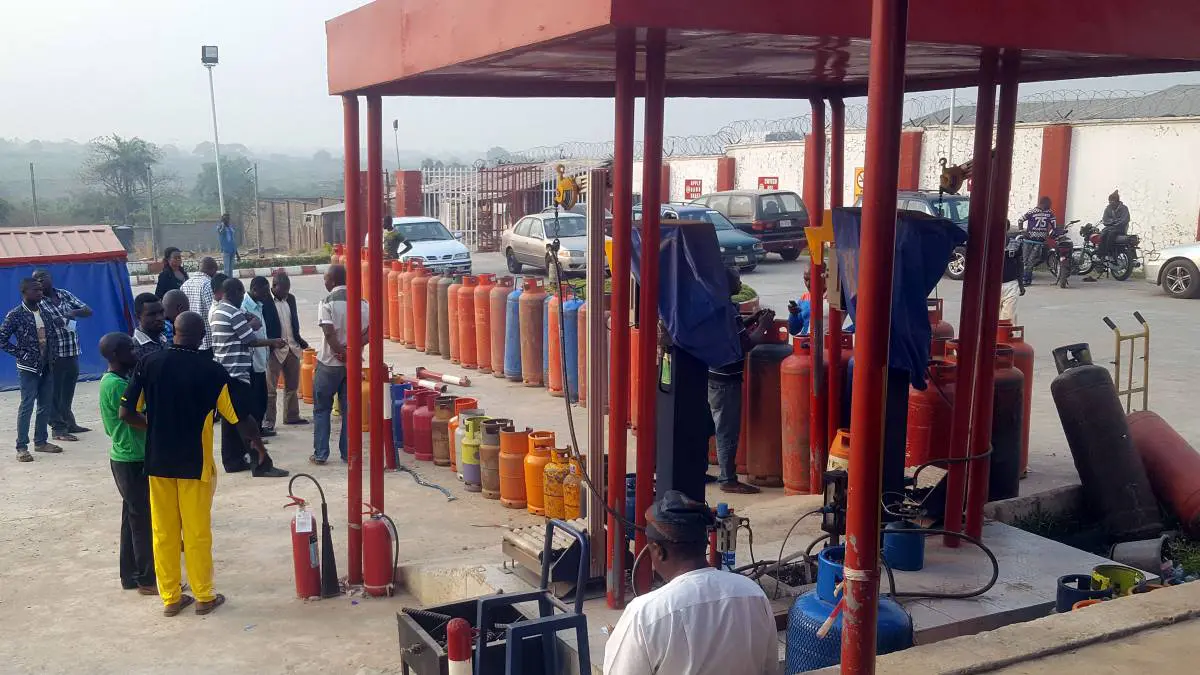
THE price of Liquefied Petroleum Gas (LPG), commonly known as cooking gas, is rapidly inching closer to N2,000 per kilogramme in several parts of Nigeria as Muslims prepare for the 2026 Eid-Al-Kabir celebrations.
News Point Nigeria development comes just as the Federal Government declared Wednesday, May 27, and Thursday, May 28, 2026, as public holidays to mark the Sallah festivities.

A survey conducted by our correspondent showed that cooking gas prices, which recently sold below N1,000 per kilogramme, have now surged to between N1,500 and N1,800 in many locations across the country.


Consumers in the South-West told our correspondent that they currently purchase LPG at prices approaching N1,700 per kilogramme, while residents in Kano, Kaduna, Katsina and Jigawa states said the product now sells between N1,800 and N2,000 per kilogramme.
Reacting to the situation, a consumer identified as Ibrahim Musa lamented the rising hardship confronting ordinary Nigerians.
“One of the only ways the government can assist the masses is through affordable cooking gas, but Nigerian leaders don’t care,” he said.
The latest increase in LPG prices represents the first major hike recorded in 2026 and the second within seven months following the October 2025 dispute involving the Dangote Petroleum Refinery and the Petroleum and Natural Gas Senior Staff Association of Nigeria, which resulted in the shutdown of oil and gas assets across the country.
Amid the growing concerns, the Nigerian Association of Liquefied Petroleum Gas Marketers has raised the alarm over what it described as erratic supply and rising costs of LPG, warning that the situation could trigger scarcity and worsen economic hardship for millions of Nigerians.
The association disclosed on Sunday that cooking gas is now selling above N1,500 per kilogramme, while marketers currently pay between N25.2 million and N26.2 million for 20 metric tonnes of the product, depending on the location.

In a statement jointly signed by the National President of NALPGAM, Edu Inyang, and the Executive Secretary, Bassey Essien, the association described the development as “sad and rather very pathetic”.
“The citizens of Nigeria have woken up to buy cooking gas, which should be a social item, at a prohibitive cost of over N1,500 per kg, while the marketers are made to pay as much as N25,200,000 or, depending on the location, N26,200,000 for 20 metric tonnes of cooking gas,” the statement read.
“We feel that if the situation is not immediately checked, the citizens may rise against the owners of gas filling stations,” the marketers warned.

According to the association, the rising cost of LPG has already brought untold hardship to millions of households, small businesses, food vendors and low-income families who depend on cooking gas for daily survival and commercial activities.
NALPGAM further stated that the current crisis threatens years of progress achieved through Federal Government policies and investments targeted at deepening LPG penetration and encouraging clean cooking energy across Nigeria.
“While millions of Nigerians have embraced cooking gas as a result of the national clean energy transition agenda, it is sad to state that those gains are at risk as households are struggling to refill cylinders, small businesses are folding under rising energy costs, while many families are reverting to firewood and charcoal despite the serious implications for public health, environmental degradation, and deforestation,” the association stated.
The marketers also warned that failure to urgently address the situation could result in “accelerated food inflation, the collapse of small-scale LPG retail businesses, job losses, reduced investor confidence, and a significant setback to Nigeria’s clean energy and climate commitments”.
Apart from the high prices, some residents also expressed concern that cooking gas is gradually becoming scarce in several neighbourhood retail outlets and local shops.
They called on the Federal Government to urgently intervene and stabilise supply and prices, especially as millions of Nigerians remain at home during the Eid-El-Kabir holiday period.