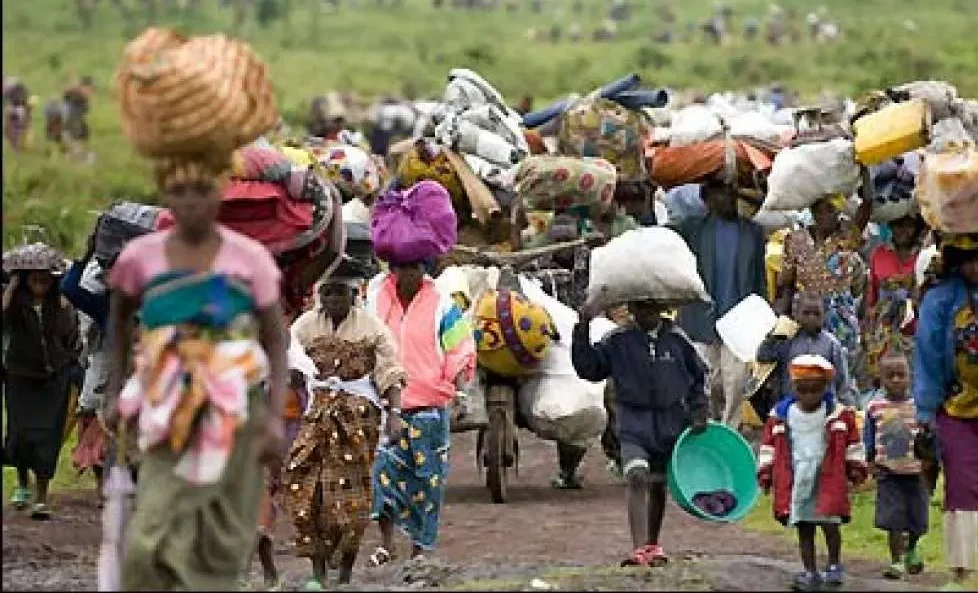
NIGERIA recorded no fewer than 3,381,228 internally displaced persons (IDPs) across 14 states in 2023, with Borno and Benue states accounting for the largest share, according to the latest Demographic Bulletin released by the National Bureau of Statistics (NBS).



The report, unveiled in Abuja, paints a broad picture of displacement, population distribution, health indicators, and migration trends, offering critical data to guide policy formulation and national planning.

Read also: 2027: Ogun Indigenes Celebrate PDP Deputy Guber Candidate In Kano, Pledge Support For Adebutu



News Point Nigeria reports that according to the bulletin, Borno State alone accounted for 1,711,481 displaced persons, representing 50.62 per cent of the total IDP population in the country. Benue followed with 394,567 persons (11.67 per cent), while Katsina recorded 244,380 individuals, accounting for 7.23 per cent.


At the lower end of the displacement scale, Gombe, Nasarawa, and Kano states recorded the least number of IDPs, with 52,383; 20,580; and 15,549 persons respectively.


Beyond displacement, the NBS report also provided updated population estimates, revealing that Nigeria’s total population stood at 221,250,127 in 2023, based on projections from the National Population Commission (NPC). This figure comprises 112,434,239 males and 108,815,888 females.
At the state level, Kano retained its position as the most populous state in the country, with an estimated population of 15,671,491 people. Lagos followed with 13,710,862 residents, while Katsina ranked third with 10,661,373.


Conversely, Nasarawa and Bayelsa were identified as the least populous states, with populations of 2,948,849 and 2,583,352 respectively.
Read also: Lagos Man Escapes Death As Moving Train Smashes Car At PWD Railway Line

The bulletin further examined reproductive health trends, showing that maternal conditions accounted for the largest share of health expenditure in 2022. Specifically, maternal health represented 50.22 per cent of capital spending and 52.46 per cent of recurrent spending.
Drawing from findings of the Multiple Indicator Cluster Survey (MICS) 2021, the report noted an improvement in access to antenatal care over the years. The proportion of women who received antenatal care from skilled providers rose from 50 per cent in 2011 to 67 per cent in 2018, before declining slightly to 63 per cent in 2021.
On family planning, Anambra State recorded the lowest proportion of women with unmet needs for birth spacing at 3.8 per cent, indicating relatively better access to reproductive health services compared to other states.


In terms of financial flows, the report highlighted remittance patterns, citing data from the Central Bank of Nigeria (CBN). It showed that the United Kingdom remained the largest source of inward remittances to Nigeria in 2023, contributing $12.38 billion, slightly lower than the $12.76 billion recorded in 2022.
Meanwhile, the United States accounted for the highest outward remittance flow, with $13.12 million recorded in 2022.
The bulletin also drew attention to human trafficking trends, reporting a total of 968 cases in 2023, spanning both domestic and international incidents.

Read also: BUK, MAAUN Shortlisted For Nigerian Universities Ranking, Boosting Kano’s Academic Profile
Of these, foreign travel linked to prostitution accounted for the highest number of cases, with 173 recorded, underscoring persistent challenges in combating trafficking networks.
The NBS noted that the Demographic Bulletin serves as a comprehensive compilation of data drawn from administrative records and surveys, aimed at supporting evidence-based decision-making, policy development, and academic research.