

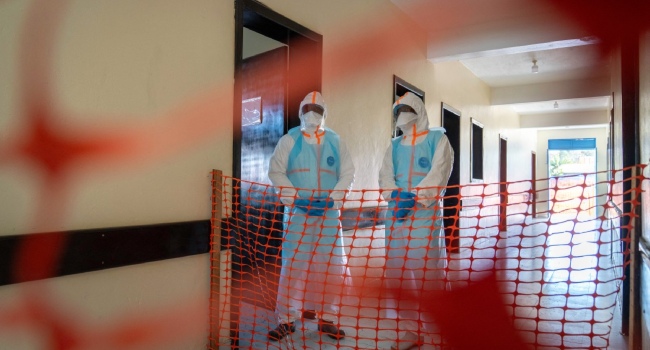
THE Federal Government said it has tightened health screening and surveillance at land borders, airports, and seaports nationwide following the outbreak of the Bundibugyo strain of Ebola virus disease.
News Point Nigeria reports that the development comes as the World Health Organization (WHO) Tuesday, scaled back the number of suspected Ebola cases in central Africa to 116, down from more than 900 previously, with 330 cases now confirmed.
In a statement issued on Tuesday, signed by the Assistant Director of Press and Public Relations, Ado Bako, the Federal Ministry of Health and Social Welfare noted that although there was currently no confirmed Ebola case in Nigeria, it stressed that heightened preparedness measures had been activated nationwide to safeguard public health.


World Health Organization (WHO) Director-General Tedros Adhanom Ghebreyesus visits the Ebola treatment center to witness the discharge of recovered patients in Bunia, in the northeastern Democratic Republic of the Congo, on May 31, 2026.
It warned that travellers identified as high-risk or displaying symptoms associated with Ebola and other viral haemorrhagic fevers will be subjected to secondary screening, isolation, and referral procedures.
“The ministry wishes to reassure Nigerians that there is presently no confirmed case of Ebola Virus Disease in Nigeria.
“However, in line with the Federal Government’s commitment to strengthening national health security and preventing cross-border disease transmission, heightened preparedness measures have been activated nationwide,” the ministry stated.
It said enhanced border surveillance remained a critical component of the government’s response, with health officials directed to strengthen screening and risk assessment procedures for all incoming travellers.
Among the measures announced were mandatory temperature checks using infrared thermal scanners and handheld thermometers, health declaration forms, travel history assessments, and intensified risk profiling at designated points of entry.

The ministry said authorities had activated “enhanced traveller risk assessment and screening procedures at designated points of entry” and put in place “secondary screening, isolation, and referral mechanisms for travellers presenting symptoms consistent with viral haemorrhagic fevers.”
Cousin Kasumbo, president of the U Report Goma community, dressed in protective equipment, raises awareness among traders alongside young members of the “U Report Goma” group who continue awareness activities at Alanine market using megaphones and focus group discussions as part of Ebola prevention and awareness measures in Goma, on May 29, 2026.
The development signals a return to heightened vigilance at Nigeria’s borders, reminiscent of measures adopted during previous public health emergencies, including the 2014 Ebola outbreak and the COVID-19 pandemic.


To strengthen disease detection beyond the nation’s borders, the ministry said surveillance systems had been reinforced across the country through enhanced Integrated Disease Surveillance and Response activities, community-based surveillance networks, and active monitoring of public health alerts.
According to the statement, “Enhanced Integrated Disease Surveillance and Response activities nationwide” and “strengthened event-based and community-based surveillance systems” are currently ongoing to ensure early detection of any suspected case.
The government also disclosed that Public Health Emergency Operations Centres had been activated, while Rapid Response Teams at national and sub-national levels had been placed on standby.
As part of efforts to prepare the healthcare system for a potential outbreak, hospitals and clinics were directed to strengthen infection prevention and control measures, improve triage systems, and ensure prompt reporting of suspected cases.
“Healthcare facilities nationwide have also been advised to maintain a high index of suspicion for viral haemorrhagic fevers, strengthen triage systems, promptly isolate suspected cases, and adhere strictly to established reporting protocols,” the ministry said.