

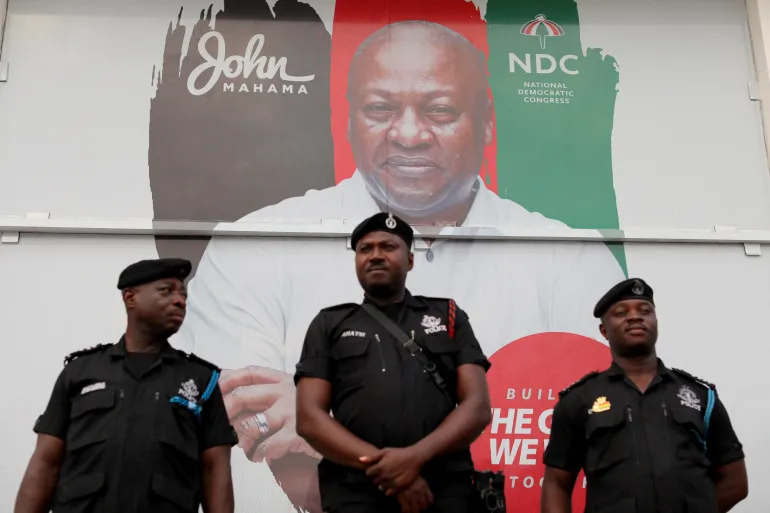
GHANA has recorded 14 arrests linked to false news and offensive speech in less than 16 months, nearly double the number documented during the previous administration’s entire eight-year tenure, according to the Media Foundation for West Africa (MFWA).
The rise has triggered a sharp debate in one of West Africa’s most stable democracies over whether authorities are simply enforcing long-standing laws in a new digital environment, or edging into a more restrictive approach to public speech.
The controversy carries added political weight because President John Mahama, while in opposition in 2022, warned that using state power to intimidate dissent was a “dangerous blueprint” for democracy.


A senior ruling party official dismissed allegations that the arrests amount to a crackdown.
“The opposition intentionally sponsors people to insult the President,” he told Al Jazeera. “When the law catches up with them, they cry persecution to score cheap political points.”
He pointed to the case of TikToker Prince Ofori, known as “Fante Comedy”, who was arrested last August over alleged threats to President Mahama.
Days after his arrest, Ofori appeared at a political rally alongside opposition figures, a development the official said showed how quickly such cases become politicised.
“They paraded him at an opposition rally,” he said.
Minority leader Alexander Afenyo-Markin has been among the most outspoken critics.

“The state-sponsored persecution must stop,” he told Al Jazeera. “Arresting citizens for words that do not constitute genuine threats is not justice. It is intimidation.”
He said free speech has limits, but argued that the state is increasingly crossing a line.
“Excessive use of state power risks undoing Ghana’s hard-won democratic gains,” he said.

At the centre of the debate are long-standing provisions in Ghana’s Criminal Code and Electronic Communications Act, which authorities say are now being applied to a fast-moving digital landscape.
Government supporters argue the increase in arrests reflects the explosion of anonymous and unregulated online content.
Critics say the problem is not the laws themselves, but how they are being used.
A legal consultant who reviewed recent cases said he counted at least 16 alleged misapplications of Section 208 in the past 18 months, compared with roughly a dozen in the previous eight years.
“The law has been abused beyond repair,” he said. “Repeal is the only remedy.”
Veteran journalist Ben Ephson said Ghana needs clearer guidance on where free expression ends and harm begins.
“The government must properly explain the arrests so people can draw the line between press freedom and responsible journalism,” he said.
He added that both journalists and state institutions risk overstepping if the rules remain unclear.
“When you compare the freedom of the media and the rights of the individual, we need to be careful that the media, in trying to do their work, don’t trample on people’s rights,” he said.
Others say Ghana’s debate mirrors tensions playing out in other democracies.
Tegha King of the Universal Peace Federation Ghana said concerns about shrinking civic space are not unique to Ghana.