

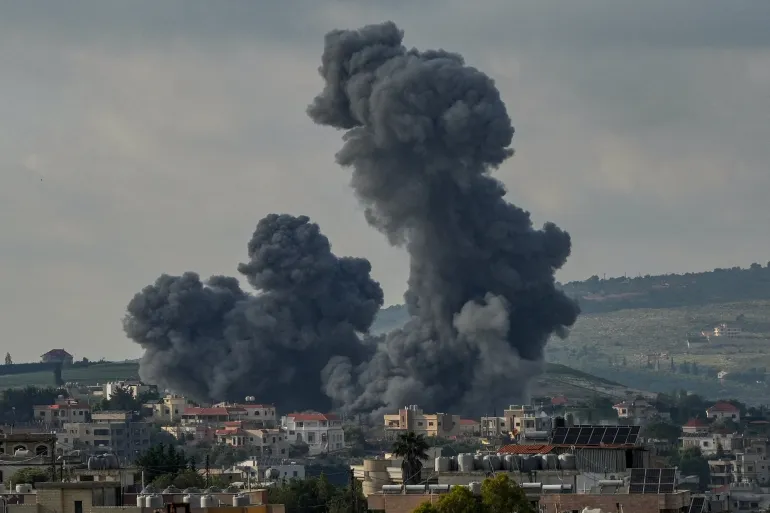
HIGH-RANKING Lebanese army officers are among at least 12 people killed in Israeli attacks across southern Lebanon, days after the countries agreed to a conditional ceasefire during United States-mediated talks.
Lebanon’s army said a brigadier general, a captain and a soldier, died in an Israeli strike on a military vehicle on the Khardali-Nabatieh road.

The Israeli army said Saturday’s attack was in an “active combat zone”, and that “movement in a combat zone requires coordination” with the Israeli army. It added that “the incident remains under investigation”.


The Lebanese army said that “the continuation of the deliberate and repeated brutal Israeli aggression … is aimed at thwarting all efforts to reach a solution”.
Lebanon’s President Joseph Aoun condemned the attack as a “flagrant violation of Lebanese sovereignty and of international laws and norms”.
Lebanese Prime Minister Nawaf Salam described it as “a heinous crime and an attack on Lebanon and all Lebanese people”.
In a statement, Salam extended his condolences to the families and colleagues of Brigadier General Wassam Sabra, Captain Elie Khoury and soldier Hussein Ghozal, as well as to the Lebanese army itself.
Later on Saturday, Lebanon’s army said that its commander General Rudolf Haykal was heading to Pakistan for talks with his Pakistani counterpart, Field Marshal Asim Munir.
Haykal’s visit comes as Pakistan continues efforts to mediate talks to end the US-Israel war on Iran, with Israeli attacks on Lebanon one of the sticking points.

The Lebanese armed group Hezbollah said Saturday’s attack was a “heinous crime” and accused the Lebanese government of exposing its country to bloodshed through the “complete surrender to the enemy’s demands in Washington”.
Iran’s Foreign Ministry spokesperson Esmaeil Baghaei said that the killings reaffirms that Israel “is laying claim to Lebanon in all its components”.
In a post on social media, Baghaei described the attack as “a heinous crime against Lebanon, its army, and its sovereignty, and a clear message of aggression stating that Israel desires no security, stability, or prosperity for Lebanon.”


Regional countries also denounced the attack. In a statement on social media, Saudi Arabia condemned the attack and “the continuing Israeli aggression against the sisterly Lebanese Republic, affirming its total rejection of any targeting of Lebanon’s sovereignty and its army”.
Jordan said it was “a flagrant violation of the sovereignty, security, and stability of brotherly Lebanon, and a blatant breach of international law”. Its foreign ministry “affirmed the necessity of an immediate halt to Israeli aggressions against Lebanon [and] the consolidation of the ceasefire agreement”.
Qatar said it was a “dangerous escalation and a blatant violation of the sovereignty” of Lebanon. The foreign ministry called on the international community to compel “the Israeli occupation authorities to cease their repeated attacks on Lebanon, to respect international conventions and laws, and to fully implement UN Security Council Resolution 1701”.