

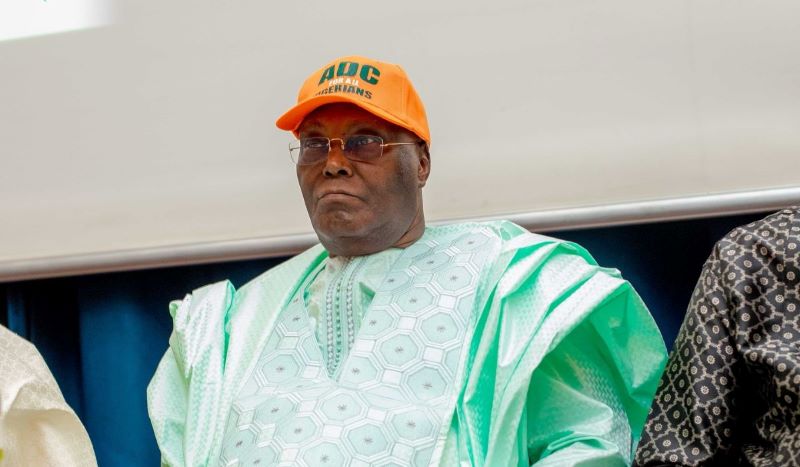
FORMER Vice President Atiku Abubakar has said the presidential candidate of the African Democratic Congress (ADC) for the 2027 elections will emerge through a consensus arrangement, as he reaffirmed that the next election cycle will mark the final chapter of his political career.
Speaking during an interview on ARISE TV on Wednesday monitored by News Point Nigeria, the ADC chieftain explained that consensus remains the preferred pathway for selecting the party’s flagbearer, although primary elections remain an alternative if consensus fails.
“The first option will be to work out a consensus. If that doesn’t work out, then we will go for primary elections. But I will support anybody who emerges,” he said.

Atiku also signalled his readiness to step aside if another candidate is chosen through either consensus or a democratic process within the coalition. “I will step aside for any winner,” he stated, adding when asked about Peter Obi, “Of course, if he is a contender, why not?”


On his personal ambition, the former vice president was unequivocal that 2027 would be his last attempt at the presidency. “Certainly yes, the stakes are higher because I believe that will be my last outing,” he said, before reinforcing the finality of the decision with the words: “That’s incontrovertible.”
A dominant figure in Nigeria’s political landscape for decades, Atiku acknowledged that persuading Nigerians to support his candidacy once again remains a key challenge. Responding to criticisms that he represents the past rather than the future, he argued that his experience bridges both eras. “I represent both the past and the future,” he said.
He further noted that while younger leaders have had opportunities to govern, their performance has not fully met public expectations. “We have seen various levels of leadership in the country, both young and old, and we’re experiencing them. And I still believe that our expectations of the young leadership are below what we thought,” he added.
Drawing from his experience as vice president under Olusegun Obasanjo between 1999 and 2007, Atiku stressed the value of mentorship and exposure in governance.
“What I was able to learn from President Obasanjo through his experience, I couldn’t have learned it outside,” he said, insisting that “young men also require experience to be able to succeed.”

During the interview, Atiku also criticised the administration of President Bola Tinubu, describing its performance as disappointing. “Bola has been a very bad President, to be honest with you. In the way he governs the country, whether economically or otherwise, it’s a disappointment,” he said.
He warned against what he described as a dangerous concentration of power within the presidency. “We have seen how, virtually, you know, the presidency has almost turned the various institutions that are supposed to be checks and balances, under one roof, which is quite dangerous,” he added.
The Waziri Adamawa also revealed that he is a central figure in efforts to build a broad-based political coalition ahead of the 2027 elections, arguing that alliances are crucial for electoral success in Nigeria. “I am one of the initiators of this coalition, or perhaps the leading initiator of the coalition,” he said.


Explaining his position, Atiku said his approach is rooted in historical political trends. “I studied the political history of Nigeria; the only future is a broad coalition,” he noted, adding that the emerging alliance cuts across major political blocs, including elements from APC, PDP, NNPP, and Labour Party.
He reaffirmed confidence in his traditional support base in Northern Nigeria, declaring, “The North still remains my major political base.”
On constitutional reform, Atiku advocated formalising zoning arrangements in the constitution to ensure fairness in power rotation. “Even if it is the only amendment I can make, I will move towards that,” he said.
Despite his continued ambition, the former vice president emphasised that the future of Nigeria’s leadership ultimately rests with a new generation. “That’s left to the next generation to take it on,” he noted.