

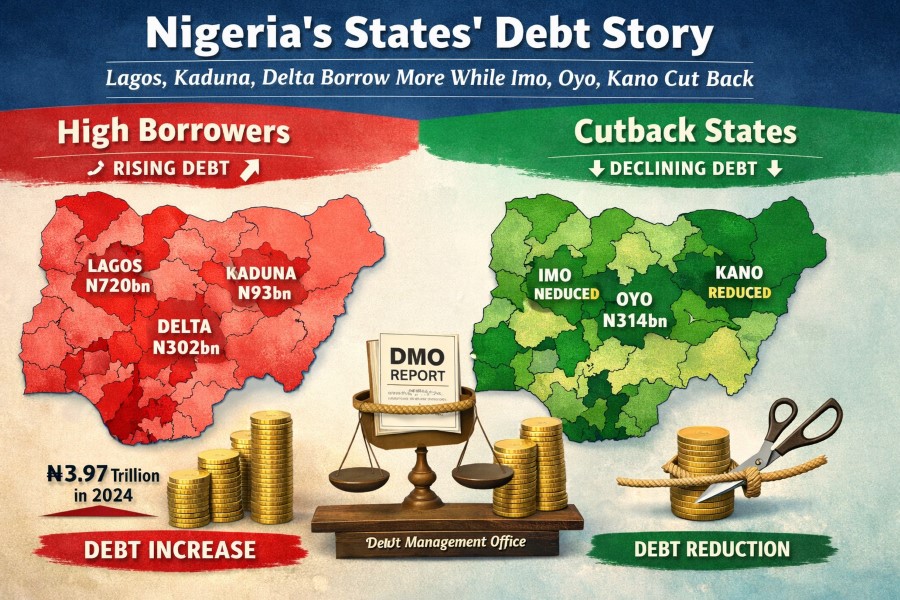
NIGERIA’s deepening subnational debt crisis came into sharp focus in recent days, as rising borrowings, uneven fiscal discipline, and mounting economic pressures continue to reshape the financial outlook of the country’s 36 states and the Federal Capital Territory (FCT).
Fresh data released by the Debt Management Office (DMO) shows that the domestic debt stock of Nigeria’s states and the FCT increased by a significant N392.41 billion between December 2024 and December 2025, highlighting a steady upward trajectory in subnational borrowing despite ongoing economic challenges and repeated calls for fiscal prudence.

A detailed analysis by News Point Nigeria reveals that total subnational domestic debt rose from N3.97 trillion in December 2024 to N4.36 trillion in December 2025, representing a 9.89 per cent increase within a single year, underscoring the persistent reliance of many states on borrowing to finance their obligations.

Interestingly, the data paints a mixed picture. While the overall debt burden increased, a majority of states, 22 in total recorded reductions in their domestic debt profiles during the period under review. However, 14 states alongside the FCT moved in the opposite direction, expanding their debt portfolios and driving the aggregate increase.


In what could be described as a year of contrasting fiscal outcomes, several states posted notable reductions in their debt levels. Imo State led the pack, slashing its domestic debt by N42.40 billion. It was followed by Akwa Ibom, which reduced its debt by N37.35 billion, and Bayelsa with a decline of N31.34 billion.
Other states that recorded significant reductions include Plateau (N26.59 billion), Gombe (N22.04 billion), Edo (N21.82 billion), Abia (N17.67 billion), and Anambra (N17.13 billion). Benue reduced its debt by N15.34 billion, while Adamawa followed with N14.21 billion. Kogi cut N13.63 billion, and Oyo reduced its debt by N12.49 billion.
Further down the list, Katsina recorded a reduction of N11.57 billion, Ekiti N9.59 billion, Sokoto N8.02 billion, and Kano N6.90 billion. Ebonyi reduced its debt by N4.63 billion, Ondo by N4.46 billion, Osun by N3.99 billion, and Zamfara by N2 billion. Kebbi and Nasarawa posted more modest reductions of N509.07 million and N189.29 million respectively.
On the other side of the spectrum, 14 states and the FCT recorded increases in their domestic debt, contributing significantly to the overall rise. Lagos State stood out prominently, adding a staggering N319.27 billion to its debt stock by far the highest increase recorded within the period.
The FCT followed with an increase of N125.31 billion, while Kaduna recorded a rise of N58.88 billion. Delta added N49.26 billion, Yobe N38.94 billion, and Enugu N38.32 billion. Cross River’s debt rose by N19.22 billion, Ogun by N15.61 billion, and Borno by N14.73 billion.

Rivers recorded an increase of N14.41 billion, Bauchi N12.10 billion, Taraba N4.12 billion, Kwara N3.91 billion, Niger N1.93 billion, and Jigawa N270.77 million, further reflecting the widespread nature of the borrowing trend across the federation.
In percentage terms, the escalation appears even more striking. Kaduna recorded the steepest increase, with its domestic debt surging by 228.53 per cent. The FCT followed with a 197.15 per cent rise, while Yobe posted a 92.60 per cent increase. Borno’s debt grew by 52.75 per cent, Lagos by 35.47 per cent, and Enugu by 32.12 per cent.
The subnational debt trend aligns with broader national debt dynamics. On April 15, the DMO disclosed that Nigeria’s total public debt rose to N159 trillion in 2025. Of this figure, domestic debt accounted for N84.84 trillion (approximately $59.11 billion), while external debt stood at N74.42 trillion (about $51.85 billion).


Earlier data also highlighted the scale of subnational indebtedness. Two months ago, News Point Nigeria reported that Nigeria’s states and the FCT recorded a combined debt of N4.002 trillion as of September 30, 2025. This represented 2.61 per cent of the country’s total public debt, which stood at N153.29 trillion at the time.
The distribution of this debt reveals a concentration among a few states. Ten states accounted for 67 per cent of the total subnational debt, amounting to N2.68 trillion. Lagos emerged as the most indebted state, with a debt stock of N1.045 trillion, representing about 26 per cent of the total.
Rivers followed distantly with N381.205 billion, while Delta recorded N247.171 billion. Enugu ranked fourth with N194.715 billion, followed by Ogun at N168.093 billion and Bauchi at N158.197 billion. Niger’s debt stood at N143.469 billion, while Cross River and Benue recorded N141.941 billion and N107.254 billion respectively. Akwa Ibom rounded off the top ten with N95.506 billion.
These figures underscore mounting fiscal pressures at the subnational level, even as the Federal Government continues to shoulder the bulk of Nigeria’s overall public debt burden.
According to a different document obtained by News Point Nigeria subnational the borrowing is often driven by budget deficits arising from infrastructure gaps and declining oil revenues. However, concerns persist that such borrowing, if not carefully managed, could constrain economic growth and undermine fiscal sustainability.
The concentration of debt in economically strategic or oil-rich states such as Lagos also reflects deeper structural issues within Nigeria’s fiscal federalism framework. Experts have increasingly called for greater revenue autonomy for states, alongside stricter borrowing limits to ensure long-term stability.
Rising debt levels are also pushing up debt servicing costs, thereby crowding out spending on critical sectors such as health and education, especially in the context of naira depreciation and high interest rates.
The DMO has repeatedly emphasised the need for prudent debt management, warning that unchecked subnational borrowing could amplify national fiscal risks, particularly amid global economic uncertainties.
Reform efforts, including improving internally generated revenue (IGR) and enhancing federal transfers, are seen as potential pathways to easing fiscal pressures.
However, the current debt profiles of many states suggest that more targeted and disciplined approaches are required.
Adding a strong layer of critique to the unfolding situation, speaking to News Point Nigeria, financial analyst, Professor Mathew Gambo of Jos University has condemned what he described as a troubling pattern of fiscal irresponsibility among several state governments.
According to Gambo, it is increasingly difficult to justify rising debt levels when states continue to receive substantial allocations from the Federation Account. He argued that the situation raises serious concerns about transparency, accountability, and the effective use of public resources.
He pointed specifically to states such as Kwara, Niger, and Jigawa, noting that their relatively modest wage bills do not justify the scale of borrowing observed. More concerning, he said, is the apparent lack of visible capital projects or infrastructure development in these states over the past three years.
In his view, borrowing should be tied to tangible developmental outcomes that directly improve citizens’ quality of life, rather than being used to sustain opaque recurrent expenditures.
Gambo warned that the continued accumulation of debt without corresponding assets or economic growth could push many states toward fiscal distress in the near future.
He described the situation as a “dangerous cycle,” where states rely heavily on borrowing while failing to expand their revenue base or invest in productive sectors capable of driving long-term growth.
Such a pattern, he cautioned, undermines fiscal sustainability and places an increasing burden on future administrations.
The Plateau-based analyst called for stricter oversight by federal authorities and greater public scrutiny of state finances, insisting that citizens must demand accountability in the management of public funds.
Without urgent reforms, he warned, the current trajectory could erode public trust and deepen economic challenges across Nigeria’s subnational landscape.
As Nigeria navigates a complex economic environment, the interplay between rising debt, fiscal discipline, and development outcomes will remain a defining issue one that continues to test the resilience and accountability of governance at all levels.