

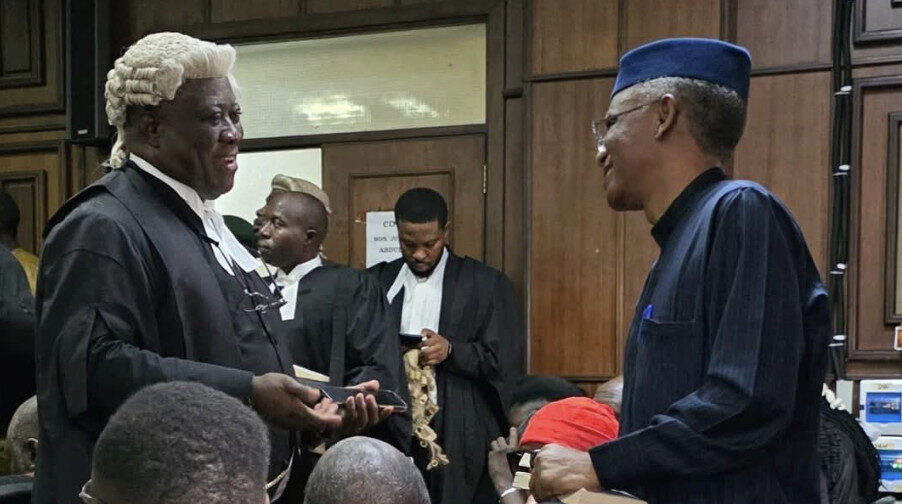
THE Department of State Services (DSS) has arraigned the immediate past governor of Kaduna State, Malam Nasir El-Rufai, before Justice Joyce Abdulmalik of the Federal High Court in Abuja over allegations of unlawfully intercepting communications.
News Point Nigeria reports that El-Rufai was brought before the court over his alleged involvement in the wiretapping of the telephone lines of the National Security Adviser (NSA), Mallam Nuhu Ribadu.

The charges stem from a suit earlier filed in February by the secret police, marked FHC/ABJ/CR/99/2026, accusing the former governor of violating provisions of the Cybercrimes (Prohibition) Act, 2024, and the Nigerian Communications Act, 2003.

At the commencement of proceedings, counsel to the DSS, Oluwole Aladedoye (SAN), informed the court that the matter was scheduled for the defendant to take his plea. He, however, disclosed that a further amended five-count charge had been filed on April 13 and sought the court’s permission to substitute it for the earlier three-count charge.


Responding, defence counsel, Oluwole Iyamu (SAN), confirmed receipt of the amended charge and stated that he had no objection to its adoption. Consequently, the court struck out the earlier three-count charge.
Upon the reading of the new charges, El-Rufai pleaded not guilty, prompting the prosecution to request three consecutive dates for the commencement of trial.
However, Iyamu opposed the request, arguing that his client was currently in the custody of the Independent Corrupt Practices and Other Related Offences Commission (ICPC), which could make access to him within the proposed three-day trial window difficult. He maintained that such an arrangement would not be in the best interest of the defence.
The defence also drew the court’s attention to a bail application filed on February 17. However, the further affidavit in support of the application was initially missing from the court’s file, leading the judge to stand down the matter to allow the defence rectify the issue.
When proceedings resumed, the missing document was located, and the DSS informed the court that it was not opposing the bail application.

The prosecution subsequently filed an application seeking an order to conceal the identities of two witnesses expected to testify during the trial.
Specifically, the DSS requested that the identities of the witnesses should not appear in public court records and that pseudonyms be used throughout the proceedings.
The prosecution argued that the families of the witnesses could be exposed to potential attacks from individuals sympathetic to El-Rufai if their identities were disclosed.


The defence, however, strongly opposed the application through a written address, an affidavit, and a further affidavit, urging the court to dismiss the request.
According to the defence, it is a constitutional right of an accused person to know the identity of his accusers.
They further contended that there was no evidence before the court suggesting that El-Rufai had any cult-like following or posed a threat to anyone.
Counsel also emphasised that the defendant had dedicated his life to public service, warning that granting a blanket anonymity order could create serious prejudice against him.
In addition, the defence applied for an order compelling the prosecution to provide proof of evidence to enable adequate preparation for trial.
The prosecution opposed the request through a counter-affidavit, arguing that the materials sought by the defence were unrelated to the processes already filed before the court.
The defence further informed the court that it had filed an application seeking to quash the charges against the defendant.
However, legal arguments were raised to the effect that such an application cannot be entertained after a plea has already been taken.
The prosecution supported this position with a written address urging the court to dismiss the application as lacking merit, while the defence responded on points of law.