

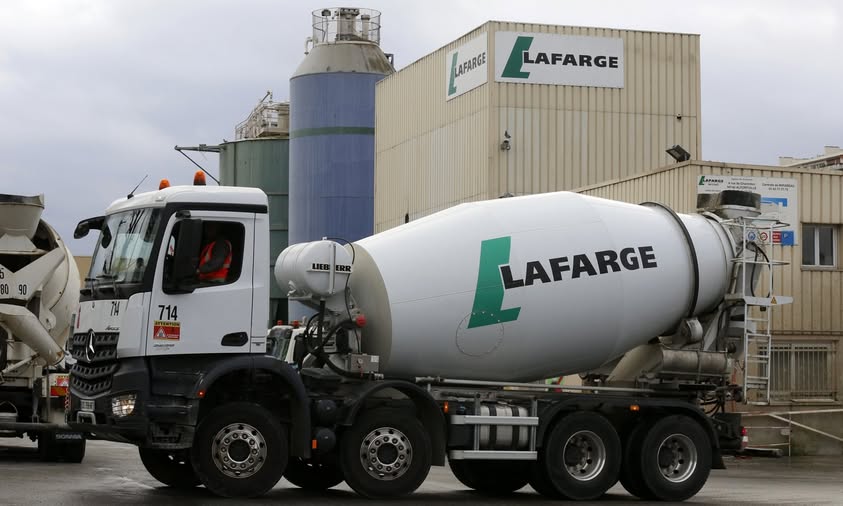
THE far-reaching implications of a landmark court ruling in France against Lafarge come sharply into focus, raising pressing and unavoidable questions for Nigeria, where the cement giant continues to maintain a significant industrial footprint despite the country’s prolonged and costly battle with terrorism.

The development has stirred debate around corporate accountability, national security sensitivities, and regulatory oversight, as News Point Nigeria examines the facts and the emerging concerns surrounding the issue.
A French court has found Lafarge guilty of financing “terrorism” through its Syrian subsidiary, imposing fines on the company and sentencing its former top executives to prison terms. The ruling, delivered in Paris, marks a historic moment as it is the first time a company has been convicted in France for financing terrorist organisations.


According to the court, Lafarge paid protection money directly to ISIL (ISIS) and other armed groups while continuing operations in northern Syria between 2013 and 2014, in violation of European sanctions. The court imposed a fine of 1.12 million euros and ordered the confiscation of assets worth 30 million euros, alongside additional penalties for breaching international sanctions. The ruling, however, remains subject to appeal.
Eight former Lafarge employees were also found guilty of financing terrorist organisations. Among them is former Chief Executive Officer Bruno Lafont, who was sentenced to six years in prison, while the company’s former deputy managing director, Christian Herrault, received a five-year sentence. Other employees were handed varying penalties ranging from one to seven years.
Delivering judgment, presiding judge Isabelle Prevost-Desprez said the payments made by Lafarge strengthened armed groups responsible for deadly attacks within Syria and beyond.
“It is clear to the court that the sole purpose of the funding of a terrorist organisation was to keep the Syrian plant running for economic reasons. Payments to terrorist entities enabled Lafarge to continue its operations,” she said, describing the arrangement as akin to a “commercial partnership” with ISIL.
The court found that Lafarge paid a total of 5.59 million euros to armed groups, including ISIL and the al-Nusra Front—both designated terrorist organisations by the European Union during the period under review.
The company’s cement plant in Jalabiya, acquired in 2008 for $680 million and operational by 2010, remained active even as the Syrian civil war escalated. Employees housed in nearby Manbij were required to cross the Euphrates River to access the facility, with over 800,000 euros reportedly paid to secure safe passage. An additional 1.6 million euros was used to procure raw materials from quarries under ISIL control.

The case, which began in 2017, has evolved over the years. In 2022, Lafarge faced a separate conviction related to crimes against humanity linked to payments made to armed groups. The company, now part of the Holcim Group, acknowledged paying nearly 13 million euros to intermediaries during the conflict but argued that it was not responsible for the funds reaching extremist groups.
While a lower court initially dismissed the charge of complicity in crimes against humanity in 2019, an appeals court later reinstated it, and a separate case on the matter remains ongoing in France.
In the United States, Lafarge also admitted in 2022 that its Syrian subsidiary paid $6 million to ISIL and the al-Nusra Front to facilitate movement through checkpoints, resulting in a $778 million settlement in forfeiture and fines.


Despite the gravity of these findings, the Federal Government of Nigeria has remained silent on the conviction of Lafarge, a development that has sparked concern among observers given the country’s own long-standing struggle with terrorism.
Efforts by News Point Nigeria to obtain official reactions from the Office of the National Security Adviser and the Office of the Attorney-General of the Federation yielded no immediate response. When contacted, the Head of Strategic Communications at the National Counter-Terrorism Centre under the NSA, Micheal Abu, indicated that the matter would be addressed at a forthcoming press briefing, while the media aide to the Attorney-General, Kamarudeen Ogundele, simply responded with “no comment.”
The timing of the Paris ruling is particularly significant, coming shortly after the federal government published a list of 48 individuals and groups allegedly linked to terrorism financing, underscoring intensified scrutiny of financial networks tied to insecurity. Among those referenced were individuals such as Simon Ekpa while organisations like ISWAP were identified as beneficiaries of illicit funding streams.
Nigeria continues to grapple with multiple security threats, including insurgency by Boko Haram and ISWAP, as well as banditry and other forms of violent crime, particularly across the northern region.
Against this backdrop, Lafarge’s continued operations in Nigeria have drawn increasing scrutiny. The company operates as Lafarge Africa Plc, with major plants located in Ewekoro and Sagamu in Ogun State, Mfamosing in Cross River State, and Ashaka in Gombe State regions that span different geopolitical zones, including areas affected by insurgency.
With an installed production capacity of about 10.5 million metric tonnes per annum, Lafarge remains one of Nigeria’s leading cement producers. Its operations extend beyond manufacturing to include ready-mix concrete in major cities such as Lagos, Abuja, and Port Harcourt, alongside product lines like Elephant Cement and newer low-carbon options such as ECOPlanet and Watershield.
The company has also announced expansion plans for its Ashaka and Sagamu plants, targeting increased production capacity, while a recent transaction saw Holcim divest its majority stake to Chinese firm Huaxin Cement in a deal valued at approximately $1 billion.
However, the controversy surrounding Lafarge has prompted concerns from security analysts. Terrorism, Geopolitical Risk, and Defense Analyst, Rtd. Col. Ibrahim Musa Bello warned that the company’s continued operations in Nigeria, despite its parent company’s legal troubles abroad, raise important national security questions.
Bello noted that Lafarge Africa Plc, a subsidiary of the Holcim Group, remains a major player in Nigeria’s cement industry, with extensive operations across multiple regions. T
The company runs key plants in Ewekoro and Sagamu in Ogun State, Mfamosing in Cross River State, and Ashaka in Gombe State, with an installed production capacity of about 10.5 million tonnes per annum.
He, however, expressed worry over what he described as a lack of transparency and public clarity regarding the company’s continued operations in Nigeria, especially in light of legal issues involving its parent company in France over allegations related to the financing of armed groups in conflict zones.
According to Bello, while it is possible that Nigerian authorities may be conducting background or security checks behind the scenes, the absence of clear communication raises legitimate questions.
He argued that institutions such as the Office of the National Security Adviser (NSA) should provide explanations to reassure the public on why the company continues to operate without visible restrictions despite the gravity of the allegations tied to its parent entity.
“Unless the government is carrying out thorough underground checks, which we do not know it becomes important for relevant authorities to come forward and explain the situation. The silence creates room for speculation and concern,” he said.
The analyst further pointed out that Nigeria has grappled with terrorism as one of its most significant national security threats for over 15 years, making any perceived link direct or indirect between corporate entities and terror financing a matter that should not be treated lightly.
He also highlighted the strategic locations of Lafarge’s operations, noting that some of its facilities are situated in regions that have experienced insurgency-related challenges.
This, he argued, makes it even more critical for the government to demonstrate that due diligence, risk assessment, and continuous monitoring are being rigorously enforced.
Bello concluded that while foreign investment and industrial growth remain vital for Nigeria’s economy, they must not come at the expense of national security.
He stressed that transparency, accountability, and proactive communication from government agencies are essential to maintaining public trust, particularly on issues as sensitive as terrorism and corporate responsibility.