

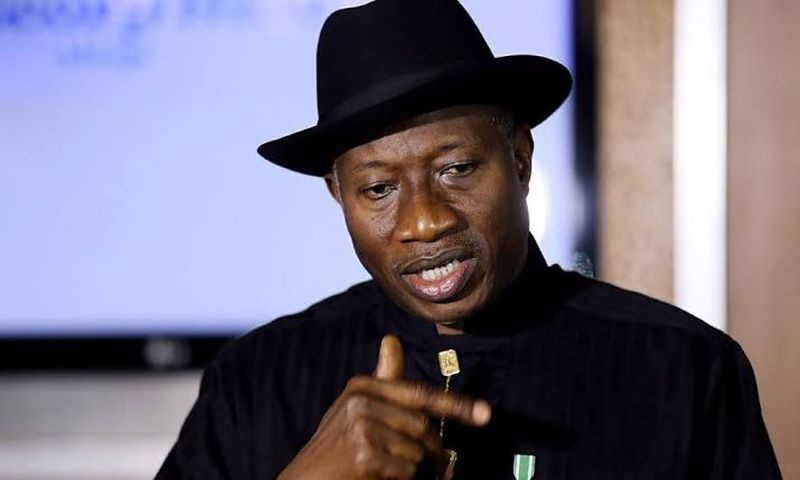
FORMER President Goodluck Ebele Jonathan has pushed back against claims by former Vice President Atiku Abubakar that inexperience shaped his decisions while in office.
News Point Nigeria reports that Jonathan maintained that his time in leadership was defined by sincere effort and responsible governance, despite the inevitability of human shortcomings.
Jonathan’s reaction comes days after Atiku, during a televised interview, described him as “inexperienced” and suggested that such limitations affected his handling of national challenges while he was in power.


However, speaking to diplomats in Abuja, the former president dismissed the criticism, arguing that no leader governs without making difficult decisions that may later be judged as mistakes.
“No one who has ever served as a governor or president will claim they did not make mistakes. If I made mistakes, yes, that is part of being human,” Jonathan said.
He also questioned the basis of the age-related criticism, noting that he assumed office in 2010 at the age of 53 and left in 2015 at 58.
“They say I was too young. Must I have been 100 years old before I could lead a country?” he asked.
Jonathan further insisted that his administration recorded notable achievements, particularly in Nigeria’s diplomatic standing on the global stage.
He pointed to Nigeria’s election into the United Nations Security Council during his tenure as evidence of strategic and deliberate engagement.

“If I were truly naive, I would not have been able to navigate that process successfully. This points to deliberate and strategic engagement on the global stage,” he said.
Beyond addressing the criticism, Jonathan expanded his remarks to focus on broader governance challenges across the region, warning that political instability remains a major obstacle to economic growth in West Africa.
He stressed that the vision behind the Economic Community of West African States (ECOWAS) cannot be fully realised without strong democratic foundations across member states.


“We cannot achieve economic progress if our societies remain politically unstable,” he said.
Jonathan acknowledged that enforcing democratic standards within ECOWAS often generates tensions, especially around issues of national sovereignty.
Nevertheless, he emphasised that regional leaders must prioritise collective stability.
“That responsibility lies with heads of state working together to ensure order and continuity,” he added.
Atiku, a leading figure in an emerging opposition coalition and a presidential aspirant under the African Democratic Congress (ADC), had in the interview also assessed other political figures.
These included Peter Obi, Rotimi Amaechi, and Rabiu Kwankwaso, while also expressing dissatisfaction with the administration of President Bola Ahmed Tinubu.
His remarks come amid early political positioning ahead of the 2027 presidential race.
The exchange between Jonathan and Atiku reflects growing political undercurrents as the 2027 election approaches.
Jonathan, who has largely maintained a statesman-like posture since leaving office in 2015, has rarely engaged directly in partisan disputes.
His latest response, however, signals a noticeable shift in tone.