
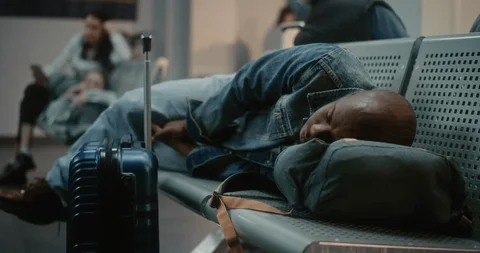
INDUSTRIAL action by pilots and cabin crew at German flagship carrier Lufthansa has disrupted flight operations, leaving some Nigerian passengers stranded and forcing others to spend the night at airports amid widespread cancellations and delays.
News Point Nigeria reports that the passengers affected by the disruption were rebooked onto alternative airlines, including Royal Air Maroc, as efforts were made to ease the impact on travellers trying to complete their journeys.

Read also: Atiku, ADC Demand Answers From INEC Over Ballot Printing Contracts, Fresh Staff Transfers
However, some passengers reported poor communication from the Moroccan carrier, alongside further flight postponements attributed to technical issues, compounding the already difficult travel situation.
On Thursday, several passengers travelling to Nigeria were forced to remain overnight at Frankfurt Airport after their flights were disrupted.
The travel chaos was traced to a series of strikes that took place in April 2026, as labour tensions escalated within Lufthansa.
Cabin crew, represented by Unabhängige Flugbegleiter Organisation, and pilots under Vereinigung Cockpit embarked on staggered walkouts. The industrial action was driven by demands for higher wages, improved pension schemes, and better working conditions, particularly in the context of ongoing restructuring within the Lufthansa Group.

Negotiations between the airline’s management and the unions had reached a deadlock, prompting the workers to proceed with the strikes.
In response, Lufthansa described the demands as financially unsustainable, noting that the airline was still recovering from past economic challenges and needed to maintain cost discipline to restore profitability.

The carrier, however, stated that it remained open to continued dialogue, while also seeking to balance the interests of its workforce with the long-term sustainability of the business.
Major aviation hubs in Germany, especially Frankfurt and Munich, experienced severe disruptions during the strike period, with hundreds of flights cancelled on peak days. At certain points, up to 80 to 90 percent of operations were affected, impacting tens of thousands of passengers across Lufthansa’s global network.
Read also: 2027: Pantami, Adebutu Missing As INEC Releases Final Governorship Candidates’ List


Amid mounting pressures, including repeated industrial actions and rising jet fuel costs, Lufthansa announced plans to accelerate its restructuring programme. The airline said it would permanently withdraw all 27 aircraft operated by its regional subsidiary, Lufthansa CityLine, from service starting April 18, 2026.
According to the airline, affected staff would be offered opportunities to transition into other units within the group, while discussions on possible redundancies were ongoing.
As part of efforts to manage the disruption, many passengers originally booked on Lufthansa flights were reassigned to other carriers to complete their travel plans.
One Nigerian passenger departing from Frankfurt described the experience as deeply frustrating, lamenting the impact on personal and professional commitments.
“The experience was horrible. I couldn’t meet my appointment in Nigeria, and that cost me a lot. It was frustrating because there was little communication at first, and people were just left to figure things out on their own,” the passenger told Sunday PUNCH.
Another traveller criticised the rebooking process and the handling of passengers by the alternative airline.
“Air Maroc is a terrible airline. A flight meant for 5:55 p.m. on Thursday was moved to the following day. Some passengers had to sleep at the airport. These were passengers whose visas had expired and the border officers did not allow them to return to Germany. The airline did not put them in the transit hotel. They just abandoned them. Some passengers were, however, put in a hotel in Frankfurt. The experience was generally awful,” he said.
Reacting to the situation, the spokesperson of the Nigeria Civil Aviation Authority, Michael Achimugu, acknowledged the development, stating that Lufthansa had formally notified the authority about the strikes.
“If they can book passengers on other airlines or lodge passengers in hotels, these moves are within the regulations. It is either that or passengers are stuck there forever,” he said.
Read also: Nigeria First: FG Orders MDAs To Buy Vehicles Only From Local Assemblers
The industrial action has once again brought attention to ongoing labour tensions within Lufthansa as the airline grapples with economic pressures and operational restructuring.
Meanwhile, passengers affected by cancellations or prolonged delays may, in many cases, be eligible for compensation under European Union regulations governing air travel disruptions.